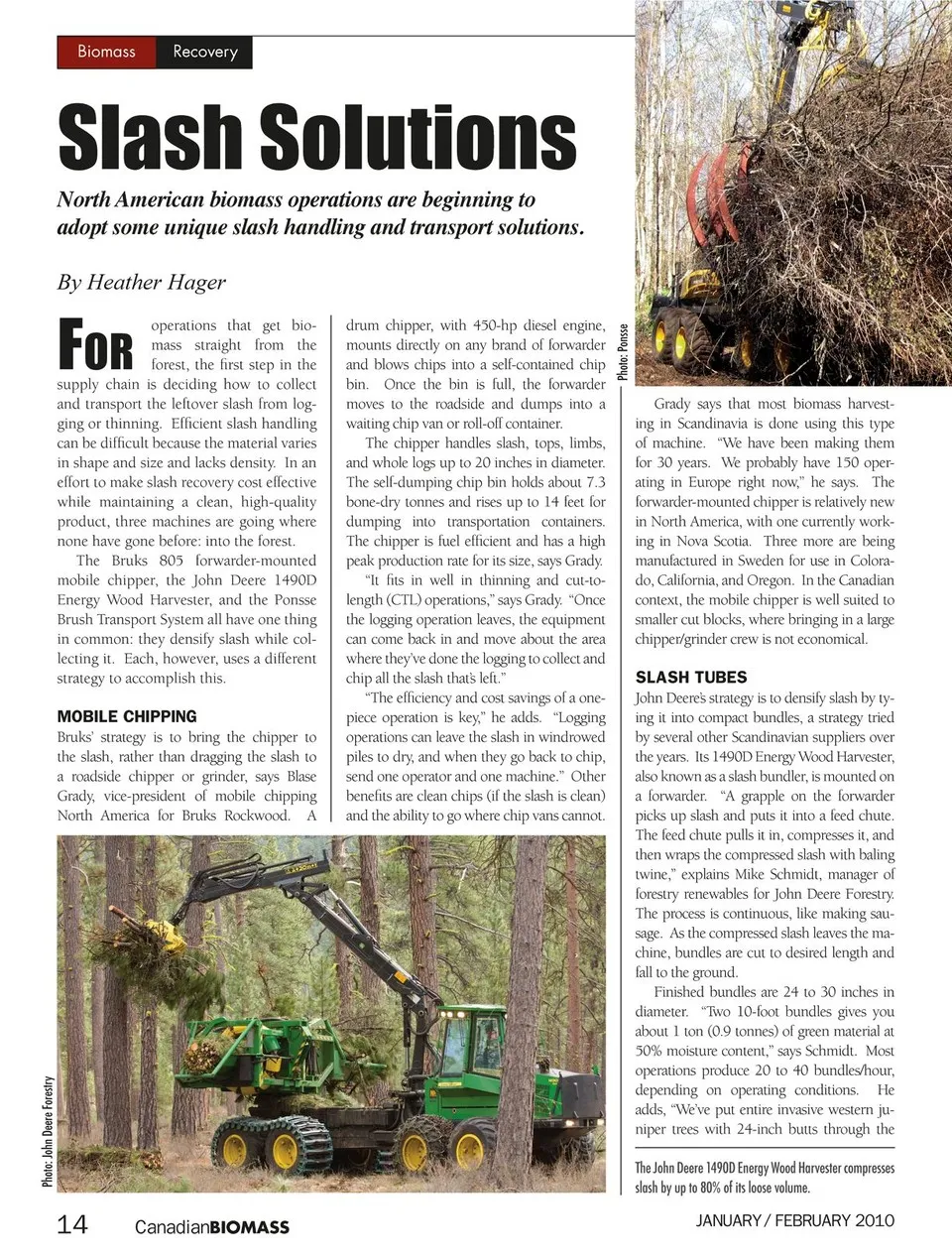
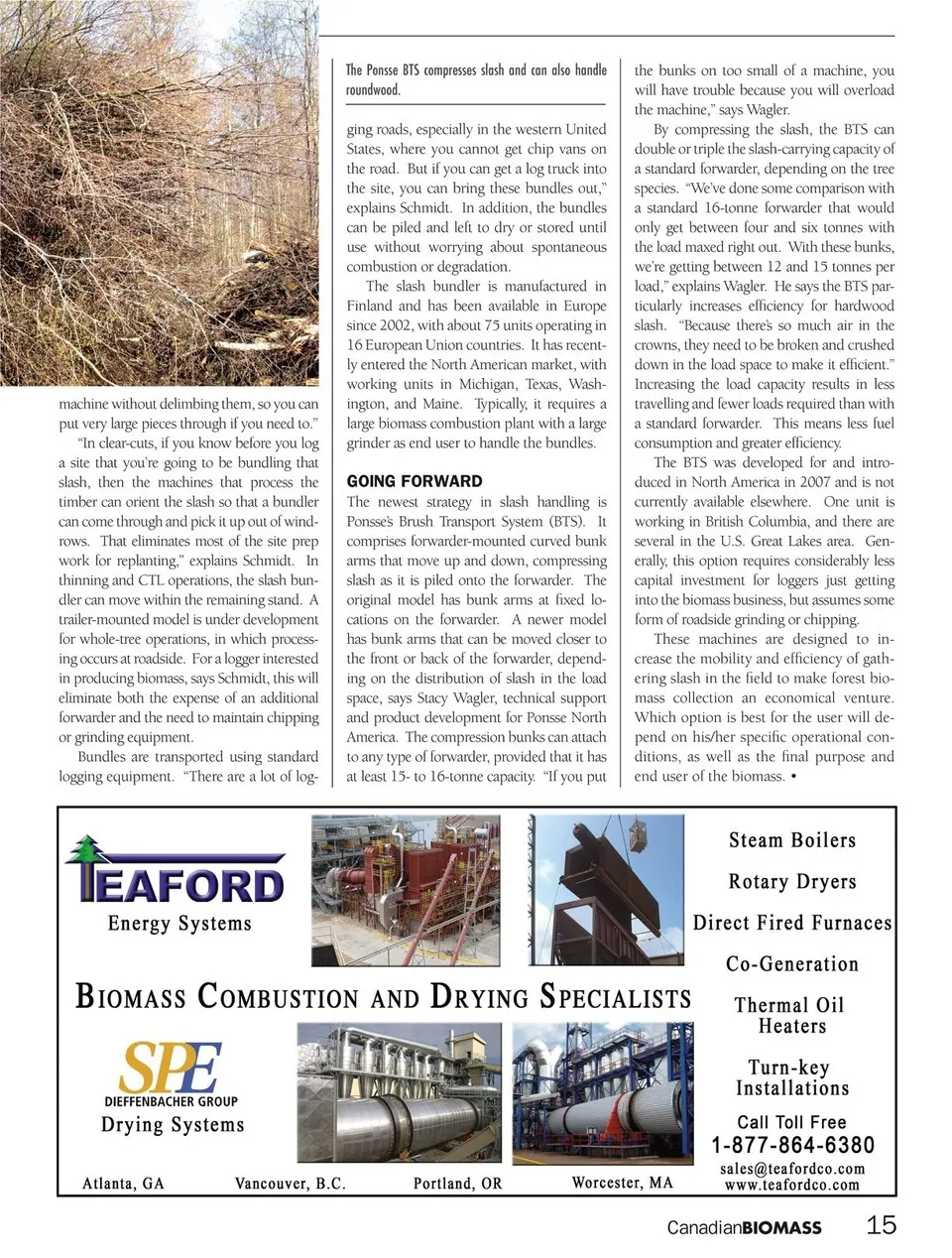
Biomass Recovery Slash Solutions North American biomass operations are beginning to adopt some unique slash handling and transport solutions. By Heather Hager supply chain is deciding how to collect and transport the leftover slash from log- ging or thinning. Efficient slash handling can be difficult because the material varies in shape and size and lacks density. In an effort to make slash recovery cost effective while maintaining a clean, high-quality product, three machines are going where none have gone before: into the forest. The Bruks 805 forwarder-mounted For mobile chipper, the John Deere 1490D Energy Wood Harvester, and the Ponsse Brush Transport System all have one thing in common: they densify slash while col- lecting it. Each, however, uses a different strategy to accomplish this. mobile cHipping Bruks’ strategy is to bring the chipper to the slash, rather than dragging the slash to a roadside chipper or grinder, says Blase Grady, vice-president of mobile chipping North America for Bruks Rockwood. A operations that get bio- mass straight from the forest, the first step in the drum chipper, with 450-hp diesel engine, mounts directly on any brand of forwarder and blows chips into a self-contained chip bin. Once the bin is full, the forwarder moves to the roadside and dumps into a waiting chip van or roll-off container. The chipper handles slash, tops, limbs, and whole logs up to 20 inches in diameter. The self-dumping chip bin holds about 7.3 bone-dry tonnes and rises up to 14 feet for dumping into transportation containers. The chipper is fuel efficient and has a high peak production rate for its size, says Grady. “It fits in well in thinning and cut-to- length (CTL) operations,” says Grady. “Once the logging operation leaves, the equipment can come back in and move about the area where they’ve done the logging to collect and chip all the slash that’s left.” “The efficiency and cost savings of a one- piece operation is key,” he adds. “Logging operations can leave the slash in windrowed piles to dry, and when they go back to chip, send one operator and one machine.” Other benefits are clean chips (if the slash is clean) and the ability to go where chip vans cannot. Grady says that most biomass harvest- ing in Scandinavia is done using this type of machine. “We have been making them for 30 years. We probably have 150 oper- ating in Europe right now,” he says. The forwarder-mounted chipper is relatively new in North America, with one currently work- ing in Nova Scotia. Three more are being manufactured in Sweden for use in Colora- do, California, and Oregon. In the Canadian context, the mobile chipper is well suited to smaller cut blocks, where bringing in a large chipper/grinder crew is not economical. slasH tubes John Deere’s strategy is to densify slash by ty- ing it into compact bundles, a strategy tried by several other Scandinavian suppliers over the years. Its 1490D Energy Wood Harvester, also known as a slash bundler, is mounted on a forwarder. “A grapple on the forwarder picks up slash and puts it into a feed chute. The feed chute pulls it in, compresses it, and then wraps the compressed slash with baling twine,” explains Mike Schmidt, manager of forestry renewables for John Deere Forestry. The process is continuous, like making sau- sage. As the compressed slash leaves the ma- chine, bundles are cut to desired length and fall to the ground. Finished bundles are 24 to 30 inches in diameter. “Two 10-foot bundles gives you about 1 ton (0.9 tonnes) of green material at 50% moisture content,” says Schmidt. Most operations produce 20 to 40 bundles/hour, depending on operating conditions. He adds, “We’ve put entire invasive western ju- niper trees with 24-inch butts through the The John Deere 1490D Energy Wood Harvester compresses slash by up to 80% of its loose volume. 14 CanadianBIOMASS JANUARY/ FEBRUARY 2010 Photo: John Deere Forestry Photo: Ponsse
Canadian Biomass January/February 2010: Page 14