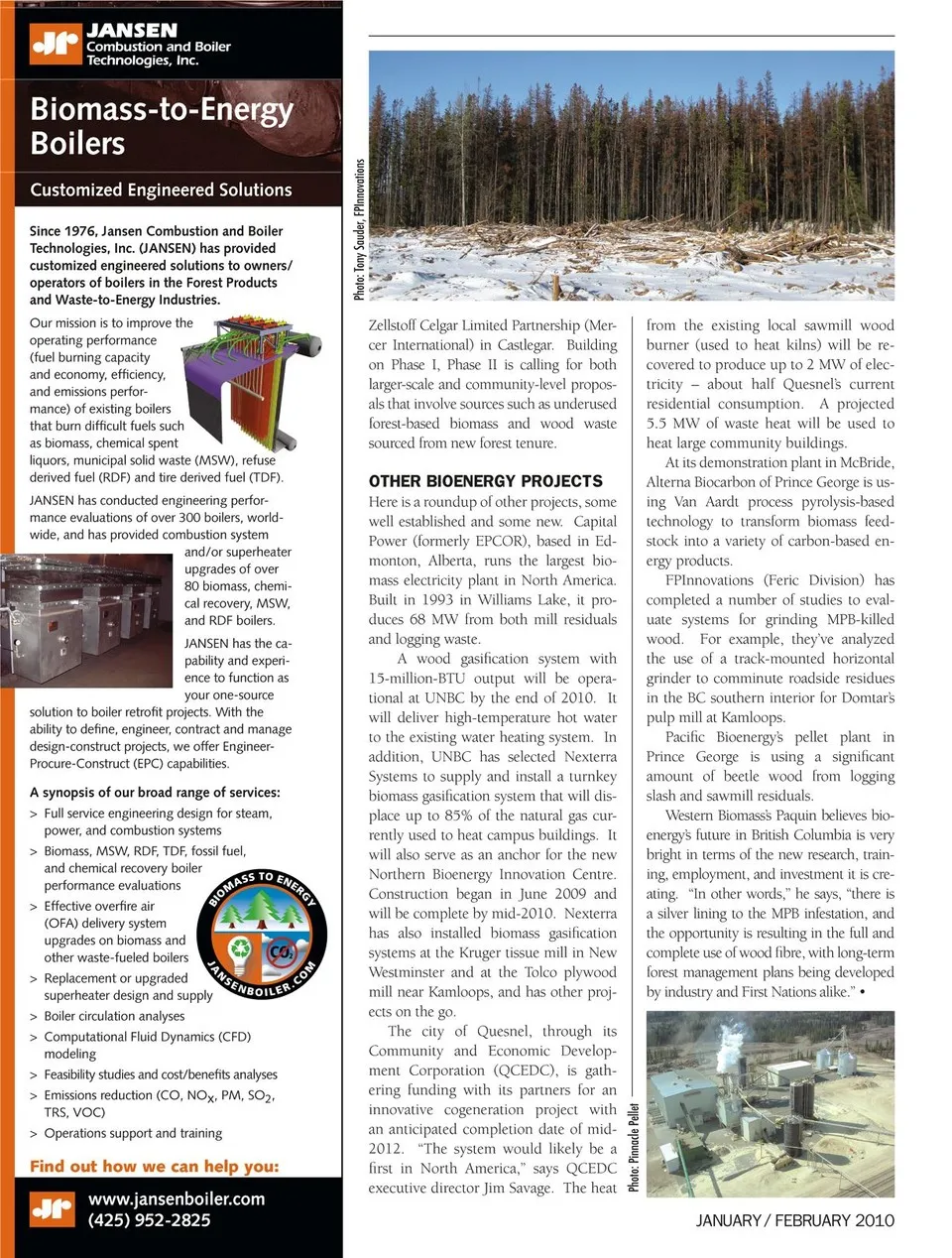
Biomass-to-Energy Boilers Customized Engineered Solutions Since 1976, Jansen Combustion and Boiler Technologies, Inc. (JANSEN) has provided customized engineered solutions to owners/ operators of boilers in the Forest Products and Waste-to-Energy Industries. Our mission is to improve the operating performance (fuel burning capacity and economy, efficiency, and emissions perfor- mance) of existing boilers that burn difficult fuels such as biomass, chemical spent liquors, municipal solid waste (MSW), refuse derived fuel (RDF) and tire derived fuel (TDF). JANSEN has conducted engineering perfor- mance evaluations of over 300 boilers, world- wide, and has provided combustion system and/or superheater upgrades of over 80 biomass, chemi- cal recovery, MSW, and RDF boilers. JANSEN has the ca- pability and experi- ence to function as your one-source solution to boiler retrofit projects. With the ability to define, engineer, contract and manage design-construct projects, we offer Engineer- Procure-Construct (EPC) capabilities. A synopsis of our broad range of services: > Full service engineering design for steam, power, and combustion systems > Biomass, MSW, RDF, TDF, fossil fuel, and chemical recovery boiler performance evaluations > Effective overfire air (OFA) delivery system upgrades on biomass and other waste-fueled boilers > Replacement or upgraded superheater design and supply > Boiler circulation analyses > Computational Fluid Dynamics (CFD) modeling > Feasibility studies and cost/benefits analyses > Emissions reduction (CO, NOx, PM, SO2, TRS, VOC) > Operations support and training Find out how we can help you: www.jansenboiler.com (425) 952-2825 CO2 Zellstoff Celgar Limited Partnership (Mer- cer International) in Castlegar. Building on Phase I, Phase II is calling for both larger-scale and community-level propos- als that involve sources such as underused forest-based biomass and wood waste sourced from new forest tenure. otHer bioenergy projects Here is a roundup of other projects, some well established and some new. Capital Power (formerly EPCOR), based in Ed- monton, Alberta, runs the largest bio- mass electricity plant in North America. Built in 1993 in Williams Lake, it pro- duces 68 MW from both mill residuals and logging waste. A wood gasification system with 15-million-BTU output will be opera- tional at UNBC by the end of 2010. It will deliver high-temperature hot water to the existing water heating system. In addition, UNBC has selected Nexterra Systems to supply and install a turnkey biomass gasification system that will dis- place up to 85% of the natural gas cur- rently used to heat campus buildings. It will also serve as an anchor for the new Northern Bioenergy Innovation Centre. Construction began in June 2009 and will be complete by mid-2010. Nexterra has also installed biomass gasification systems at the Kruger tissue mill in New Westminster and at the Tolco plywood mill near Kamloops, and has other proj- ects on the go. The city of Quesnel, through its Community and Economic Develop- ment Corporation (QCEDC), is gath- ering funding with its partners for an innovative cogeneration project with an anticipated completion date of mid- 2012. “The system would likely be a first in North America,” says QCEDC executive director Jim Savage. The heat from the existing local sawmill wood burner (used to heat kilns) will be re- covered to produce up to 2 MW of elec- tricity – about half Quesnel’s current residential consumption. A projected 5.5 MW of waste heat will be used to heat large community buildings. At its demonstration plant in McBride, Alterna Biocarbon of Prince George is us- ing Van Aardt process pyrolysis-based technology to transform biomass feed- stock into a variety of carbon-based en- ergy products. FPInnovations (Feric Division) has completed a number of studies to eval- uate systems for grinding MPB-killed wood. For example, they’ve analyzed the use of a track-mounted horizontal grinder to comminute roadside residues in the BC southern interior for Domtar’s pulp mill at Kamloops. Pacific Bioenergy’s pellet plant in Prince George is using a significant amount of beetle wood from logging slash and sawmill residuals. Western Biomass’s Paquin believes bio- energy’s future in British Columbia is very bright in terms of the new research, train- ing, employment, and investment it is cre- ating. “In other words,” he says, “there is a silver lining to the MPB infestation, and the opportunity is resulting in the full and complete use of wood fibre, with long-term forest management plans being developed by industry and First Nations alike.” • JANUARY/ FEBRUARY 2010 Photo: Tony Sauder, FPInnovations Photo: Pinnacle Pellet
Canadian Biomass January/February 2010: Page 12