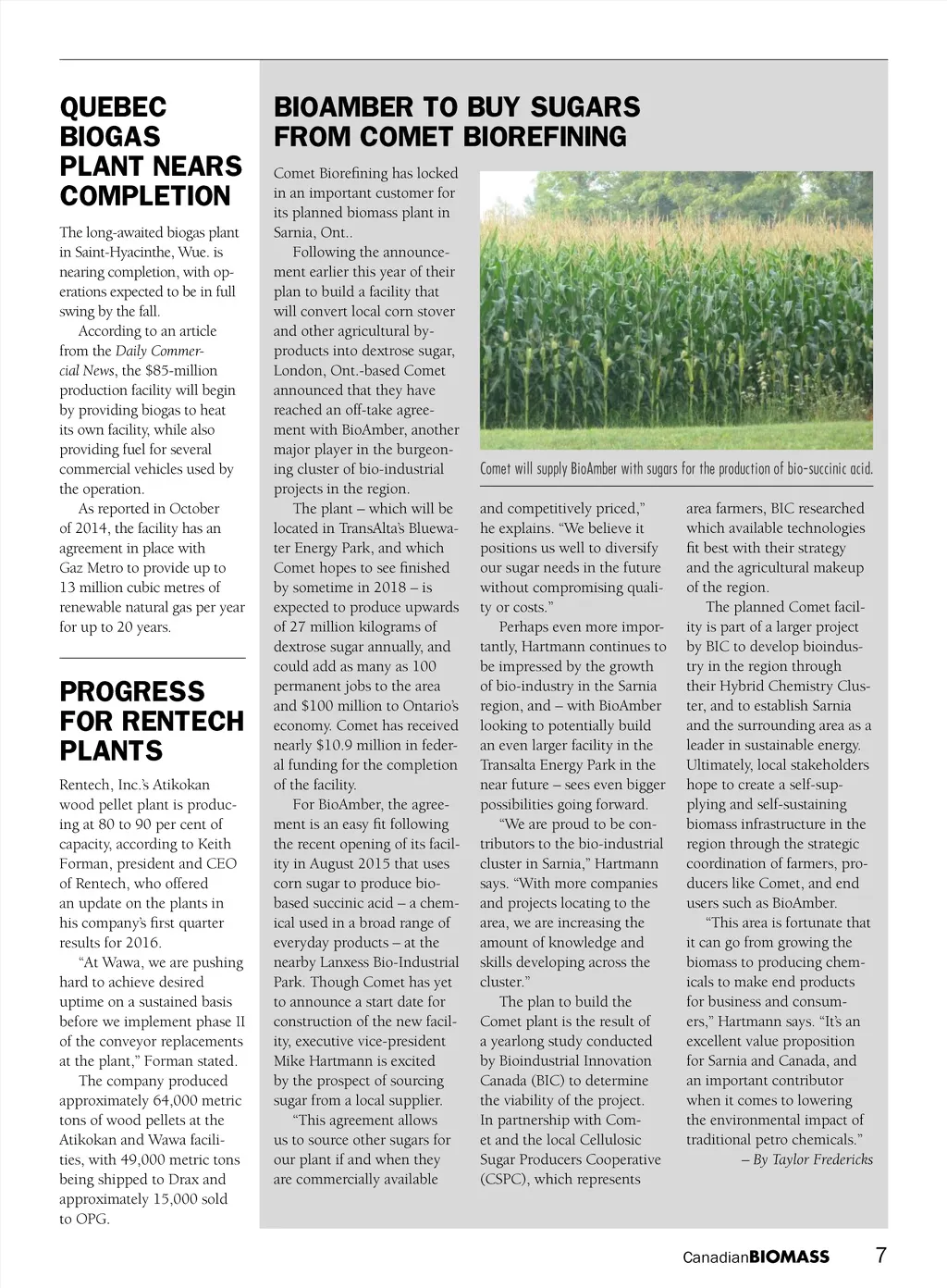
QUEBEC BIOGAS PLANT NEARS COMPLETION The long-awaited biogas plant in Saint-Hyacinthe, Wue. is nearing completion, with op-erations expected to be in full swing by the fall. According to an article from the Daily Commer-cial News , the $85-million production facility will begin by providing biogas to heat its own facility, while also providing fuel for several commercial vehicles used by the operation. As reported in October of 2014, the facility has an agreement in place with Gaz Metro to provide up to 13 million cubic metres of renewable natural gas per year for up to 20 years. BIOAMBER TO BUY SUGARS FROM COMET BIOREFINING Comet Biorefining has locked in an important customer for its planned biomass plant in Sarnia, Ont.. Following the announce-ment earlier this year of their plan to build a facility that will convert local corn stover and other agricultural by-products into dextrose sugar, London, Ont.-based Comet announced that they have reached an off-take agree-ment with BioAmber, another major player in the burgeon-ing cluster of bio-industrial projects in the region. The plant – which will be located in TransAlta’s Bluewa-ter Energy Park, and which Comet hopes to see finished by sometime in 2018 – is expected to produce upwards of 27 million kilograms of dextrose sugar annually, and could add as many as 100 permanent jobs to the area and $100 million to Ontario’s economy. Comet has received nearly $10.9 million in feder-al funding for the completion of the facility. For BioAmber, the agree-ment is an easy fit following the recent opening of its facil-ity in August 2015 that uses corn sugar to produce bio-based succinic acid – a chem-ical used in a broad range of everyday products – at the nearby Lanxess Bio-Industrial Park. Though Comet has yet to announce a start date for construction of the new facil-ity, executive vice-president Mike Hartmann is excited by the prospect of sourcing sugar from a local supplier. “This agreement allows us to source other sugars for our plant if and when they are commercially available Comet will supply BioAmber with sugars for the production of bio-succinic acid. PROGRESS FOR RENTECH PLANTS Rentech, Inc.’s Atikokan wood pellet plant is produc-ing at 80 to 90 per cent of capacity, according to Keith Forman, president and CEO of Rentech, who offered an update on the plants in his company’s first quarter results for 2016. “At Wawa, we are pushing hard to achieve desired uptime on a sustained basis before we implement phase II of the conveyor replacements at the plant,” Forman stated. The company produced approximately 64,000 metric tons of wood pellets at the Atikokan and Wawa facili-ties, with 49,000 metric tons being shipped to Drax and approximately 15,000 sold to OPG. and competitively priced,” he explains. “We believe it positions us well to diversify our sugar needs in the future without compromising quali-ty or costs.” Perhaps even more impor-tantly, Hartmann continues to be impressed by the growth of bio-industry in the Sarnia region, and – with BioAmber looking to potentially build an even larger facility in the Transalta Energy Park in the near future – sees even bigger possibilities going forward. “We are proud to be con-tributors to the bio-industrial cluster in Sarnia,” Hartmann says. “With more companies and projects locating to the area, we are increasing the amount of knowledge and skills developing across the cluster.” The plan to build the Comet plant is the result of a yearlong study conducted by Bioindustrial Innovation Canada (BIC) to determine the viability of the project. In partnership with Com-et and the local Cellulosic Sugar Producers Cooperative (CSPC), which represents area farmers, BIC researched which available technologies fit best with their strategy and the agricultural makeup of the region. The planned Comet facil-ity is part of a larger project by BIC to develop bioindus-try in the region through their Hybrid Chemistry Clus-ter, and to establish Sarnia and the surrounding area as a leader in sustainable energy. Ultimately, local stakeholders hope to create a self-sup-plying and self-sustaining biomass infrastructure in the region through the strategic coordination of farmers, pro-ducers like Comet, and end users such as BioAmber. “This area is fortunate that it can go from growing the biomass to producing chem-icals to make end products for business and consum-ers,” Hartmann says. “It’s an excellent value proposition for Sarnia and Canada, and an important contributor when it comes to lowering the environmental impact of traditional petro chemicals.” – By Taylor Fredericks Canadian BIOMASS 7
Canadian Biomass June 2016: Page 7