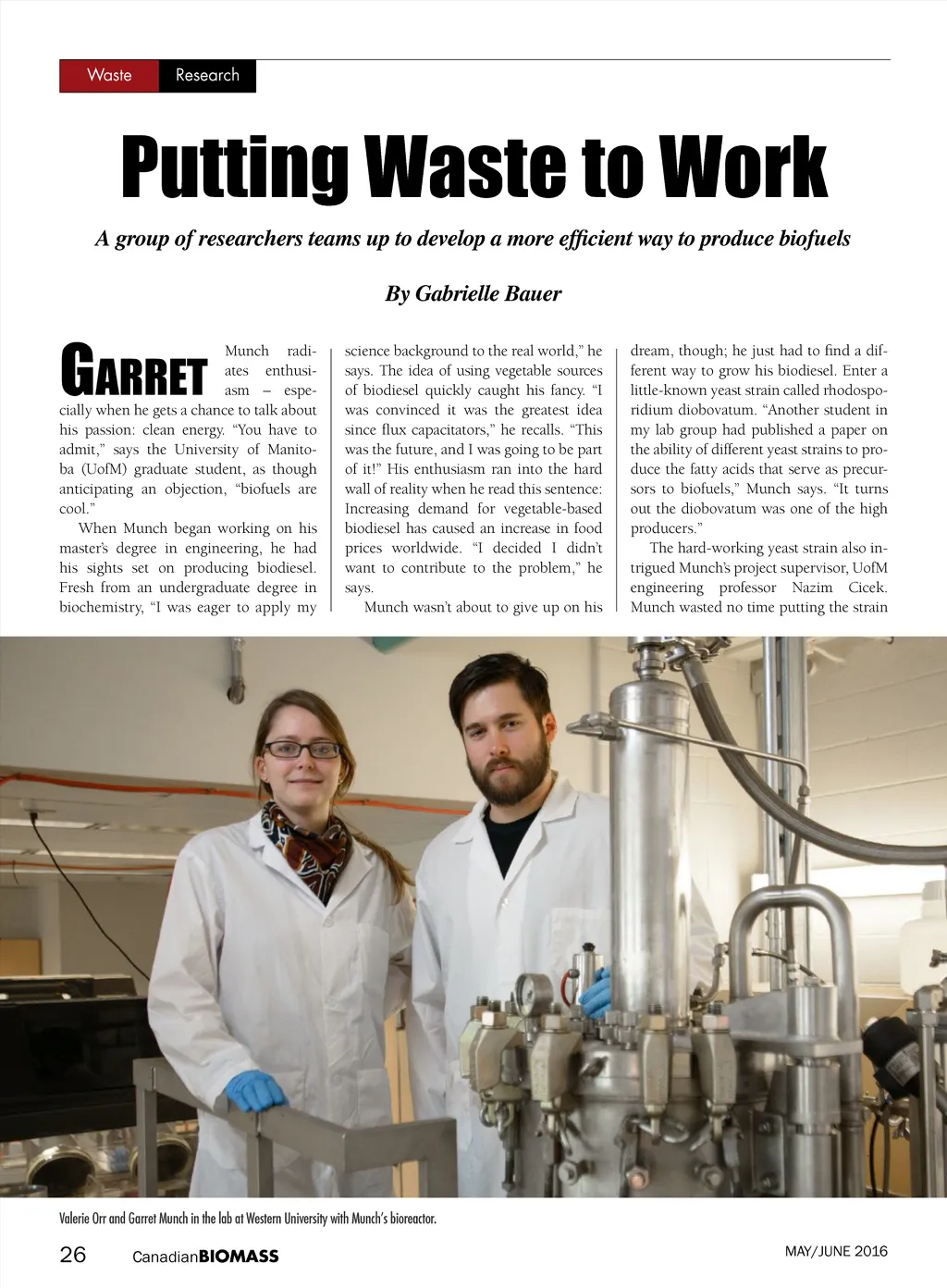
to the test in Cicek’s lab. He soon found it had star quality: not only did it grow very fast and produce fatty acids in abun-dance, but it could metabolize a num-ber of different carbon sources, one of them the glycerol recovered – ironically enough – from the sludge left over after producing biodiesel from vegetable oil. Munch had proven the strain’s worth in a laboratory flask. But what kind of yield would it produce on a larger scale? In bottom-line terms, “We wanted to scale up the process to find out if it had commercial potential,” Cicek says. “I also thought it would be useful for Munch to learn what post-treatment looks like.” Munch knew just where to turn. Some months earlier, he had attended a Bio-FuelNet annual general meeting where he met a student of Lars Rehmann, an assistant professor of chemical and bio-chemical engineering at the Western Uni-versity in London, Ont. As the two grad students chatted about their respective projects, Munch learned that Rehmann’s chief interest lay in optimizing bioreactor performance. As such, he had the equip-ment and expertise to pilot-test Munch’s bioprocess on a larger scale. TRAINING THE FUTURE and research facilities, he was able up his production scale to a 100-L pilot-scale re-actor system. He breathed a sigh of relief when his yeast came through with flying colours. “Thanks to my BioFuelNet con-nections, I’ll be able to go even bigger,” he says. BACK TO THE DRAWING BOARD This led to Munch to apply for a BioFu-elNet exchange grant, which funded an eight-week stint in Rehmann’s lab. Such grants are an integral part of BioFuelNet’s ongoing education and training program. The program helps train and launch a large number of young professionals, dubbed Highly Qualified Personnel, who will develop the Canadian biofuels indus-try to its full extent. Specifically, the program provides R&D training, professional skills train-ing, career development and networking opportunities, and funding for R&D ini-tiatives within the academic, public and private sectors in Canada and beyond. Student exchanges such as the one that brought Munch and Rehmann to-gether seek to strengthen interactions within the BioFuelNet community, trans-fer knowledge between labs, expose young professionals to different prob-lem-solving approaches, and strengthen Canada’s exposure to the international biofuels scene. The exchange bore ample fruit for Munch. Drawing on Rehmann’s experience As it happens, “going bigger” isn’t as sim-ple as using larger quantities of starting materials. “A process can be straightfor-ward when you’re working with just a li-tre, but as the system gets larger, the sur-face area-to-volume ratio changes, which makes it more challenging to get oxygen into the system,” Rehmann explains. What’s more, “using a larger impeller [the rotating component of a centrifugal pump] increases the shear stress on the yeast, which can lead to cell breakdown.” In other words, it’s not a given that a pro-cedure that works in a beaker will also work in a bioreactor. “That’s why it’s important to take small ideas and move them up to a semi-industrial scale,” Reh-mann says. The final step will be to determine whether the process has economic legs. “This will depend on several factors, in-cluding the price of fossil fuels and the availability of industrial partners,” Reh-mann notes. The research group even-tually plans to expand the project to in-clude other sources of waste to feed the yeast. Ideally, “we can eventually link up with a biofuel production company that generates the waste we use as fuel,” Cicek says – a win-win scenario if ever there was one. In the meantime, Munch plans to re-turn to the UofM, where he and Cicek will work on fine-tuning the growth con-ditions for his yeast strain in hopes of achieving even higher fatty acid yields. Munch is right where he wants to be. He’s still growing fuel, just as he set out to do. “The only difference is that my ‘la-bour force’ is microscopic,” he says with a chuckle. “And I think it’s amazing that the waste I’m using in the process comes from biodiesel production itself. Talk about closing the loop!” • For more information on groundbreaking research, visit www.canadianbiomassmagazine.ca Canadian BIOMASS 27
Canadian Biomass June 2016: Page 27