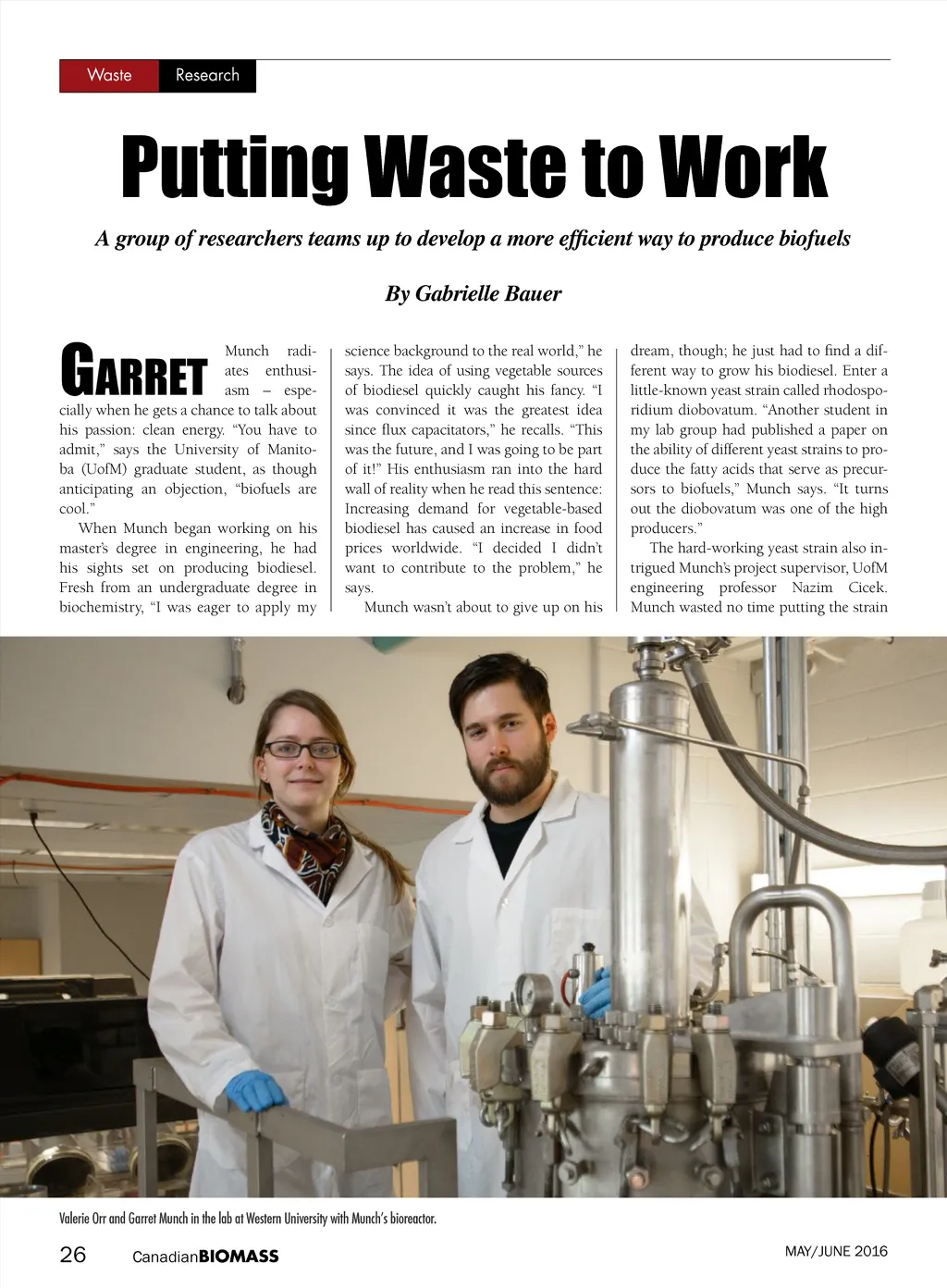
Waste Research Putting Waste to Work A group of researchers teams up to develop a more efficient way to produce biofuels By Gabrielle Bauer Munch radi-ates enthusi-asm – espe-cially when he gets a chance to talk about his passion: clean energy. “You have to admit,” says the University of Manito-ba (UofM) graduate student, as though anticipating an objection, “biofuels are cool.” When Munch began working on his master’s degree in engineering, he had his sights set on producing biodiesel. Fresh from an undergraduate degree in biochemistry, “I was eager to apply my G arret science background to the real world,” he says. The idea of using vegetable sources of biodiesel quickly caught his fancy. “I was convinced it was the greatest idea since flux capacitators,” he recalls. “This was the future, and I was going to be part of it!” His enthusiasm ran into the hard wall of reality when he read this sentence: Increasing demand for vegetable-based biodiesel has caused an increase in food prices worldwide. “I decided I didn’t want to contribute to the problem,” he says. Munch wasn’t about to give up on his dream, though; he just had to find a dif-ferent way to grow his biodiesel. Enter a little-known yeast strain called rhodospo-ridium diobovatum. “Another student in my lab group had published a paper on the ability of different yeast strains to pro-duce the fatty acids that serve as precur-sors to biofuels,” Munch says. “It turns out the diobovatum was one of the high producers.” The hard-working yeast strain also in-trigued Munch’s project supervisor, UofM engineering professor Nazim Cicek. Munch wasted no time putting the strain Valerie Orr and Garret Munch in the lab at Western University with Munch’s bioreactor. 26 Canadian BIOMASS MAY/JUNE 2016
Canadian Biomass June 2016: Page 26