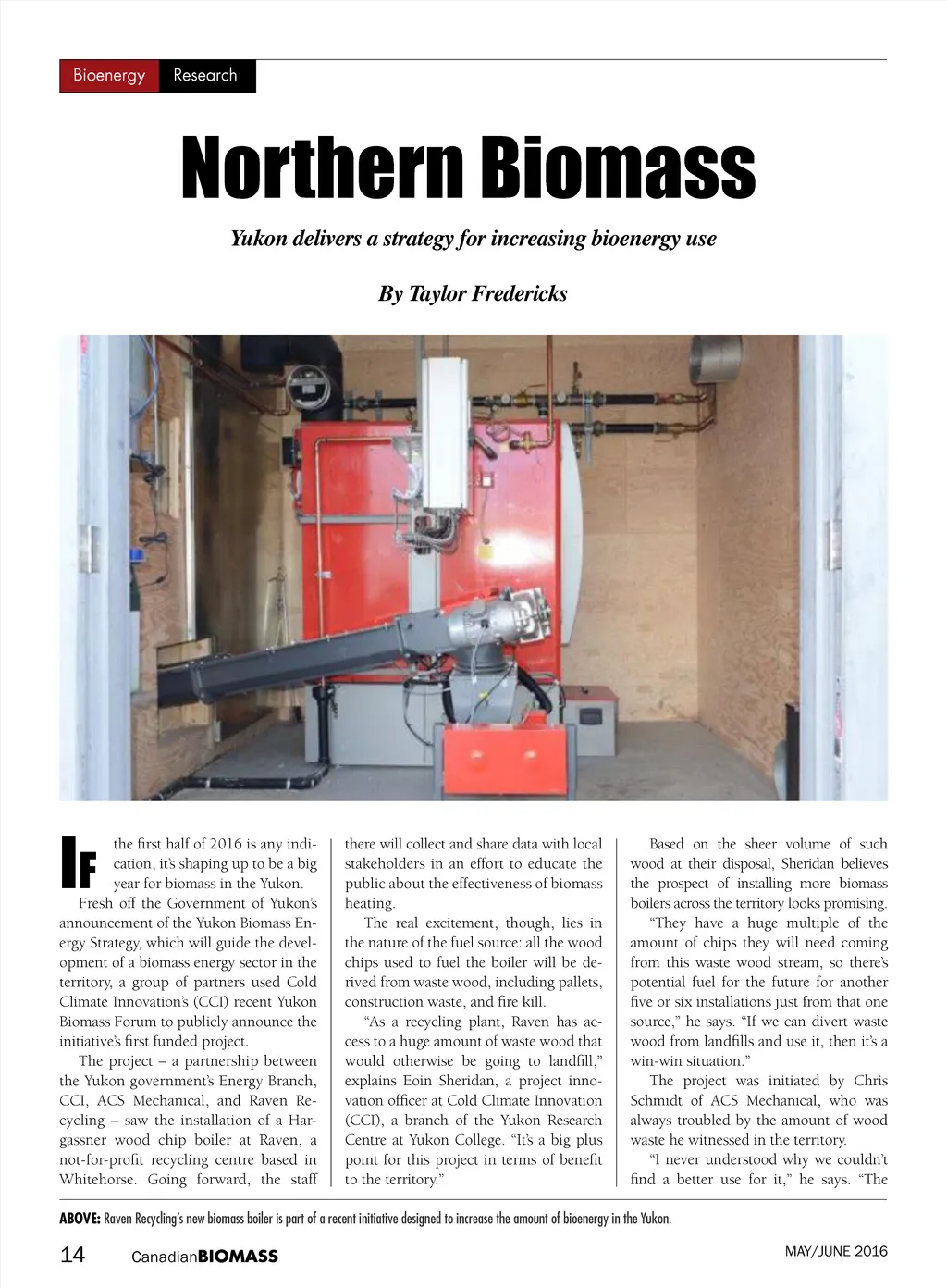
LEFT: The government’s introduction of the Yukon Biomass Energy Strategy will help grow the bioener-gy in the territory. RIGHT: There is no shortage of fibre that can be diverted from landfills to biomass boiler installa-tions throughout the territory. work is done – all you need to do is chip it and haul it to a site.” Hoping to find a better alternative, Schmidt figures he had been research-ing biomass heating alternatives for seven or eight years when the opera-tors at Raven asked him about replac-ing their boilers. “I’ve been doing maintenance at Raven Recycling for over 10 years,” he adds. “There were three old oil boilers there, and they asked me to look into replacing them. That’s when I discov-ered the Hargassner wood chip boiler, which was the only one I’d seen that was Canadian Standards Agency [CSA] approved.” After presenting his idea to CCI – who agreed to provide support and funding, and helped to secure addi-tional funding from the Energy Branch – Schmidt travelled to Quebec to visit representatives with Hargassner Cana-da and to learn how to use the machine and ensure its proper functioning. So far, Schmidt is more than happy with the results. “I’m over the moon,” he said. “I’ve tried to develop projects like this in the past, but there was very little support and I couldn’t find a site. It’s just such an amazing machine. It cleans itself, it gasifies, it has a lambda sensor – which senses oxygen in exhaust – and it adjusts the damper to burn the fuel source with the most efficiency.” Sheridan, for his part, is excited by the potential knowledge, expertise, and insight to be gained from the pilot project at Raven, which he hopes will pave the way for future biomass proj-ects in the territory. “We hope to have more sophisticat-ed projects happening in the future, and it’s nice to have someone we call on for information and experience,” he said. “If we can get some early-stage information that can help people do-ing projects in the future, that’s always a good thing.” All of this thinking fits nicely with the aims laid out in the Yukon Biomass Energy Strategy, which lists six key action areas, including using biomass energy for government infrastructure and facilitating the development of a biomass energy industry in the Yu-kon. It was also on full display at CCI’s two-day Yukon Biomass Forum, where Sheridan’s team sought to create new relationships among stakeholders. “With the forum, we are trying to bring people together,” Sheridan explains. “If we can get people with knowledge from different areas to work together and come together and share knowledge, then it’s our hope that ideas can grow out of that and possibly create projects we can support in the future. That’s our goal here.” Looking at everything that has taken place so far this year, Schmidt believes the territory is on the right track, and has high hopes for the places this new-found momentum could take them. “I’d like to see this as a shift, and my hope is that it becomes a whole indus-try – just using what we have,” he said. “Road construction, ditch cleaning, power lines, lot clearing – think of all that biomass. If we could use all that, that would take care of a lot of energy.” • Canadian BIOMASS 15
Canadian Biomass June 2016: Page 15