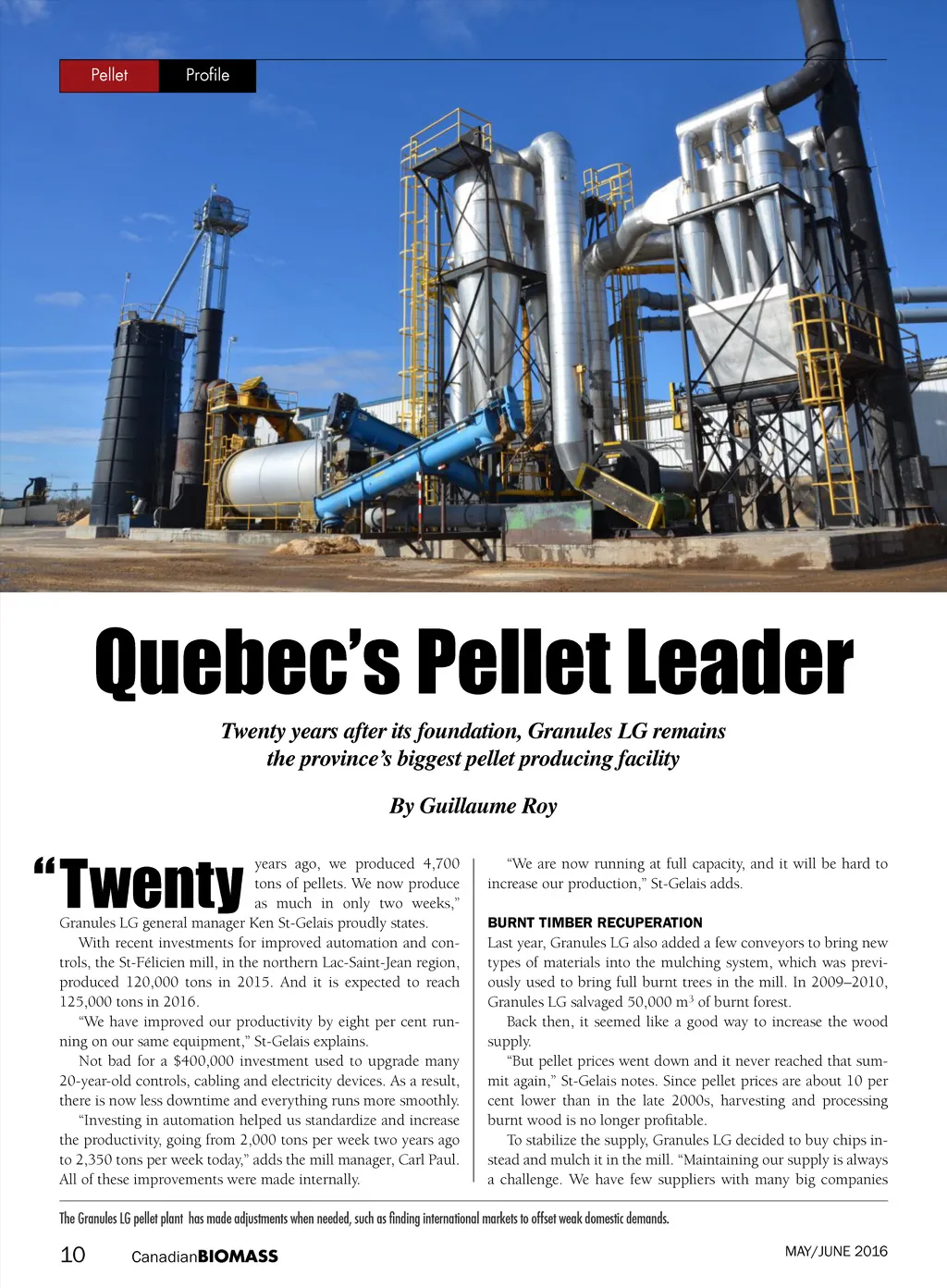
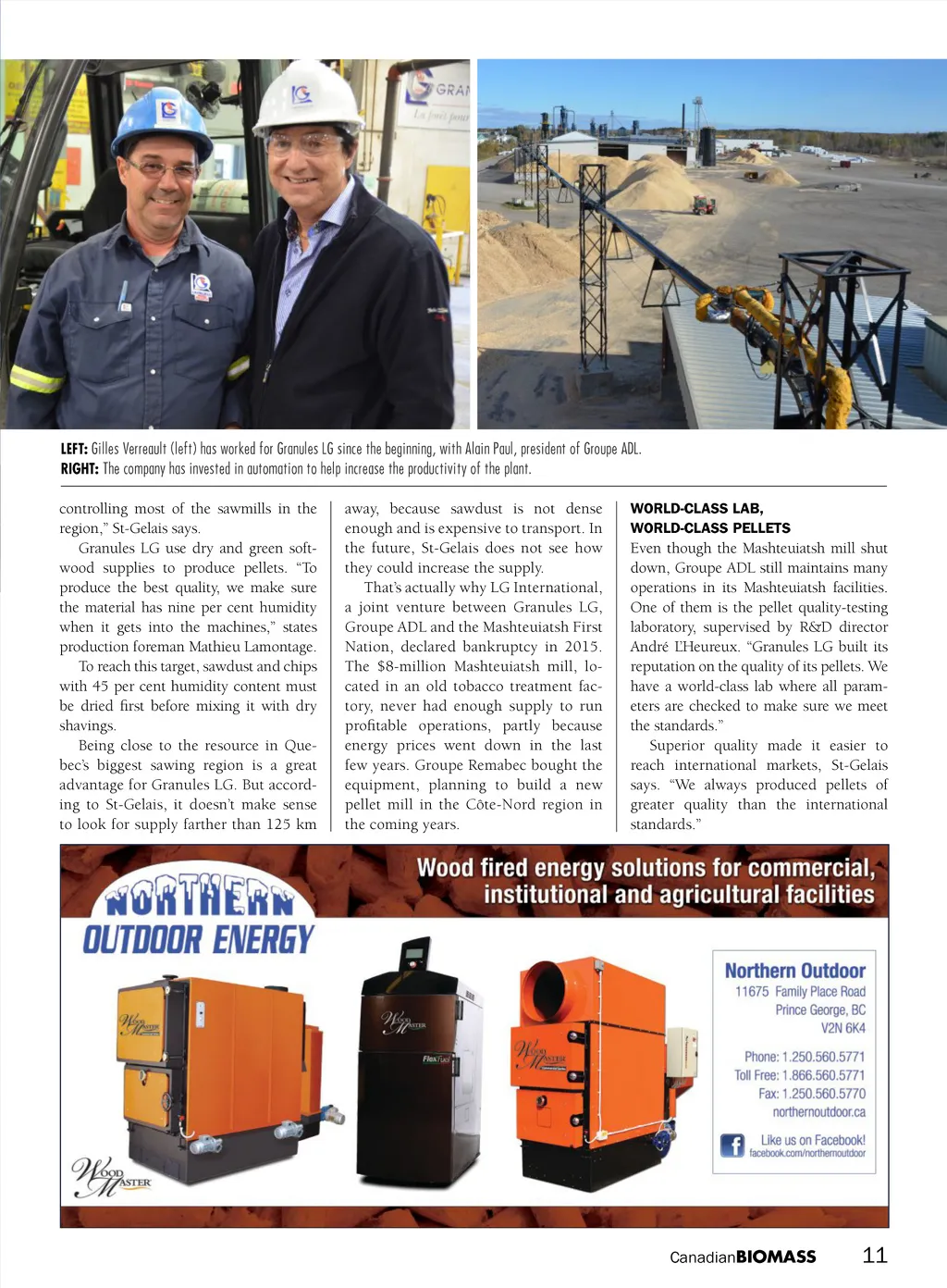
LEFT: Gilles Verreault (left) has worked for Granules LG since the beginning, with Alain Paul, president of Groupe ADL. RIGHT: The company has invested in automation to help increase the productivity of the plant. controlling most of the sawmills in the region,” St-Gelais says. Granules LG use dry and green soft-wood supplies to produce pellets. “To produce the best quality, we make sure the material has nine per cent humidity when it gets into the machines,” states production foreman Mathieu Lamontage. To reach this target, sawdust and chips with 45 per cent humidity content must be dried first before mixing it with dry shavings. Being close to the resource in Que-bec’s biggest sawing region is a great advantage for Granules LG. But accord-ing to St-Gelais, it doesn’t make sense to look for supply farther than 125 km away, because sawdust is not dense enough and is expensive to transport. In the future, St-Gelais does not see how they could increase the supply. That’s actually why LG International, a joint venture between Granules LG, Groupe ADL and the Mashteuiatsh First Nation, declared bankruptcy in 2015. The $8-million Mashteuiatsh mill, lo-cated in an old tobacco treatment fac-tory, never had enough supply to run profitable operations, partly because energy prices went down in the last few years. Groupe Remabec bought the equipment, planning to build a new pellet mill in the Côte-Nord region in the coming years. WORLD-CLASS LAB, WORLD-CLASS PELLETS Even though the Mashteuiatsh mill shut down, Groupe ADL still maintains many operations in its Mashteuiatsh facilities. One of them is the pellet quality-testing laboratory, supervised by R&D director André L’Heureux. “Granules LG built its reputation on the quality of its pellets. We have a world-class lab where all param-eters are checked to make sure we meet the standards.” Superior quality made it easier to reach international markets, St-Gelais says. “We always produced pellets of greater quality than the international standards.” Canadian BIOMASS 11
Canadian Biomass June 2016: Page 11