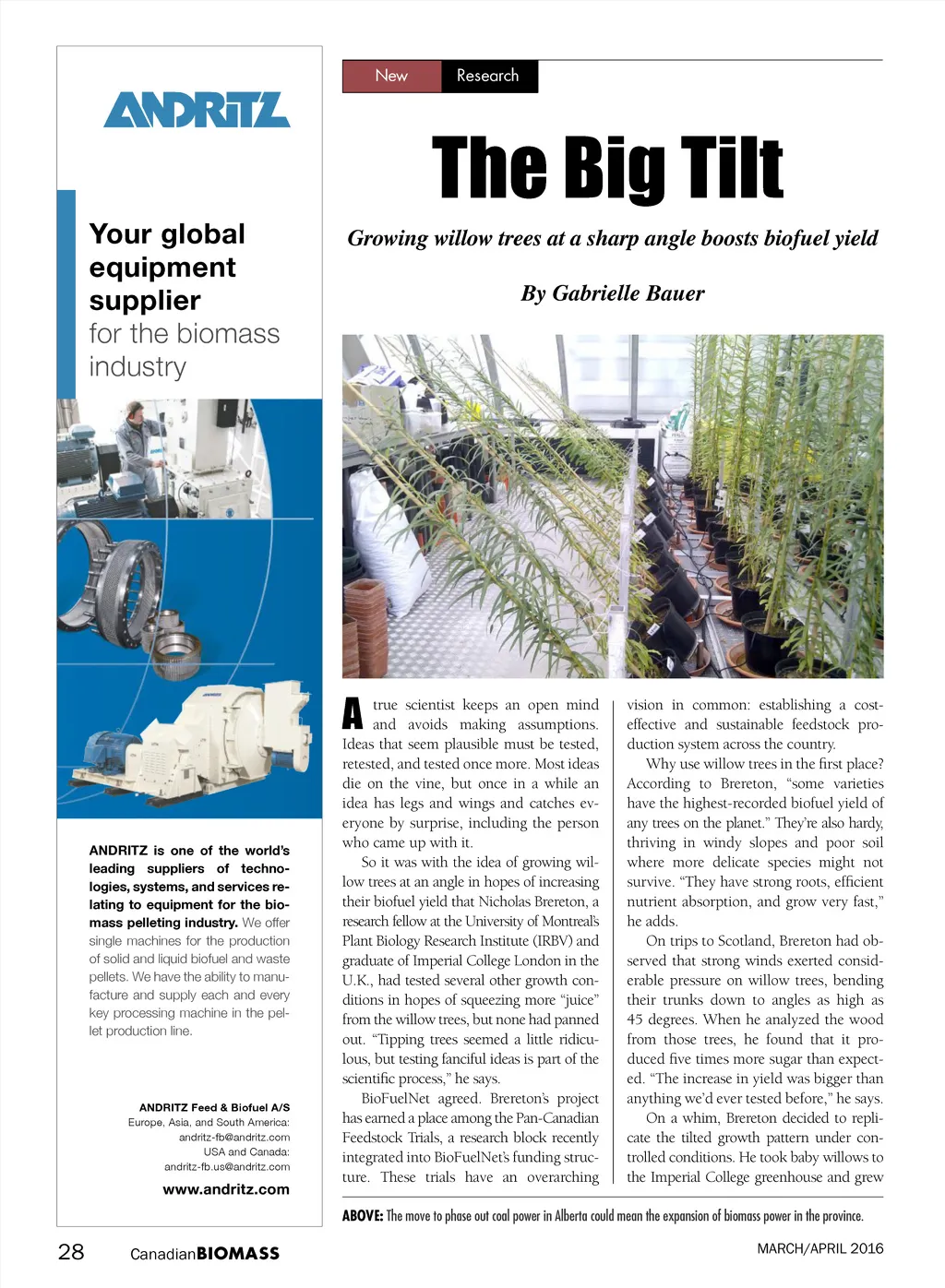
them at a 45-degree angle. To his happy surprise, the wood in these “cultured” wil-lows showed the same qualities as the wood in the windswept Scotland trees. Ever the scientist, Brereton wanted to know why. Having recently seen a London Natural History Museum exhibit in which researchers used computed tomography (CT) to scan fossils, he contacted museum personnel and asked if he could borrow their equipment. “Our building adjoins the museum, so I just hauled my samples over to the museum equipment,” he says with a chuckle. The high-resolution tech-nology enabled him to view the compo-sition of the wood at a cellular level. “We found that tilting the tree prolongs the life of certain cells that would normally die,” he says. This leads the tree to produce a gelatinous, sugar-rich fibre – the tree’s strategy for staying upright – that accounts for its increased biofuel yield. It was through BioFuelNet that Brere-ton’s work came to the attention of Michel Labrecque, an adjunct botany professor at the University of Montreal and head of the research division at the Montreal Bo-tanical Garden. “One of my BioFuelNet colleagues had collaborated with Nick and told me what he was doing,” he says. “It seemed like a good idea to import his expertise.” Labrecque’s own expertise lies in phy-toremediation, the ability of plants to tol-erate and even thrive in harsh conditions. “We know that willow trees grow well in soil that contains long hydrocarbons pro-duced by the oil industry,” says Labrec-que. “They can actually help decontami-nate polluted soil.” In order to figure out what conditions prompted the trees to get into this “clean-up mode,” Labrecque’s research group was working on analyzing trees’ responses to different stressors – a hand-in-glove fit with Brereton’s work, as it turned out. Brereton readily accepted Labrecque’s offer to join his lab as a post-doctoral fellow, with partial funding from BioFuel-Net. “Canada has many species of willow trees – in fact, a third of our woody flora is composed of willows – and many different environments, so it’s the perfect laboratory for the type of work I’m doing,” he says. What’s more, a network of willow-based phytoremediation trials already exists across the province of Quebec. Over the past year, Brereton and Labrecque have been following two paral-lel tracks: identifying stressors that trigger phytoremediation and those that produce better wood. In addition to wind, they plan to investigate the impact of dry soil, marshy soil, and soil with different types of pollutants. “It stands to reason there might be an overlap between the variables that lead to phytoremediation and those that improve the quality of the wood,” says Brereton. If his hunch proves cor-rect, the commercial applications could be huge. “Having trees that can clean up the land and give a high yield of biofuel makes it economically viable to compete with the oil industry.” BioFuelNet has recently agreed to fund the second phase of the project. This phase has the researchers teaming up with colleagues in Alberta and Northern Ire-land, who are shipping them a variety of local tree samples treated with different contaminants. “Our hope is that some of the samples will have that win-win quality we’re after,” says Brereton. Looking further ahead, the group plans to induce the bene-ficial stressors artificially, much as Brereton did when he angled greenhouse-grown willow trees. BioFuelNet has also integrated the project into its Low Cost Sustainable Feedstock Task Force, a multidisciplinary group involving members from academia, industry and government. The task force seeks to take the uncertainty out of sourc-ing low-cost, reliable and sustainable feedstock supplies for biorefinery oper-ators. Dr. Brereton’s work has the added advantage of using land unsuitable for conventional agriculture. Although Brereton says he “wouldn’t mind seeing the end of the winter snow,” he hopes to stay in Canada for the foresee-able future. “Everyone is so nice here,” he says, adding that “in London, people can be a bit brusque.” Wherever he ends up, Brereton plans to continue tapping the willow tree’s rich potential. “It’s rare that you find a line of investigation that has such low risk and high potential,” he says. “It’s a path worth exploring further.” • There’s a saying that gets tossed around a lot here: “It just runs.” Our pellet mills and hammermills aren’t the prettiest. But they’re rock-solid. And they run— year after year after year. But “It just runs” isn’t just about our products. It’s about our company that literally spans centuries. And it’s about our ongoing relationships with our customers—how we’ll always be there for you. Give us a call, and find out just how CPM can run for you. GLOBAL BIOMASS GROUP Your Partner in Productivity CPM Biomass Group CPM/Europe BV 601-932-9080 • www.cpm.net +31 75 65 12 611 • www.cpmeurope.nl For more information about bioenergy and bioproducts, visit canadianbiomassmagazine.ca Client: CPM Biomass Publication: Canadian Biomass Canadian BIOMASS Order: 828 Line: 2 Insertion Date: Mar/Apr CBM_MarApr16_CPMGlobal_CSA.indd 1 29 2016-03-07 7:36 AM
Canadian Biomass March April 2016: Page 29