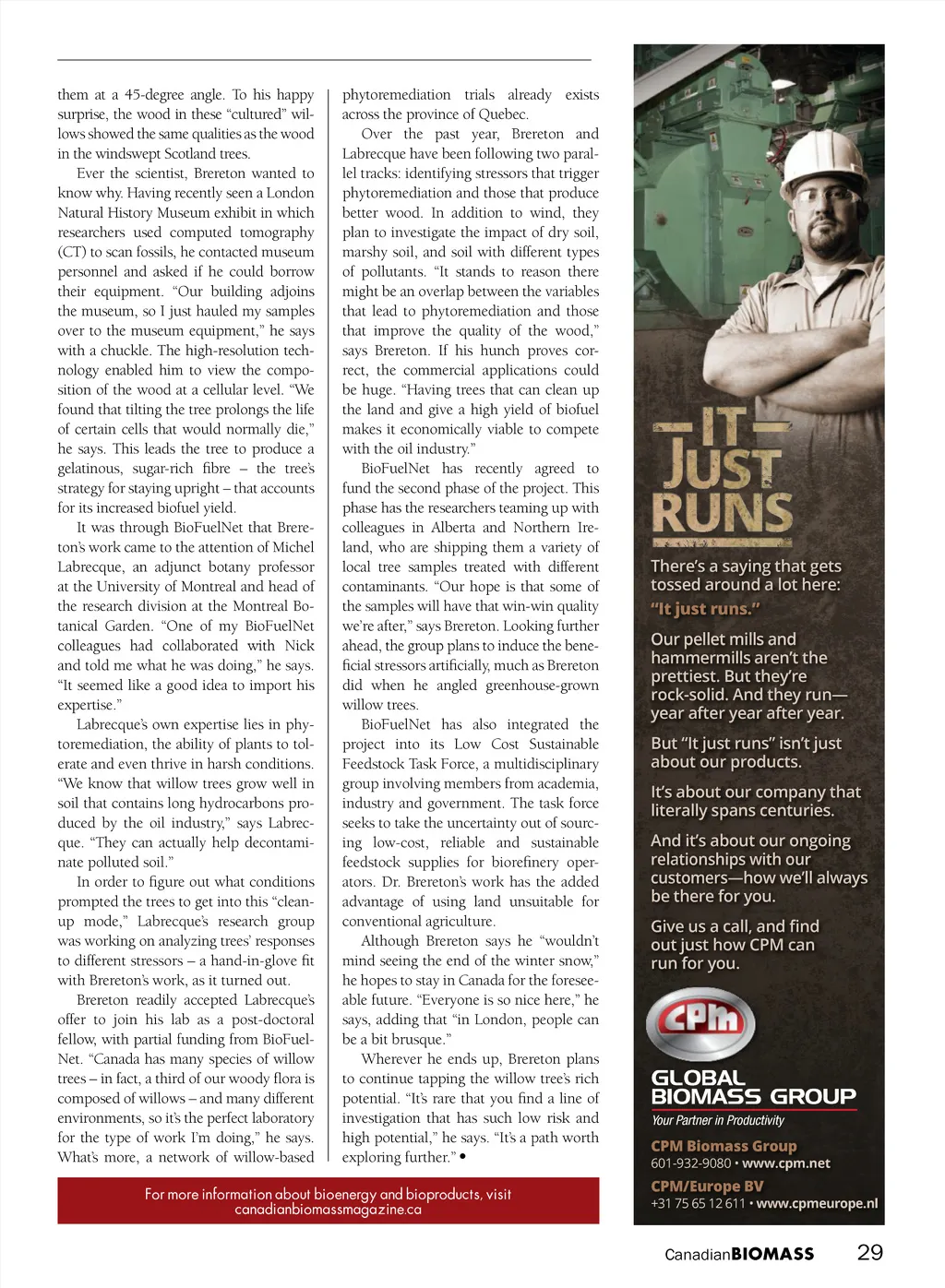
New Research Your global equipment supplier for the biomass industry The Big Tilt Growing willow trees at a sharp angle boosts biofuel yield By Gabrielle Bauer A ANDRITZ is one of the world’s leading suppliers of techno logies, systems, and services re lating to equipment for the bio mass pelleting industry. We offer single machines for the production of solid and liquid biofuel and waste pellets. We have the abili ty to manu-facture and supply each and every key processing machine in the pel-let production line. ANDRITZ Feed & Biofuel A/S Europe, Asia, and South America: [email protected] USA and Canada: [email protected] www.andritz.com true scientist keeps an open mind and avoids making assumptions. Ideas that seem plausible must be tested, retested, and tested once more. Most ideas die on the vine, but once in a while an idea has legs and wings and catches ev-eryone by surprise, including the person who came up with it. So it was with the idea of growing wil-low trees at an angle in hopes of increasing their biofuel yield that Nicholas Brereton, a research fellow at the University of Montreal’s Plant Biology Research Institute (IRBV) and graduate of Imperial College London in the U.K., had tested several other growth con-ditions in hopes of squeezing more “juice” from the willow trees, but none had panned out. “Tipping trees seemed a little ridicu-lous, but testing fanciful ideas is part of the scientific process,” he says. BioFuelNet agreed. Brereton’s project has earned a place among the Pan-Canadian Feedstock Trials, a research block recently integrated into BioFuelNet’s funding struc-ture. These trials have an overarching vision in common: establishing a cost-effective and sustainable feedstock pro-duction system across the country. Why use willow trees in the first place? According to Brereton, “some varieties have the highest-recorded biofuel yield of any trees on the planet.” They’re also hardy, thriving in windy slopes and poor soil where more delicate species might not survive. “They have strong roots, efficient nutrient absorption, and grow very fast,” he adds. On trips to Scotland, Brereton had ob-served that strong winds exerted consid-erable pressure on willow trees, bending their trunks down to angles as high as 45 degrees. When he analyzed the wood from those trees, he found that it pro-duced five times more sugar than expect-ed. “The increase in yield was bigger than anything we’d ever tested before,” he says. On a whim, Brereton decided to repli-cate the tilted growth pattern under con-trolled conditions. He took baby willows to the Imperial College greenhouse and grew ABOVE: The move to phase out coal power in Alberta could mean the expansion of biomass power in the province. 28 Canadian BIOMASS MARCH/APRIL 2016
Canadian Biomass March April 2016: Page 28