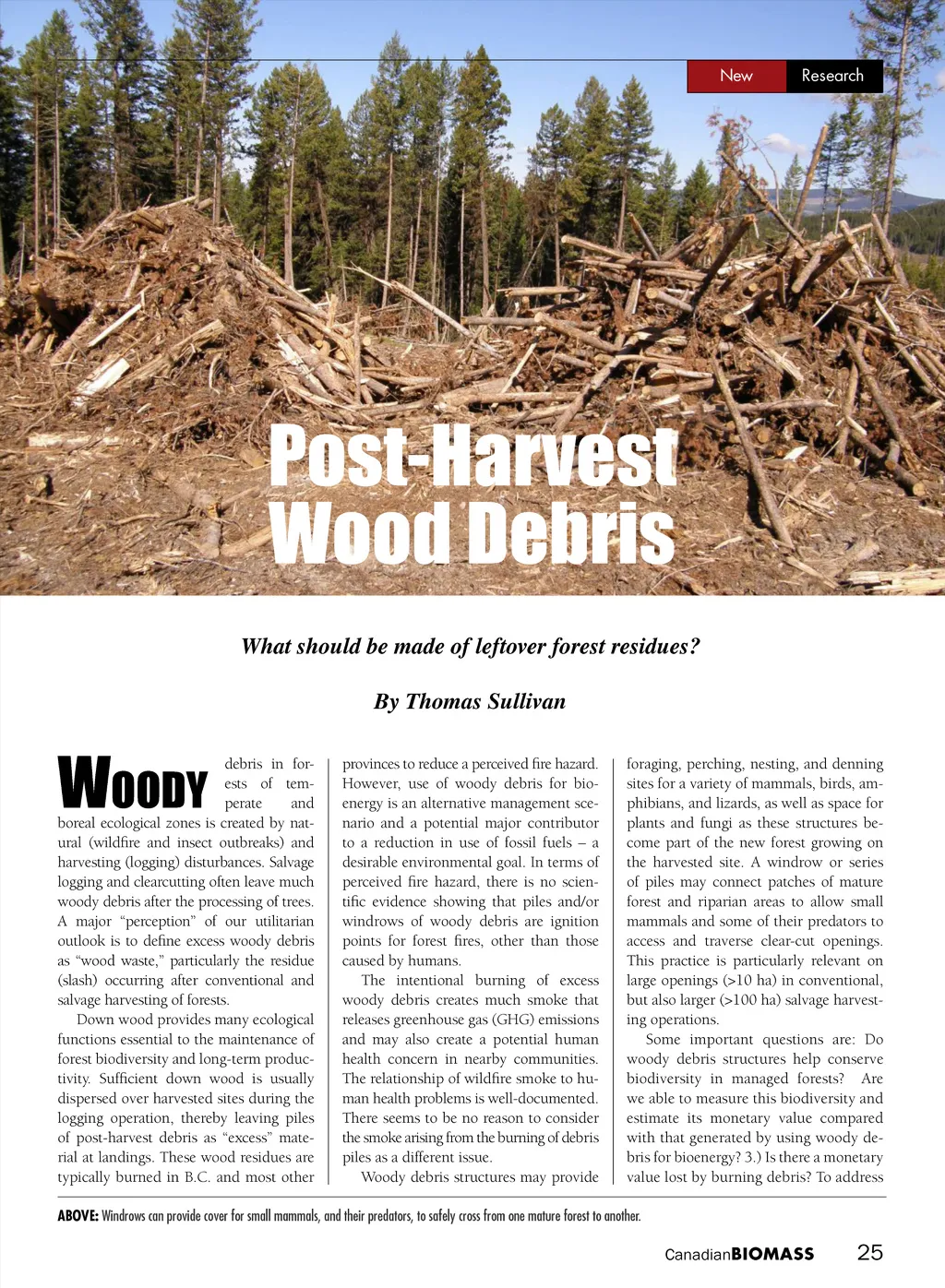
New Research Post-Harvest Wood Debris What should be made of leftover forest residues? By Thomas Sullivan W oody debris in for-ests of tem-perate and boreal ecological zones is created by nat-ural (wildfire and insect outbreaks) and harvesting (logging) disturbances. Salvage logging and clearcutting often leave much woody debris after the processing of trees. A major “perception” of our utilitarian outlook is to define excess woody debris as “wood waste,” particularly the residue (slash) occurring after conventional and salvage harvesting of forests. Down wood provides many ecological functions essential to the maintenance of forest biodiversity and long-term produc-tivity. Sufficient down wood is usually dispersed over harvested sites during the logging operation, thereby leaving piles of post-harvest debris as “excess” mate-rial at landings. These wood residues are typically burned in B.C. and most other provinces to reduce a perceived fire hazard. However, use of woody debris for bio-energy is an alternative management sce-nario and a potential major contributor to a reduction in use of fossil fuels – a desirable environmental goal. In terms of perceived fire hazard, there is no scien-tific evidence showing that piles and/or windrows of woody debris are ignition points for forest fires, other than those caused by humans. The intentional burning of excess woody debris creates much smoke that releases greenhouse gas (GHG) emissions and may also create a potential human health concern in nearby communities. The relationship of wildfire smoke to hu-man health problems is well-documented. There seems to be no reason to consider the smoke arising from the burning of debris piles as a different issue. Woody debris structures may provide foraging, perching, nesting, and denning sites for a variety of mammals, birds, am-phibians, and lizards, as well as space for plants and fungi as these structures be-come part of the new forest growing on the harvested site. A windrow or series of piles may connect patches of mature forest and riparian areas to allow small mammals and some of their predators to access and traverse clear-cut openings. This practice is particularly relevant on large openings (>10 ha) in conventional, but also larger (>100 ha) salvage harvest-ing operations. Some important questions are: Do woody debris structures help conserve biodiversity in managed forests? Are we able to measure this biodiversity and estimate its monetary value compared with that generated by using woody de-bris for bioenergy? 3.) Is there a monetary value lost by burning debris? To address ABOVE: Windrows can provide cover for small mammals, and their predators, to safely cross from one mature forest to another. Canadian BIOMASS 25
Canadian Biomass March April 2016: Page 25