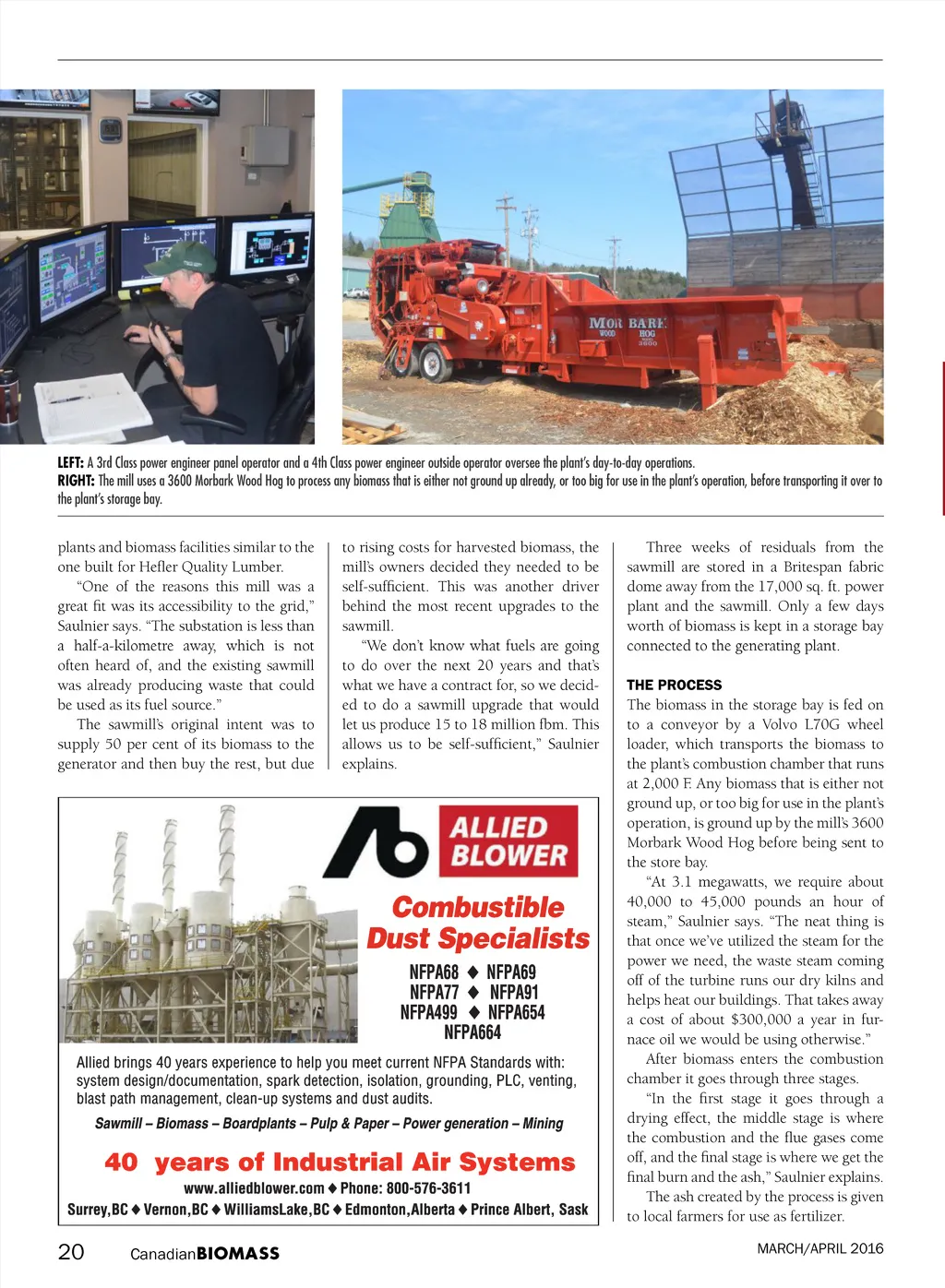
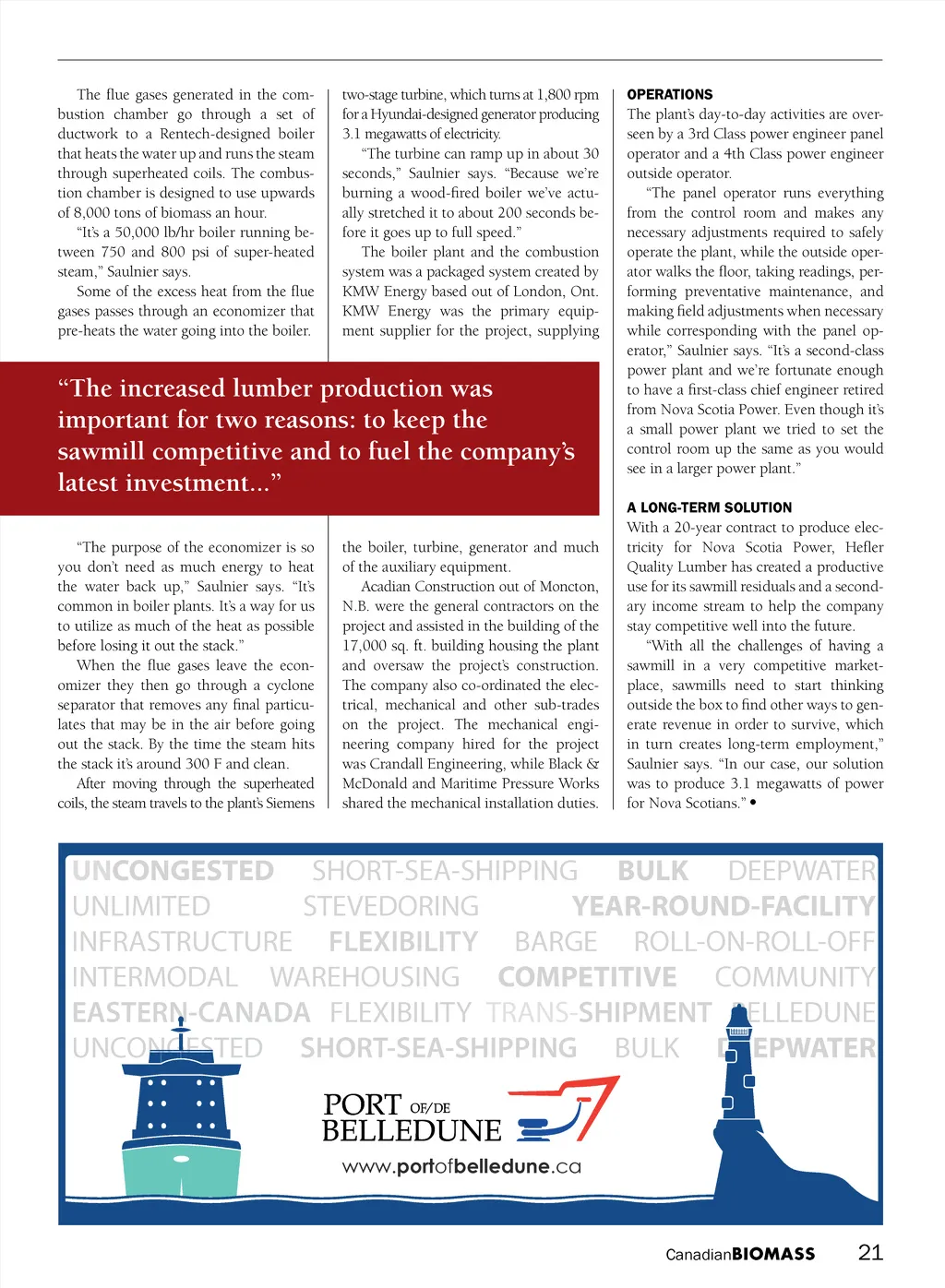
LEFT: A 3rd Class power engineer panel operator and a 4th Class power engineer outside operator oversee the plant’s day-to-day operations. RIGHT: The mill uses a 3600 Morbark Wood Hog to process any biomass that is either not ground up already, or too big for use in the plant’s operation, before transporting it over to the plant’s storage bay. plants and biomass facilities similar to the one built for Hefler Quality Lumber. “One of the reasons this mill was a great fit was its accessibility to the grid,” Saulnier says. “The substation is less than a half-a-kilometre away, which is not often heard of, and the existing sawmill was already producing waste that could be used as its fuel source.” The sawmill’s original intent was to supply 50 per cent of its biomass to the generator and then buy the rest, but due to rising costs for harvested biomass, the mill’s owners decided they needed to be self-sufficient. This was another driver behind the most recent upgrades to the sawmill. “We don’t know what fuels are going to do over the next 20 years and that’s what we have a contract for, so we decid-ed to do a sawmill upgrade that would let us produce 15 to 18 million fbm. This allows us to be self-sufficient,” Saulnier explains. Three weeks of residuals from the sawmill are stored in a Britespan fabric dome away from the 17,000 sq. ft. power plant and the sawmill. Only a few days worth of biomass is kept in a storage bay connected to the generating plant. THE PROCESS The biomass in the storage bay is fed on to a conveyor by a Volvo L70G wheel loader, which transports the biomass to the plant’s combustion chamber that runs at 2,000 F . Any biomass that is either not ground up, or too big for use in the plant’s operation, is ground up by the mill’s 3600 Morbark Wood Hog before being sent to the store bay. “At 3.1 megawatts, we require about 40,000 to 45,000 pounds an hour of steam,” Saulnier says. “The neat thing is that once we’ve utilized the steam for the power we need, the waste steam coming off of the turbine runs our dry kilns and helps heat our buildings. That takes away a cost of about $300,000 a year in fur-nace oil we would be using otherwise.” After biomass enters the combustion chamber it goes through three stages. “In the first stage it goes through a drying effect, the middle stage is where the combustion and the flue gases come off, and the final stage is where we get the final burn and the ash,” Saulnier explains. The ash created by the process is given to local farmers for use as fertilizer. MARCH/APRIL 2016 20 Canadian BIOMASS
Canadian Biomass March April 2016: Page 20