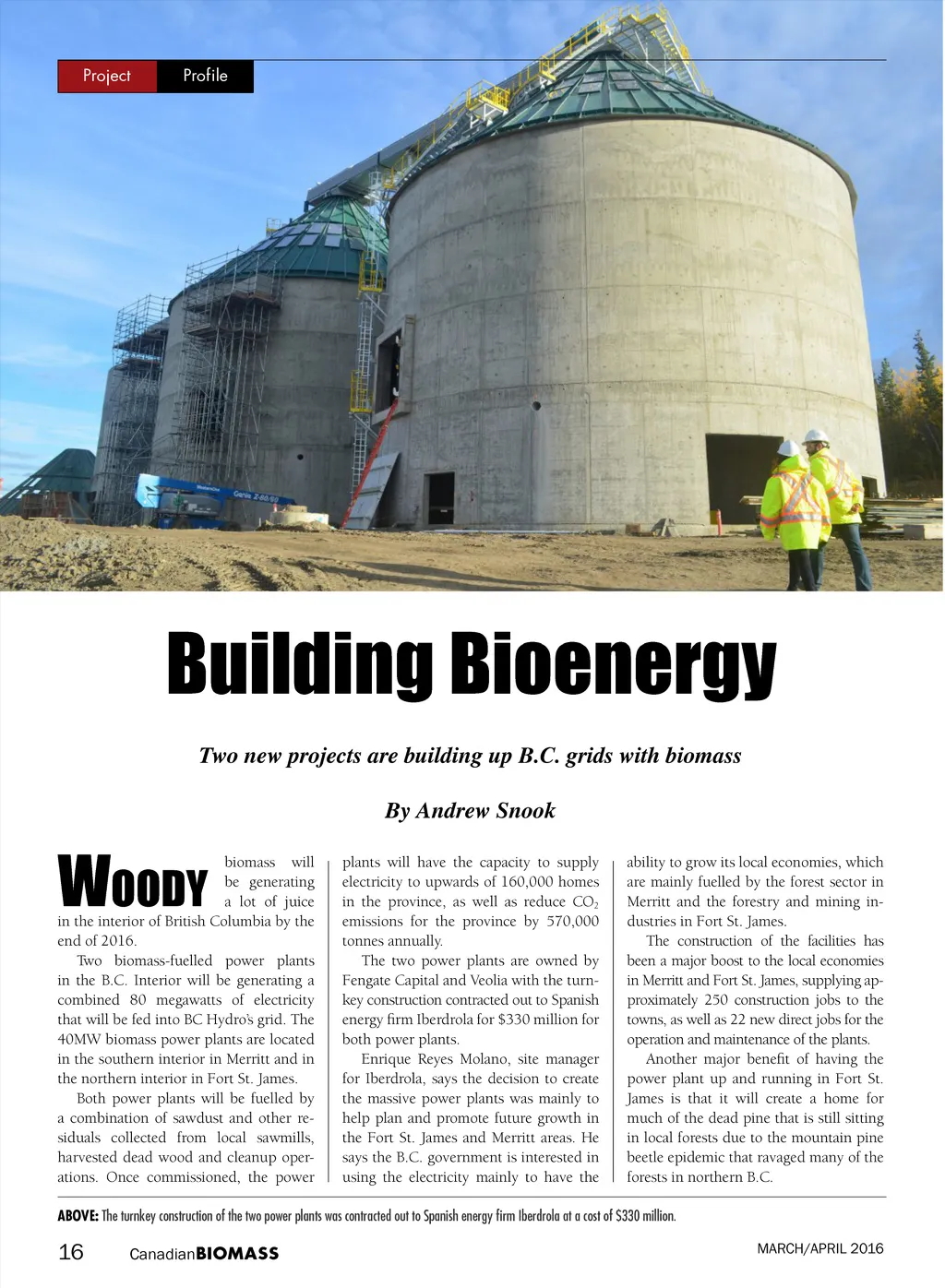
“We’ve had increased harvesting of the forests but we’re going to see that drop off real soon,” says Emily Colombo, econom-ic development officer for the Fort St. James District. “Because the dead wood standing in the forest loses merchant-ability year after year, it’s only good for harvesting and processing for a number of years. Even though there’s lots of dead wood in the forests, it’s no longer going to be desirable by the sawmill companies. So it’s great to have the Fort St. James green energy project starting up because it gives us a purpose for our waste wood. Until now it’s been burned in the bush… it’s just releasing carbon dioxide into the atmosphere.” The construction of the Fort St. James plant is expected to be complete by Novem-ber 2016 with the Merritt power plant coming online this December. The main equipment installed for each project is a Siemens SST-400, 40MW condensing steam turbine; an FSE bio-mass boiler (307,260 PPH); a GC Power transformer (30/40/50 MVA, 65C Wye Delta); and an Emerson distributed con-trol system (DCS). FEEDING SYSTEMS The fuel is received, weighed and off-loaded in a dedicated area. It is then screened and stored in the three concrete silos, which required 4,440 m 3 of con-crete and 570,000 kg of reinforced steel in their construction. All of the silos are equipped with a steel roof, are 11.6 metres in height and have a silo diameter of 25 metres. In Merritt, the boilers are fed woody biomass via a large conveyor connected directly to Tolko’s sawmill located next to the power plant. Each power plant will consume ap-proximately 24 dry tonnes per hour of biomass with a total annual consumption of about 200,000 dry tonnes. BOILERS AND TURBINES In Fort St. James, the boilers are fed woody biomass via three 6,560 m 3 silos that can hold upwards of a 6.75-day supply for the plant. The fuel is supplied through the residuals from the local Con-fiex and Apollo Forest Products sawmills, as well as through local contractors har-vesting local dead wood. Both locations feature a state-of-the-art grate, natural circulation biomass boiler supplied by FSE Energy. The flue gases heat the wall tubes of the combustion chambers and the water is partly evap-orated. Water and steam rise through tubes back to the steam drum where the steam is separated from the water. After leaving the steam drum, the saturated steam is transferred to the superheaters then is transferred into a Siemens SST-400, 40MW-condensing steam turbine. Each Siemens generator is rated at 1,800 rpm and produces electricity at 13.8 kV with each turbine rated at 5,143 rpm, producing upwards of 41.39MW of electricity that will be fed in BC Hydro’s grid. Air-cooled condensers are being built at both facilities to keep water requirements to a minimum. Canadian BIOMASS CBM_MarApr16_WestSalem_CSA.indd 1 17 2016-03-03 2:52 PM
Canadian Biomass March April 2016: Page 17