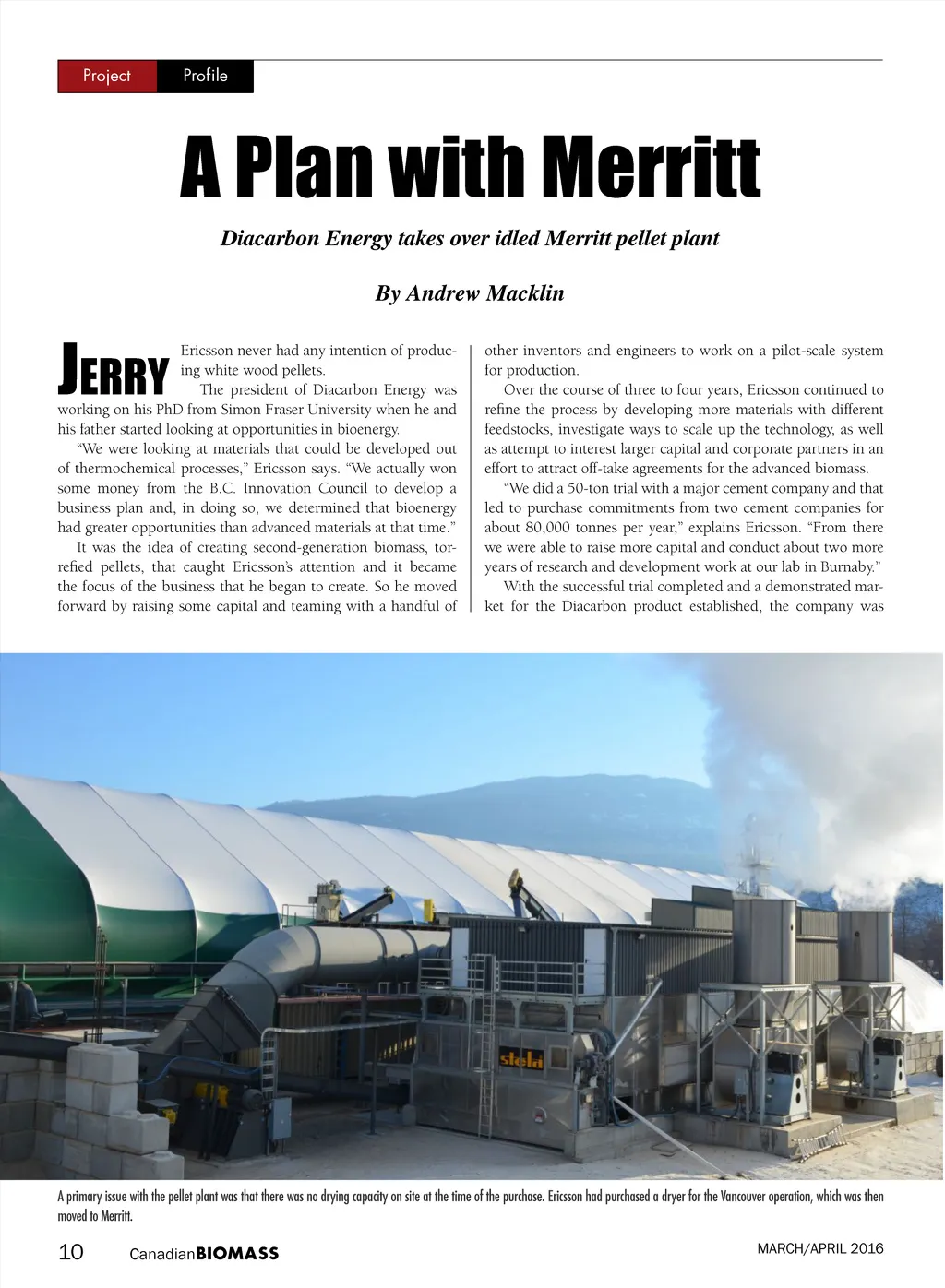
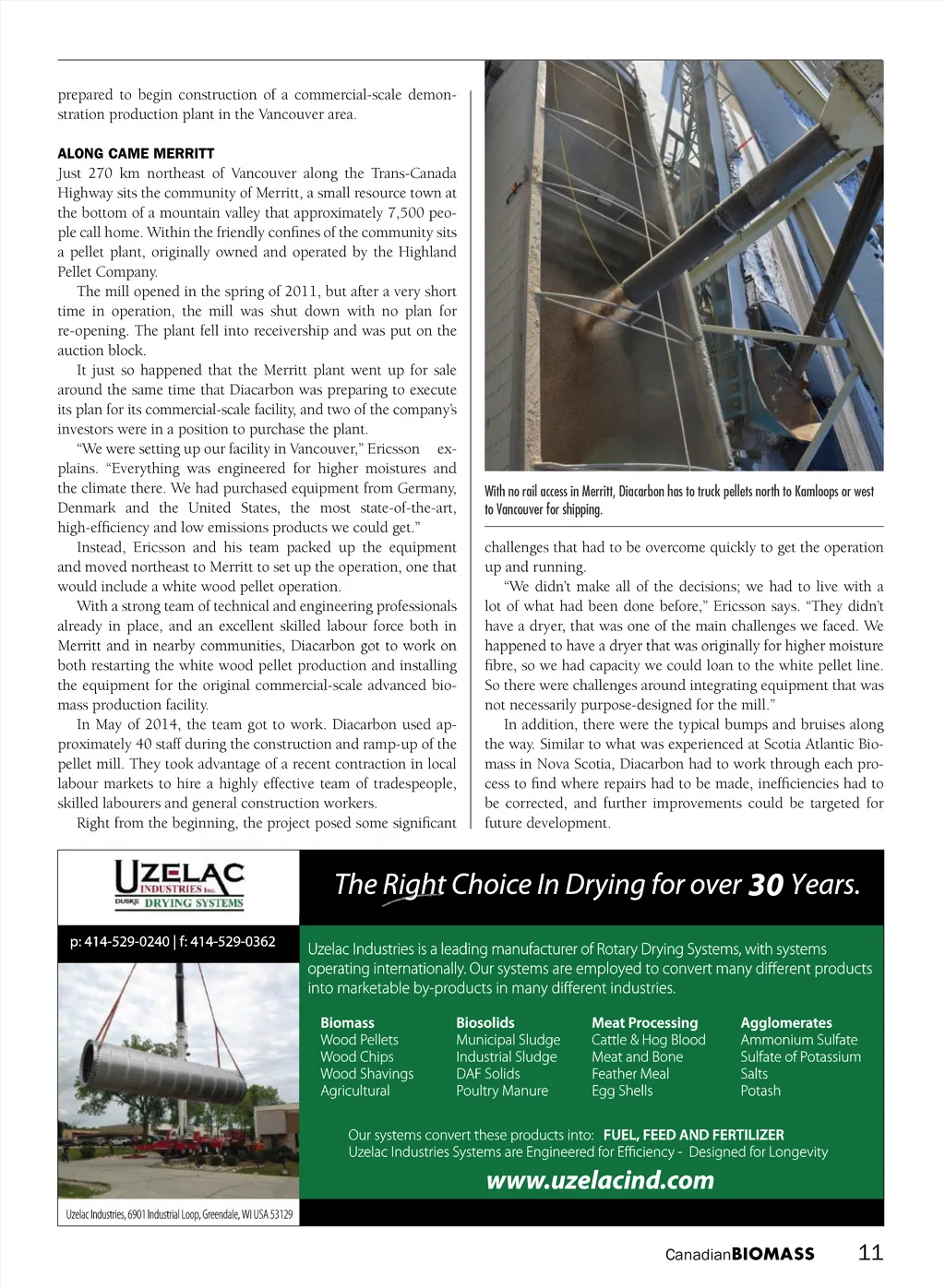
prepared to begin construction of a commercial-scale demon-stration production plant in the Vancouver area. ALONG CAME MERRITT Just 270 km northeast of Vancouver along the Trans-Canada Highway sits the community of Merritt, a small resource town at the bottom of a mountain valley that approximately 7,500 peo-ple call home. Within the friendly confines of the community sits a pellet plant, originally owned and operated by the Highland Pellet Company. The mill opened in the spring of 2011, but after a very short time in operation, the mill was shut down with no plan for re-opening. The plant fell into receivership and was put on the auction block. It just so happened that the Merritt plant went up for sale around the same time that Diacarbon was preparing to execute its plan for its commercial-scale facility, and two of the company’s investors were in a position to purchase the plant. “We were setting up our facility in Vancouver,” Ericsson ex-plains. “Everything was engineered for higher moistures and the climate there. We had purchased equipment from Germany, Denmark and the United States, the most state-of-the-art, high-efficiency and low emissions products we could get.” Instead, Ericsson and his team packed up the equipment and moved northeast to Merritt to set up the operation, one that would include a white wood pellet operation. With a strong team of technical and engineering professionals already in place, and an excellent skilled labour force both in Merritt and in nearby communities, Diacarbon got to work on both restarting the white wood pellet production and installing the equipment for the original commercial-scale advanced bio-mass production facility. In May of 2014, the team got to work. Diacarbon used ap-proximately 40 staff during the construction and ramp-up of the pellet mill. They took advantage of a recent contraction in local labour markets to hire a highly effective team of tradespeople, skilled labourers and general construction workers. Right from the beginning, the project posed some significant With no rail access in Merritt, Diacarbon has to truck pellets north to Kamloops or west to Vancouver for shipping. challenges that had to be overcome quickly to get the operation up and running. “We didn’t make all of the decisions; we had to live with a lot of what had been done before,” Ericsson says. “They didn’t have a dryer, that was one of the main challenges we faced. We happened to have a dryer that was originally for higher moisture fibre, so we had capacity we could loan to the white pellet line. So there were challenges around integrating equipment that was not necessarily purpose-designed for the mill.” In addition, there were the typical bumps and bruises along the way. Similar to what was experienced at Scotia Atlantic Bio-mass in Nova Scotia, Diacarbon had to work through each pro-cess to find where repairs had to be made, inefficiencies had to be corrected, and further improvements could be targeted for future development. CBM_MarApr16_Uzelac_MLD.indd 1 Canadian BIOMASS 2016-03-16 10:16 AM 11
Canadian Biomass March April 2016: Page 11