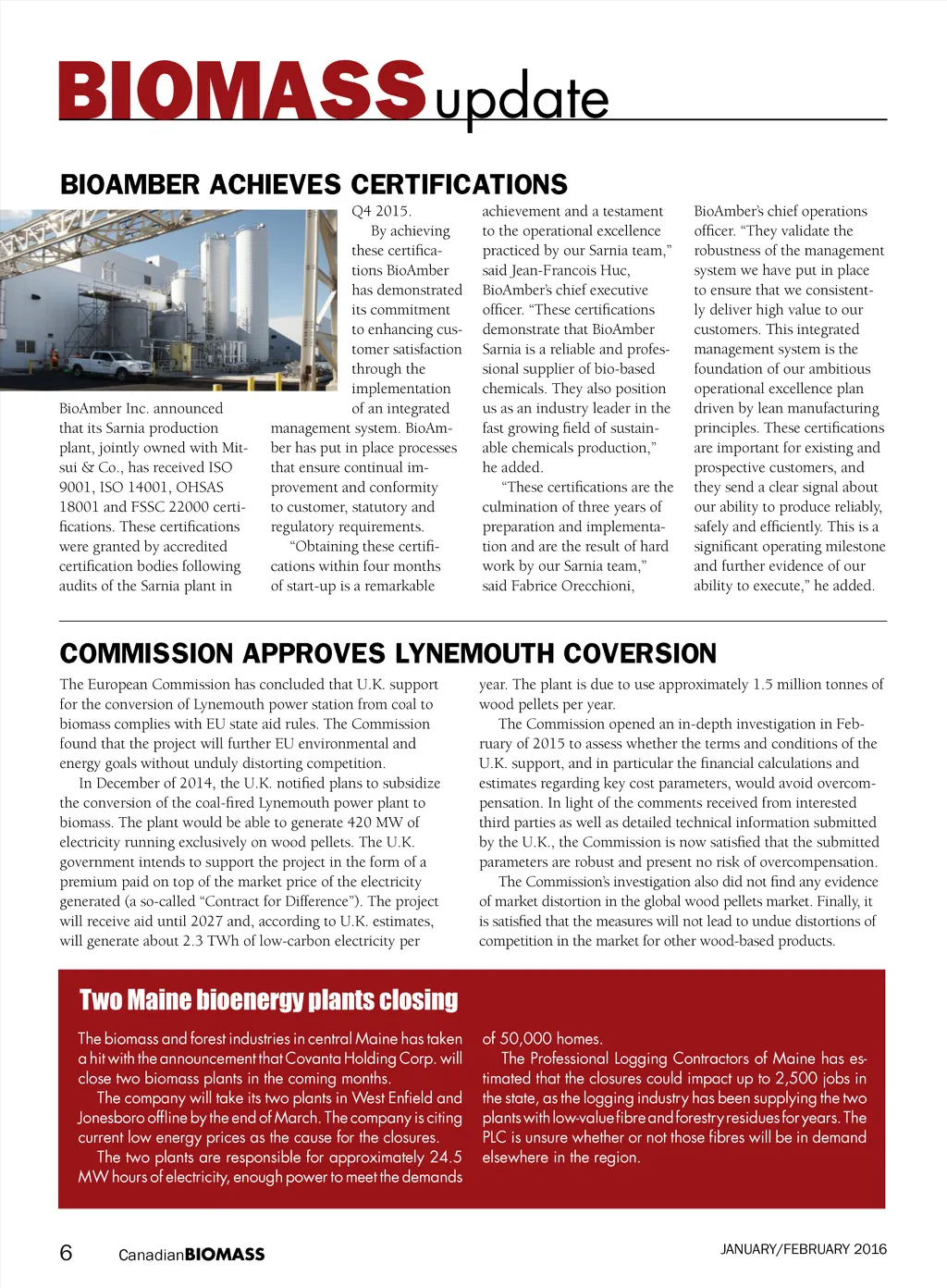
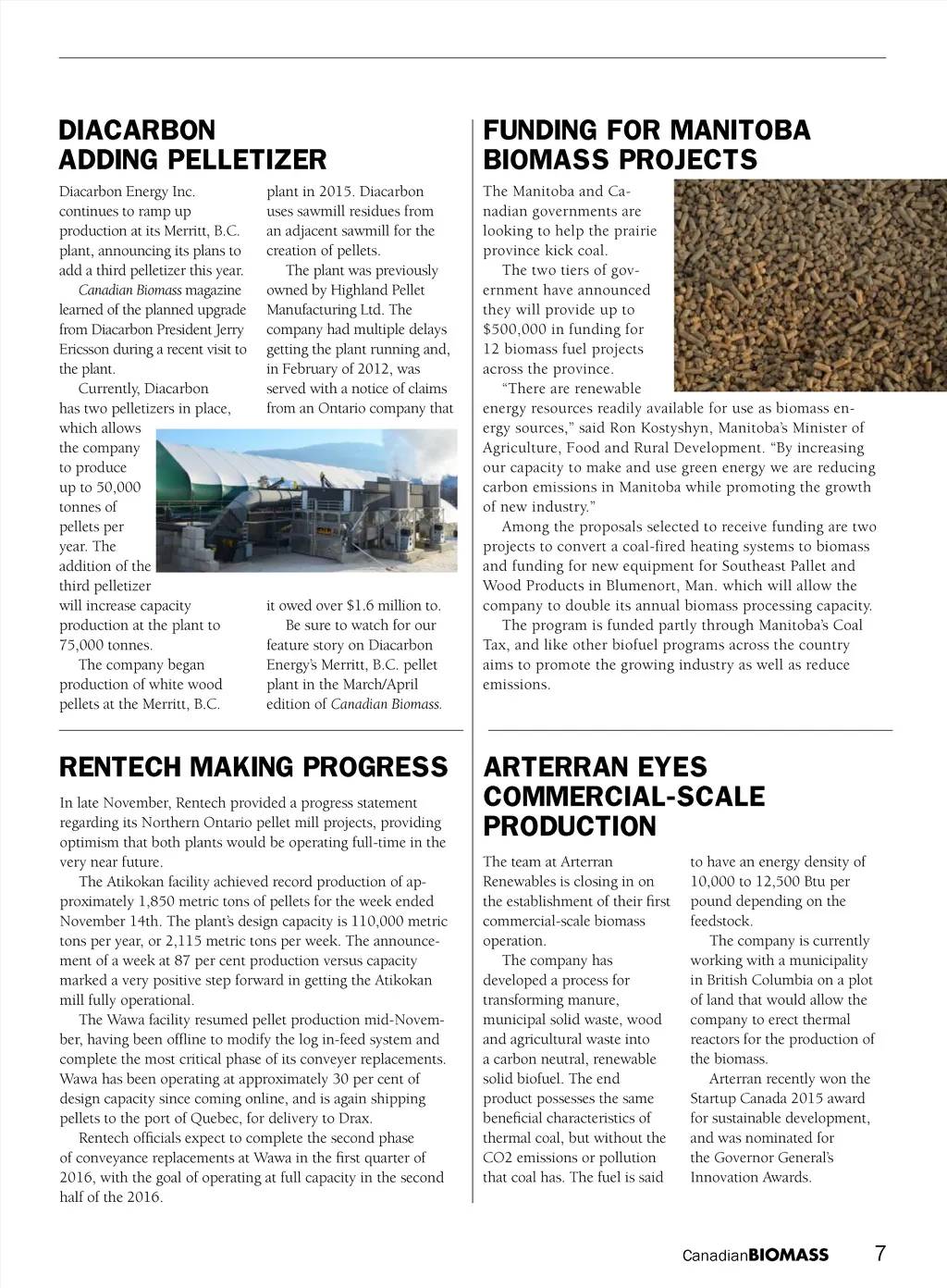
DIACARBON ADDING PELLETIZER Diacarbon Energy Inc. continues to ramp up production at its Merritt, B.C. plant, announcing its plans to add a third pelletizer this year. Canadian Biomass magazine learned of the planned upgrade from Diacarbon President Jerry Ericsson during a recent visit to the plant. Currently, Diacarbon has two pelletizers in place, which allows the company to produce up to 50,000 tonnes of pellets per year. The addition of the third pelletizer will increase capacity production at the plant to 75,000 tonnes. The company began production of white wood pellets at the Merritt, B.C. plant in 2015. Diacarbon uses sawmill residues from an adjacent sawmill for the creation of pellets. The plant was previously owned by Highland Pellet Manufacturing Ltd. The company had multiple delays getting the plant running and, in February of 2012, was served with a notice of claims from an Ontario company that FUNDING FOR MANITOBA BIOMASS PROJECTS The Manitoba and Ca-nadian governments are looking to help the prairie province kick coal. The two tiers of gov-ernment have announced they will provide up to $500,000 in funding for 12 biomass fuel projects across the province. “There are renewable energy resources readily available for use as biomass en-ergy sources,” said Ron Kostyshyn, Manitoba’s Minister of Agriculture, Food and Rural Development. “By increasing our capacity to make and use green energy we are reducing carbon emissions in Manitoba while promoting the growth of new industry.” Among the proposals selected to receive funding are two projects to convert a coal-fired heating systems to biomass and funding for new equipment for Southeast Pallet and Wood Products in Blumenort, Man. which will allow the company to double its annual biomass processing capacity. The program is funded partly through Manitoba’s Coal Tax, and like other biofuel programs across the country aims to promote the growing industry as well as reduce emissions. it owed over $1.6 million to. Be sure to watch for our feature story on Diacarbon Energy’s Merritt, B.C. pellet plant in the March/April edition of Canadian Biomass. RENTECH MAKING PROGRESS In late November, Rentech provided a progress statement regarding its Northern Ontario pellet mill projects, providing optimism that both plants would be operating full-time in the very near future. The Atikokan facility achieved record production of ap-proximately 1,850 metric tons of pellets for the week ended November 14th. The plant’s design capacity is 110,000 metric tons per year, or 2,115 metric tons per week. The announce-ment of a week at 87 per cent production versus capacity marked a very positive step forward in getting the Atikokan mill fully operational. The Wawa facility resumed pellet production mid-Novem-ber, having been offline to modify the log in-feed system and complete the most critical phase of its conveyer replacements. Wawa has been operating at approximately 30 per cent of design capacity since coming online, and is again shipping pellets to the port of Quebec, for delivery to Drax. Rentech officials expect to complete the second phase of conveyance replacements at Wawa in the first quarter of 2016, with the goal of operating at full capacity in the second half of the 2016. ARTERRAN EYES COMMERCIAL-SCALE PRODUCTION The team at Arterran Renewables is closing in on the establishment of their first commercial-scale biomass operation. The company has developed a process for transforming manure, municipal solid waste, wood and agricultural waste into a carbon neutral, renewable solid biofuel. The end product possesses the same beneficial characteristics of thermal coal, but without the CO2 emissions or pollution that coal has. The fuel is said to have an energy density of 10,000 to 12,500 Btu per pound depending on the feedstock. The company is currently working with a municipality in British Columbia on a plot of land that would allow the company to erect thermal reactors for the production of the biomass. Arterran recently won the Startup Canada 2015 award for sustainable development, and was nominated for the Governor General’s Innovation Awards. Canadian BIOMASS 7
Canadian Biomass January February 2016: Page 7