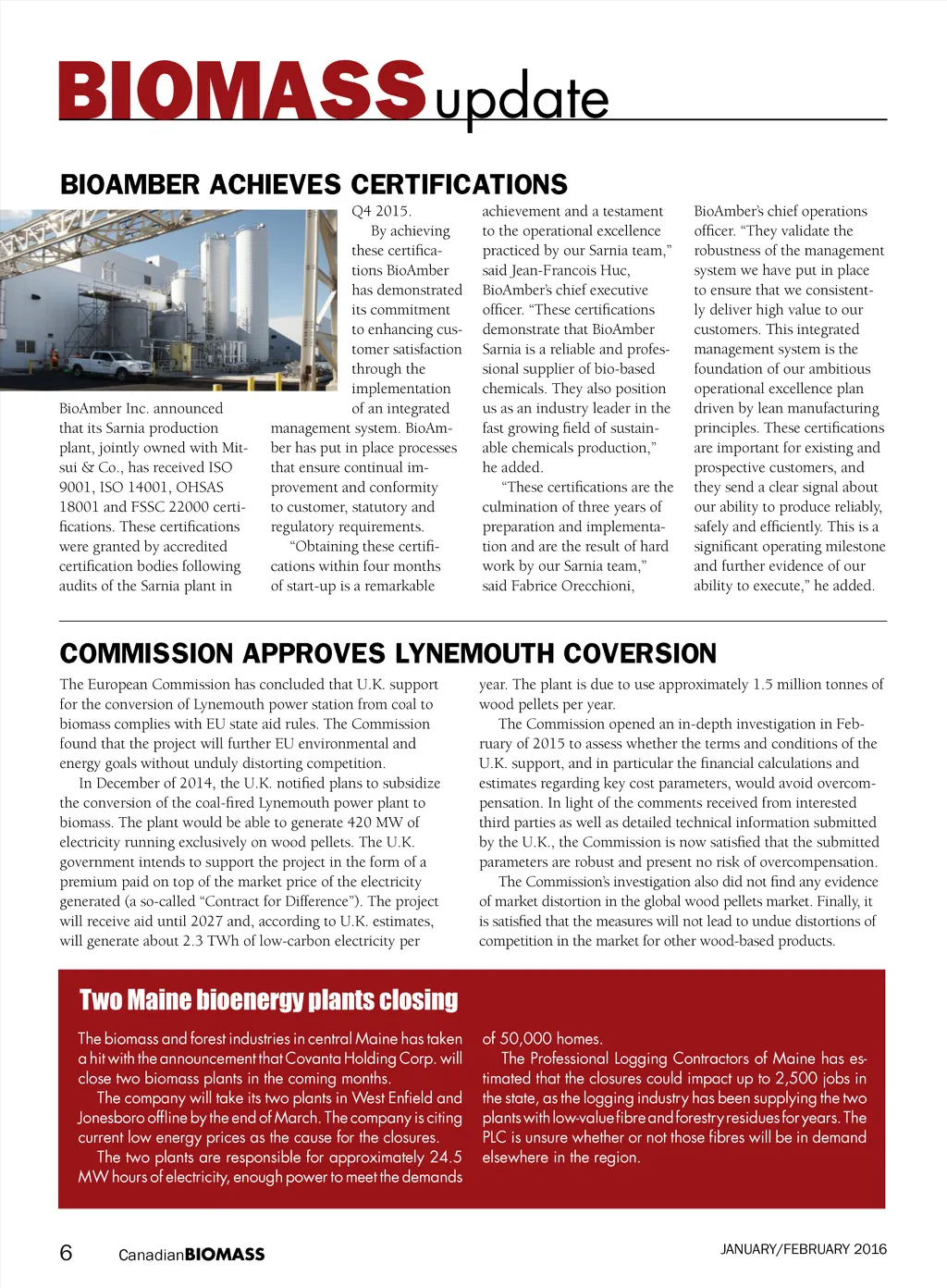
BIOMASS update BIOAMBER ACHIEVES CERTIFICATIONS Q4 2015. By achieving these certifica-tions BioAmber has demonstrated its commitment to enhancing cus-tomer satisfaction through the implementation of an integrated management system. BioAm-ber has put in place processes that ensure continual im-provement and conformity to customer, statutory and regulatory requirements. “Obtaining these certifi-cations within four months of start-up is a remarkable achievement and a testament to the operational excellence practiced by our Sarnia team,” said Jean-Francois Huc, BioAmber’s chief executive officer. “These certifications demonstrate that BioAmber Sarnia is a reliable and profes-sional supplier of bio-based chemicals. They also position us as an industry leader in the fast growing field of sustain-able chemicals production,” he added. “These certifications are the culmination of three years of preparation and implementa-tion and are the result of hard work by our Sarnia team,” said Fabrice Orecchioni, BioAmber’s chief operations officer. “They validate the robustness of the management system we have put in place to ensure that we consistent-ly deliver high value to our customers. This integrated management system is the foundation of our ambitious operational excellence plan driven by lean manufacturing principles. These certifications are important for existing and prospective customers, and they send a clear signal about our ability to produce reliably, safely and efficiently. This is a significant operating milestone and further evidence of our ability to execute,” he added. BioAmber Inc. announced that its Sarnia production plant, jointly owned with Mit-sui & Co., has received ISO 9001, ISO 14001, OHSAS 18001 and FSSC 22000 certi-fications. These certifications were granted by accredited certification bodies following audits of the Sarnia plant in COMMISSION APPROVES LYNEMOUTH COVERSION The European Commission has concluded that U.K. support for the conversion of Lynemouth power station from coal to biomass complies with EU state aid rules. The Commission found that the project will further EU environmental and energy goals without unduly distorting competition. In December of 2014, the U.K. notified plans to subsidize the conversion of the coal-fired Lynemouth power plant to biomass. The plant would be able to generate 420 MW of electricity running exclusively on wood pellets. The U.K. government intends to support the project in the form of a premium paid on top of the market price of the electricity generated (a so-called “Contract for Difference”). The project will receive aid until 2027 and, according to U.K. estimates, will generate about 2.3 TWh of low-carbon electricity per year. The plant is due to use approximately 1.5 million tonnes of wood pellets per year. The Commission opened an in-depth investigation in Feb-ruary of 2015 to assess whether the terms and conditions of the U.K. support, and in particular the financial calculations and estimates regarding key cost parameters, would avoid overcom-pensation. In light of the comments received from interested third parties as well as detailed technical information submitted by the U.K., the Commission is now satisfied that the submitted parameters are robust and present no risk of overcompensation. The Commission’s investigation also did not find any evidence of market distortion in the global wood pellets market. Finally, it is satisfied that the measures will not lead to undue distortions of competition in the market for other wood-based products. Two Maine bioenergy plants closing The biomass and forest industries in central Maine has taken a hit with the announcement that Covanta Holding Corp. will close two biomass plants in the coming months. The company will take its two plants in West Enfield and Jonesboro offline by the end of March. The company is citing current low energy prices as the cause for the closures. The two plants are responsible for approximately 24.5 MW hours of electricity, enough power to meet the demands of 50,000 homes. The Professional Logging Contractors of Maine has es-timated that the closures could impact up to 2,500 jobs in the state, as the logging industry has been supplying the two plants with low-value fibre and forestry residues for years. The PLC is unsure whether or not those fibres will be in demand elsewhere in the region. 6 Canadian BIOMASS JANUARY/FEBRUARY 2016
Canadian Biomass January February 2016: Page 6