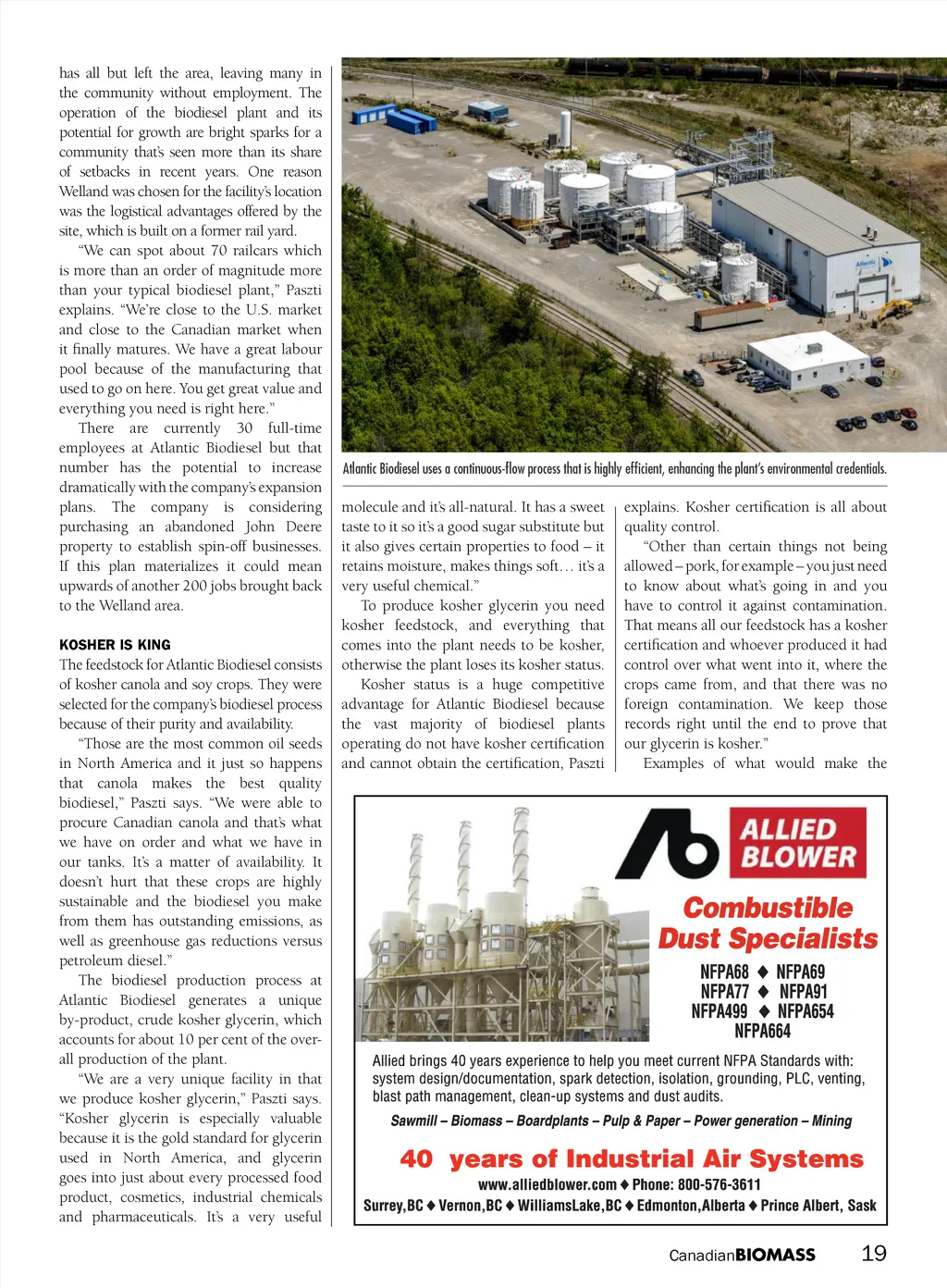
has all but left the area, leaving many in the community without employment. The operation of the biodiesel plant and its potential for growth are bright sparks for a community that’s seen more than its share of setbacks in recent years. One reason Welland was chosen for the facility’s location was the logistical advantages offered by the site, which is built on a former rail yard. “We can spot about 70 railcars which is more than an order of magnitude more than your typical biodiesel plant,” Paszti explains. “We’re close to the U.S. market and close to the Canadian market when it finally matures. We have a great labour pool because of the manufacturing that used to go on here. You get great value and everything you need is right here.” There are currently 30 full-time employees at Atlantic Biodiesel but that number has the potential to increase dramatically with the company’s expansion plans. The company is considering purchasing an abandoned John Deere property to establish spin-off businesses. If this plan materializes it could mean upwards of another 200 jobs brought back to the Welland area. KOSHER IS KING Atlantic Biodiesel uses a continuous-flow process that is highly efficient, enhancing the plant’s environmental credentials. The feedstock for Atlantic Biodiesel consists of kosher canola and soy crops. They were selected for the company’s biodiesel process because of their purity and availability. “Those are the most common oil seeds in North America and it just so happens that canola makes the best quality biodiesel,” Paszti says. “We were able to procure Canadian canola and that’s what we have on order and what we have in our tanks. It’s a matter of availability. It doesn’t hurt that these crops are highly sustainable and the biodiesel you make from them has outstanding emissions, as well as greenhouse gas reductions versus petroleum diesel.” The biodiesel production process at Atlantic Biodiesel generates a unique by-product, crude kosher glycerin, which accounts for about 10 per cent of the over-all production of the plant. “We are a very unique facility in that we produce kosher glycerin,” Paszti says. “Kosher glycerin is especially valuable because it is the gold standard for glycerin used in North America, and glycerin goes into just about every processed food product, cosmetics, industrial chemicals and pharmaceuticals. It’s a very useful molecule and it’s all-natural. It has a sweet taste to it so it’s a good sugar substitute but it also gives certain properties to food – it retains moisture, makes things soft… it’s a very useful chemical.” To produce kosher glycerin you need kosher feedstock, and everything that comes into the plant needs to be kosher, otherwise the plant loses its kosher status. Kosher status is a huge competitive advantage for Atlantic Biodiesel because the vast majority of biodiesel plants operating do not have kosher certification and cannot obtain the certification, Paszti explains. Kosher certification is all about quality control. “Other than certain things not being allowed – pork, for example – you just need to know about what’s going in and you have to control it against contamination. That means all our feedstock has a kosher certification and whoever produced it had control over what went into it, where the crops came from, and that there was no foreign contamination. We keep those records right until the end to prove that our glycerin is kosher.” Examples of what would make the Canadian BIOMASS allied blower biomass novdec14.indd 1 19 2014-11-18 2:22 PM
Canadian Biomass January February 2016: Page 19