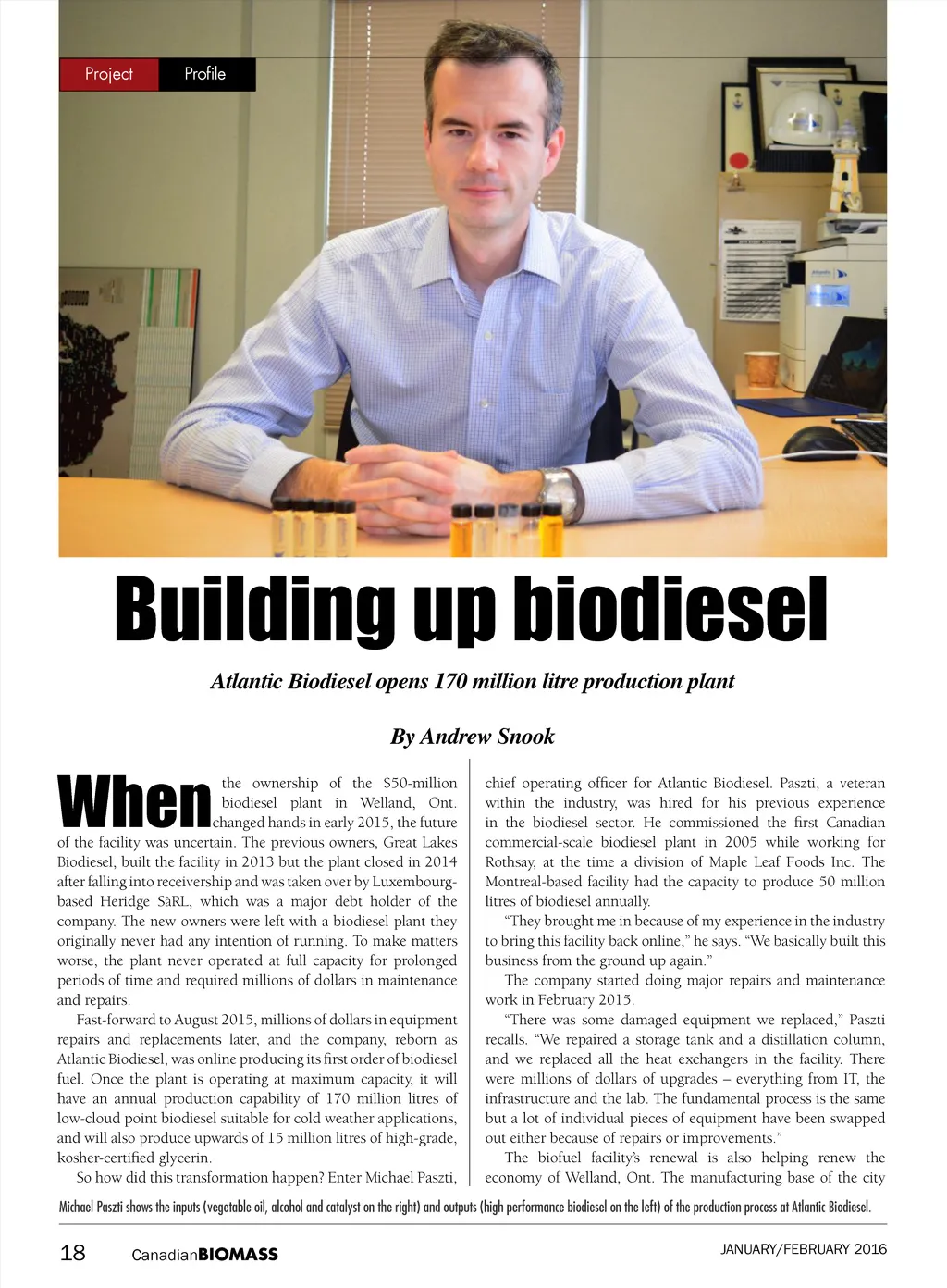
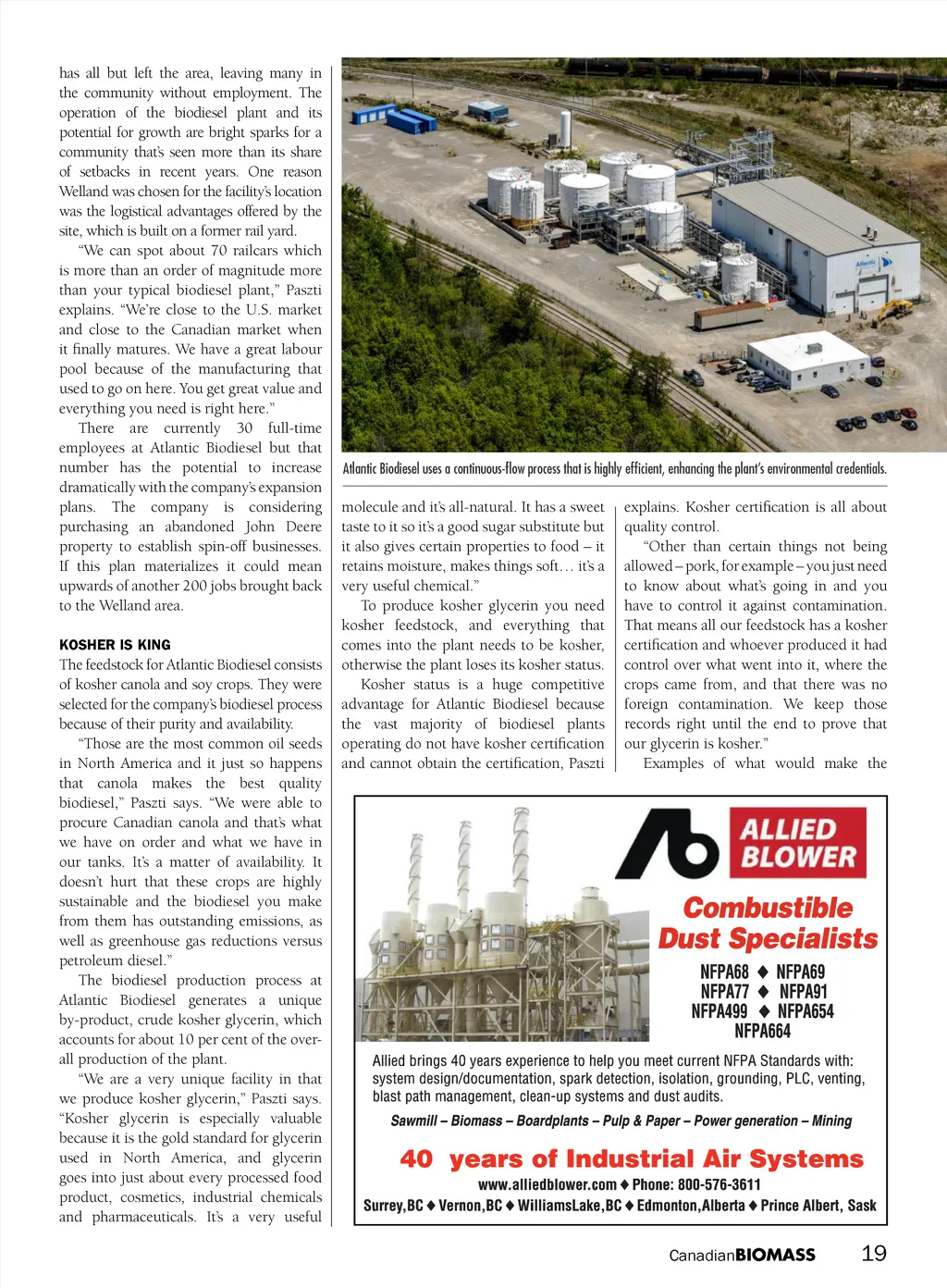
Project Profile Building up biodiesel Atlantic Biodiesel opens 170 million litre production plant By Andrew Snook the ownership of the $50-million biodiesel plant in Welland, Ont. changed hands in early 2015, the future of the facility was uncertain. The previous owners, Great Lakes Biodiesel, built the facility in 2013 but the plant closed in 2014 after falling into receivership and was taken over by Luxembourg-based Heridge SàRL, which was a major debt holder of the company. The new owners were left with a biodiesel plant they originally never had any intention of running. To make matters worse, the plant never operated at full capacity for prolonged periods of time and required millions of dollars in maintenance and repairs. Fast-forward to August 2015, millions of dollars in equipment repairs and replacements later, and the company, reborn as Atlantic Biodiesel, was online producing its first order of biodiesel fuel. Once the plant is operating at maximum capacity, it will have an annual production capability of 170 million litres of low-cloud point biodiesel suitable for cold weather applications, and will also produce upwards of 15 million litres of high-grade, kosher-certified glycerin. So how did this transformation happen? Enter Michael Paszti, When chief operating officer for Atlantic Biodiesel. Paszti, a veteran within the industry, was hired for his previous experience in the biodiesel sector. He commissioned the first Canadian commercial-scale biodiesel plant in 2005 while working for Rothsay, at the time a division of Maple Leaf Foods Inc. The Montreal-based facility had the capacity to produce 50 million litres of biodiesel annually. “They brought me in because of my experience in the industry to bring this facility back online,” he says. “We basically built this business from the ground up again.” The company started doing major repairs and maintenance work in February 2015. “There was some damaged equipment we replaced,” Paszti recalls. “We repaired a storage tank and a distillation column, and we replaced all the heat exchangers in the facility. There were millions of dollars of upgrades – everything from IT, the infrastructure and the lab. The fundamental process is the same but a lot of individual pieces of equipment have been swapped out either because of repairs or improvements.” The biofuel facility’s renewal is also helping renew the economy of Welland, Ont. The manufacturing base of the city Michael Paszti shows the inputs (vegetable oil, alcohol and catalyst on the right) and outputs (high performance biodiesel on the left) of the production process at Atlantic Biodiesel. 18 Canadian BIOMASS JANUARY/FEBRUARY 2016
Canadian Biomass January February 2016: Page 18