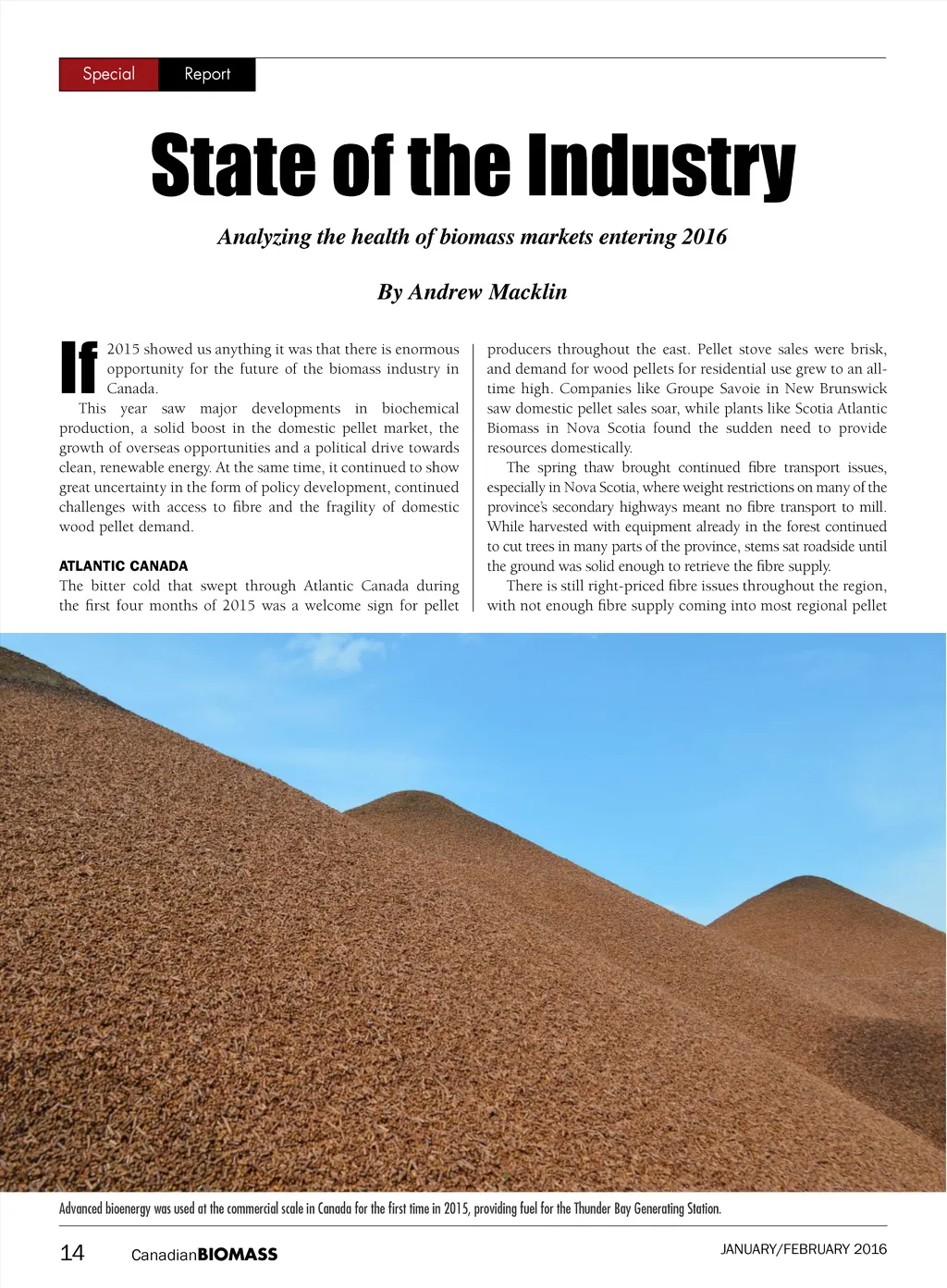
TOP STORIES OF 2015 Here are the most-read online industry stories of 2015 at canadianbiomassmagazine.ca. Most read news story Wood pellets in demand (2015 Industry Report) Most read wood pellets story Whitesand Waiting Most read biofuel story Enerkem begins commercial production at Edmonton plant Most read bioenergy story Conifex completes 72 hour run test Most read R&D story Carlsberg developing wood based beer bottle mills to allow them to run at full capacity. Despite this, there was solid growth, especially in New Brunswick and PEI, of small-scale bioenergy projects. Driven by government support, PEI has already announced seven additional installations coming online in early 2016. Rumours of renewed efforts to establish pellet operations continued to surface in Newfoundland, even though there has been little progress on plant development since Rentech won harvesting rights of the 280,000 cubic metre supply formerly used to supply the Abitibi-Bowater mill in Grand Falls-Windsor in April of 2014. As the year wrapped up, a warm start to winter put a severe damper on the domestic pellet demand that boosted the region to start the year. QUEBEC This past year started well and ended poorly for the majority of pellet producers in Quebec. A banner year for domestic pellet demand started 2015, as a cold winter led to strong sales for wood pellets in Quebec. As a result of the winter weather, and in anticipation of another cold winter to start 2016, many pellet producers found themselves running their production close to capacity for the year. Two plants, Granules LG in St-Félicien and Energex in Lac-Mégantic, made significant upgrades to their operations in order to keep production running around the clock. For two plants, 2015 was a year to forget. A fire at Granule Boreal in Amos in April destroyed the company’s 50,000 tonne/ year plant, and the owners of the plant chose not to rebuild the operation. For Trebio in Portage-du-Fort, continuing fibre supply issues are causing the plant’s production to decrease substantially, with current production running at around 25 per cent of its original capacity. The fibre shortfall has come largely as a result of not enough accessible fibre in the Pontiac region, as well as competition from the restarting of Pembroke MDF . The use of bioenergy continues to grow in the province, with many communities exploring new options for its integration. Near the end of 2014, Quebec had over 30 projects in the planning stages and several have broken ground and are progressing. With the uncertain future of Trebio, and the warm start to winter, the pellet market in Quebec sits in a precarious position in 2016. ONTARIO In southern Ontario, BioAmber made its biochemical breakthrough with the opening of its bio-succinic acid plant in Sarnia. Despite plummeting oil prices, the plant is providing a cost-competitive alternative to petroleum-based succinic acid, but without harmful emissions. It is the first commercial-scale plant of its kind in the world and provides a model for other biochemical producers to follow in 2016 and beyond. One of North America’s largest biodiesel plants now resides in southern Ontario, as Atlantic Biodiesel officially started production in Welland (see page 18 for our feature story). The plant, which did its first official pour in October, is expected to produce upwards of 170 million litres of biodiesel per year, as well as 15 million litres of high-grade glycerol, for consumption in the Canadian and U.S. markets. In the northern part of the province, the highly-anticipated renovation of Ontario Power Generation’s Thunder Bay Generating Station marked the first facility in the world to burn advanced biomass. The renovation from coal to biomass burning cost just five million dollars to complete. While there is no current fuel provider in North America, there is already talk that the provincial government could be looking to financially support a domestic producer for the fuel. Also in the north, Rentech looks to be back on track after a series of equipment struggles at its Wawa pellet plant. The Atikokan plant is already producing pellets for its contract with OPG, while the first major shipment from the Wawa plant took place at the end of the year. THE PRAIRIES Weather was also at play in the prairie provinces, especially Saskatchewan, where dry weather cut canola output. The estimated cutback was about 15 per cent versus output from 2014. Also hurting ethanol production in the region was the official phase out of the Saskatchewan Ethanol Fuel Program. The Program, which began in 2002, originally provided a 15 cent/ litre incentive for blending Saskatchewan-produced ethanol with petroleum fuel resources. As of April 1st, that incentive was removed as a result of the program review completed in 2013. Manitoba remained quiet on the biomass/bioenergy front in 2015. The province continues work with small-scale operations for conversion to bioenergy, including agricultural operations. Manitoba is the only province in 2016 with an election, so it will be interesting to see how much work is done to bring bio-initiatives to the forefront during the campaign. ALBERTA Without question, it was a big year for Ontario in the biomass, biofuel and bioenergy industries, with three highly anticipated projects completing construction and one other nearing the finish line. The official startup of Enerkem’s waste-to-ethanol facility was one Canadian BIOMASS 15
Canadian Biomass January February 2016: Page 15