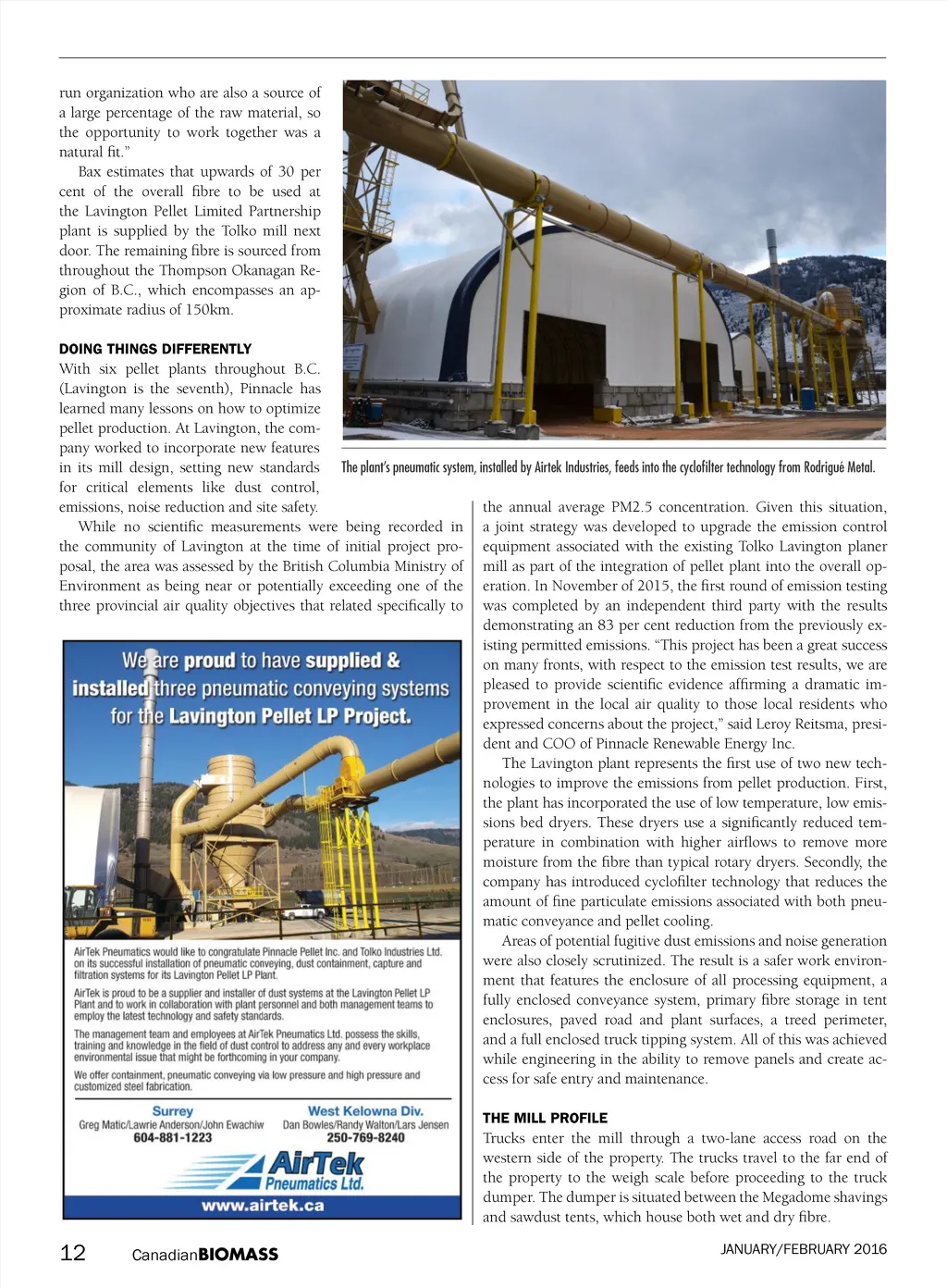
run organization who are also a source of a large percentage of the raw material, so the opportunity to work together was a natural fit.” Bax estimates that upwards of 30 per cent of the overall fibre to be used at the Lavington Pellet Limited Partnership plant is supplied by the Tolko mill next door. The remaining fibre is sourced from throughout the Thompson Okanagan Re-gion of B.C., which encompasses an ap-proximate radius of 150km. DOING THINGS DIFFERENTLY With six pellet plants throughout B.C. (Lavington is the seventh), Pinnacle has learned many lessons on how to optimize pellet production. At Lavington, the com-pany worked to incorporate new features in its mill design, setting new standards The plant’s pneumatic system, installed by Airtek Industries, feeds into the cyclofilter technology from Rodrigué Metal. for critical elements like dust control, the annual average PM2.5 concentration. Given this situation, emissions, noise reduction and site safety. While no scientific measurements were being recorded in a joint strategy was developed to upgrade the emission control the community of Lavington at the time of initial project pro-equipment associated with the existing Tolko Lavington planer posal, the area was assessed by the British Columbia Ministry of mill as part of the integration of pellet plant into the overall op-Environment as being near or potentially exceeding one of the eration. In November of 2015, the first round of emission testing three provincial air quality objectives that related specifically to was completed by an independent third party with the results demonstrating an 83 per cent reduction from the previously ex-isting permitted emissions. “This project has been a great success on many fronts, with respect to the emission test results, we are pleased to provide scientific evidence affirming a dramatic im-provement in the local air quality to those local residents who expressed concerns about the project,” said Leroy Reitsma, presi-dent and COO of Pinnacle Renewable Energy Inc. The Lavington plant represents the first use of two new tech-nologies to improve the emissions from pellet production. First, the plant has incorporated the use of low temperature, low emis-sions bed dryers. These dryers use a significantly reduced tem-perature in combination with higher airflows to remove more moisture from the fibre than typical rotary dryers. Secondly, the company has introduced cyclofilter technology that reduces the amount of fine particulate emissions associated with both pneu-matic conveyance and pellet cooling. Areas of potential fugitive dust emissions and noise generation were also closely scrutinized. The result is a safer work environ-ment that features the enclosure of all processing equipment, a fully enclosed conveyance system, primary fibre storage in tent enclosures, paved road and plant surfaces, a treed perimeter, and a full enclosed truck tipping system. All of this was achieved while engineering in the ability to remove panels and create ac-cess for safe entry and maintenance. THE MILL PROFILE Trucks enter the mill through a two-lane access road on the western side of the property. The trucks travel to the far end of the property to the weigh scale before proceeding to the truck dumper. The dumper is situated between the Megadome shavings and sawdust tents, which house both wet and dry fibre. 12 Canadian BIOMASS JANUARY/FEBRUARY 2016
Canadian Biomass January February 2016: Page 12