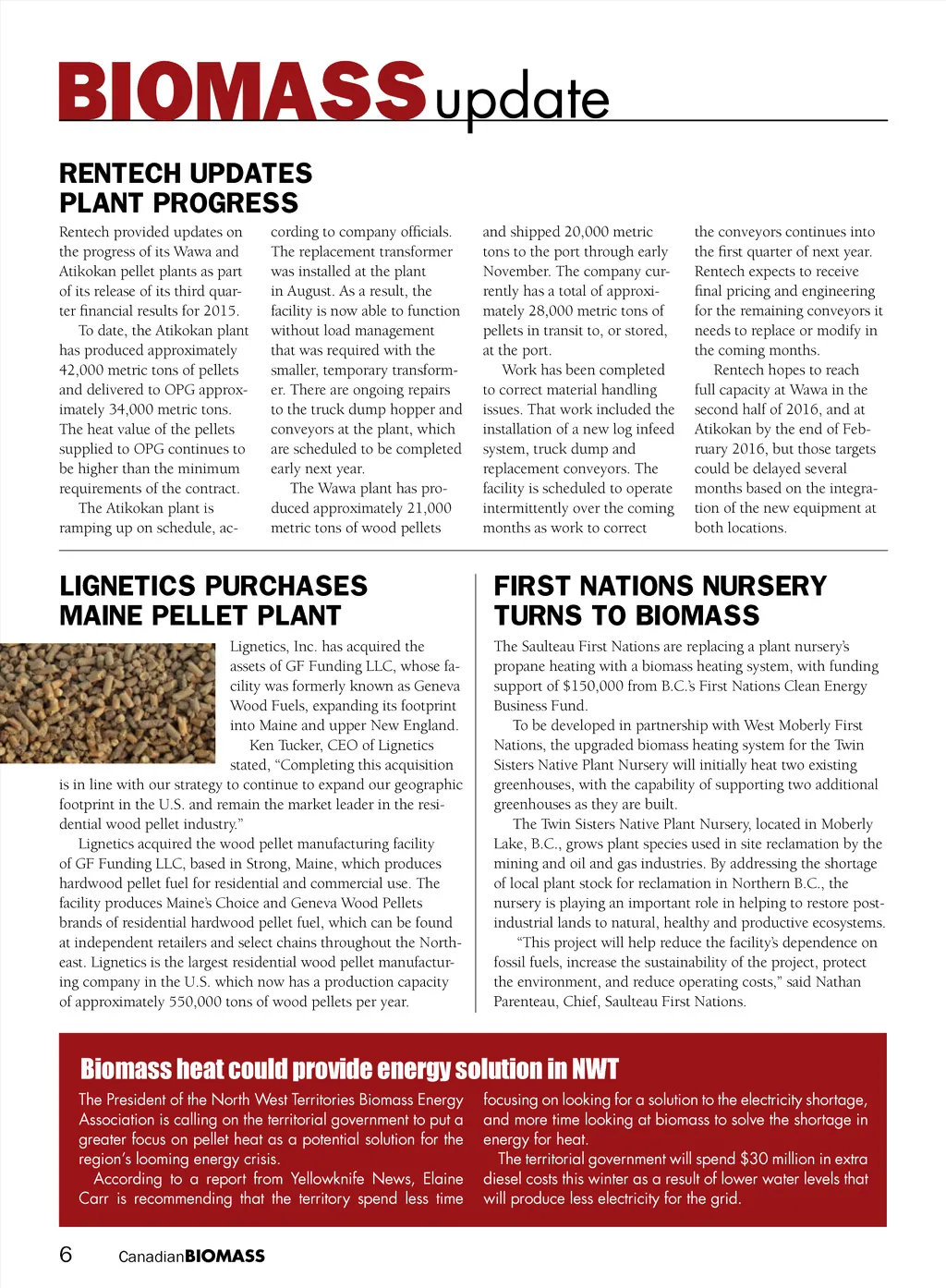
BIOMASS update RENTECH UPDATES PLANT PROGRESS Rentech provided updates on the progress of its Wawa and Atikokan pellet plants as part of its release of its third quar-ter financial results for 2015. To date, the Atikokan plant has produced approximately 42,000 metric tons of pellets and delivered to OPG approx-imately 34,000 metric tons. The heat value of the pellets supplied to OPG continues to be higher than the minimum requirements of the contract. The Atikokan plant is ramping up on schedule, ac-cording to company officials. The replacement transformer was installed at the plant in August. As a result, the facility is now able to function without load management that was required with the smaller, temporary transform-er. There are ongoing repairs to the truck dump hopper and conveyors at the plant, which are scheduled to be completed early next year. The Wawa plant has pro-duced approximately 21,000 metric tons of wood pellets and shipped 20,000 metric tons to the port through early November. The company cur-rently has a total of approxi-mately 28,000 metric tons of pellets in transit to, or stored, at the port. Work has been completed to correct material handling issues. That work included the installation of a new log infeed system, truck dump and replacement conveyors. The facility is scheduled to operate intermittently over the coming months as work to correct the conveyors continues into the first quarter of next year. Rentech expects to receive final pricing and engineering for the remaining conveyors it needs to replace or modify in the coming months. Rentech hopes to reach full capacity at Wawa in the second half of 2016, and at Atikokan by the end of Feb-ruary 2016, but those targets could be delayed several months based on the integra-tion of the new equipment at both locations. LIGNETICS PURCHASES MAINE PELLET PLANT Lignetics, Inc. has acquired the assets of GF Funding LLC, whose fa-cility was formerly known as Geneva Wood Fuels, expanding its footprint into Maine and upper New England. Ken Tucker, CEO of Lignetics stated, “Completing this acquisition is in line with our strategy to continue to expand our geographic footprint in the U.S. and remain the market leader in the resi-dential wood pellet industry.” Lignetics acquired the wood pellet manufacturing facility of GF Funding LLC, based in Strong, Maine, which produces hardwood pellet fuel for residential and commercial use. The facility produces Maine’s Choice and Geneva Wood Pellets brands of residential hardwood pellet fuel, which can be found at independent retailers and select chains throughout the North-east. Lignetics is the largest residential wood pellet manufactur-ing company in the U.S. which now has a production capacity of approximately 550,000 tons of wood pellets per year. FIRST NATIONS NURSERY TURNS TO BIOMASS The Saulteau First Nations are replacing a plant nursery’s propane heating with a biomass heating system, with funding support of $150,000 from B.C.’s First Nations Clean Energy Business Fund. To be developed in partnership with West Moberly First Nations, the upgraded biomass heating system for the Twin Sisters Native Plant Nursery will initially heat two existing greenhouses, with the capability of supporting two additional greenhouses as they are built. The Twin Sisters Native Plant Nursery, located in Moberly Lake, B.C., grows plant species used in site reclamation by the mining and oil and gas industries. By addressing the shortage of local plant stock for reclamation in Northern B.C., the nursery is playing an important role in helping to restore post-industrial lands to natural, healthy and productive ecosystems. “This project will help reduce the facility’s dependence on fossil fuels, increase the sustainability of the project, protect the environment, and reduce operating costs,” said Nathan Parenteau, Chief, Saulteau First Nations. Biomass heat could provide energy solution in NWT The President of the North West Territories Biomass Energy Association is calling on the territorial government to put a greater focus on pellet heat as a potential solution for the region’s looming energy crisis. According to a report from Yellowknife News, Elaine Carr is recommending that the territory spend less time focusing on looking for a solution to the electricity shortage, and more time looking at biomass to solve the shortage in energy for heat. The territorial government will spend $30 million in extra diesel costs this winter as a result of lower water levels that will produce less electricity for the grid. 6 Canadian BIOMASS
Canadian Biomass November/December 2015: Page 6