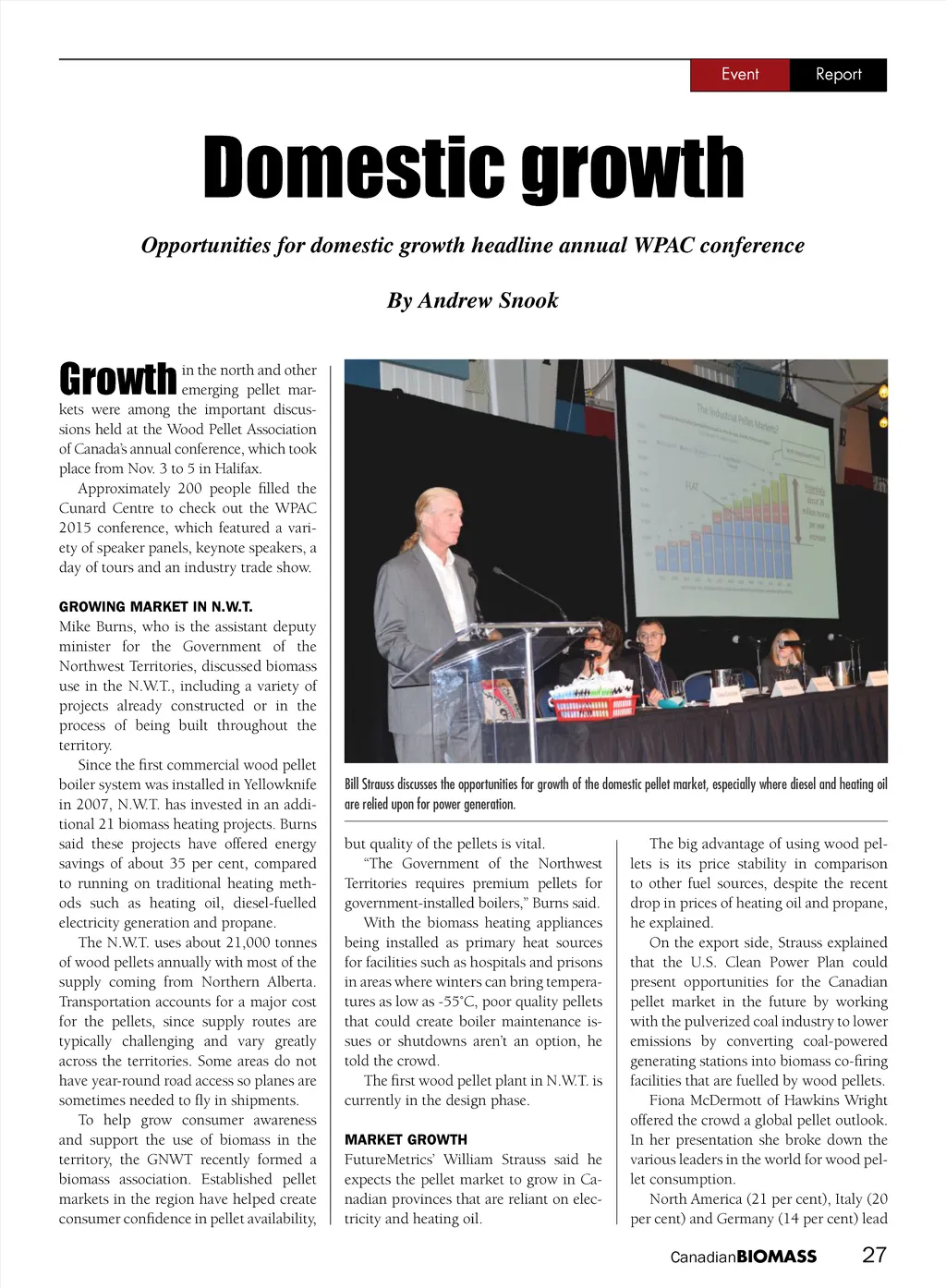
Event Report Domestic growth Opportunities for domestic growth headline annual WPAC conference By Andrew Snook Growth in the north and other emerging pellet mar-kets were among the important discus-sions held at the Wood Pellet Association of Canada’s annual conference, which took place from Nov. 3 to 5 in Halifax. Approximately 200 people filled the Cunard Centre to check out the WPAC 2015 conference, which featured a vari-ety of speaker panels, keynote speakers, a day of tours and an industry trade show. GROWING MARKET IN N.W.T. Mike Burns, who is the assistant deputy minister for the Government of the Northwest Territories, discussed biomass use in the N.W.T., including a variety of projects already constructed or in the process of being built throughout the territory. Since the first commercial wood pellet boiler system was installed in Yellowknife in 2007, N.W.T. has invested in an addi-tional 21 biomass heating projects. Burns said these projects have offered energy savings of about 35 per cent, compared to running on traditional heating meth-ods such as heating oil, diesel-fuelled electricity generation and propane. The N.W.T. uses about 21,000 tonnes of wood pellets annually with most of the supply coming from Northern Alberta. Transportation accounts for a major cost for the pellets, since supply routes are typically challenging and vary greatly across the territories. Some areas do not have year-round road access so planes are sometimes needed to fly in shipments. To help grow consumer awareness and support the use of biomass in the territory, the GNWT recently formed a biomass association. Established pellet markets in the region have helped create consumer confidence in pellet availability, Bill Strauss discusses the opportunities for growth of the domestic pellet market, especially where diesel and heating oil are relied upon for power generation. but quality of the pellets is vital. “The Government of the Northwest Territories requires premium pellets for government-installed boilers,” Burns said. With the biomass heating appliances being installed as primary heat sources for facilities such as hospitals and prisons in areas where winters can bring tempera-tures as low as -55˚C, poor quality pellets that could create boiler maintenance is-sues or shutdowns aren’t an option, he told the crowd. The first wood pellet plant in N.W.T. is currently in the design phase. MARKET GROWTH FutureMetrics’ William Strauss said he expects the pellet market to grow in Ca-nadian provinces that are reliant on elec-tricity and heating oil. The big advantage of using wood pel-lets is its price stability in comparison to other fuel sources, despite the recent drop in prices of heating oil and propane, he explained. On the export side, Strauss explained that the U.S. Clean Power Plan could present opportunities for the Canadian pellet market in the future by working with the pulverized coal industry to lower emissions by converting coal-powered generating stations into biomass co-firing facilities that are fuelled by wood pellets. Fiona McDermott of Hawkins Wright offered the crowd a global pellet outlook. In her presentation she broke down the various leaders in the world for wood pel-let consumption. North America (21 per cent), Italy (20 per cent) and Germany (14 per cent) lead Canadian BIOMASS 27
Canadian Biomass November/December 2015: Page 27