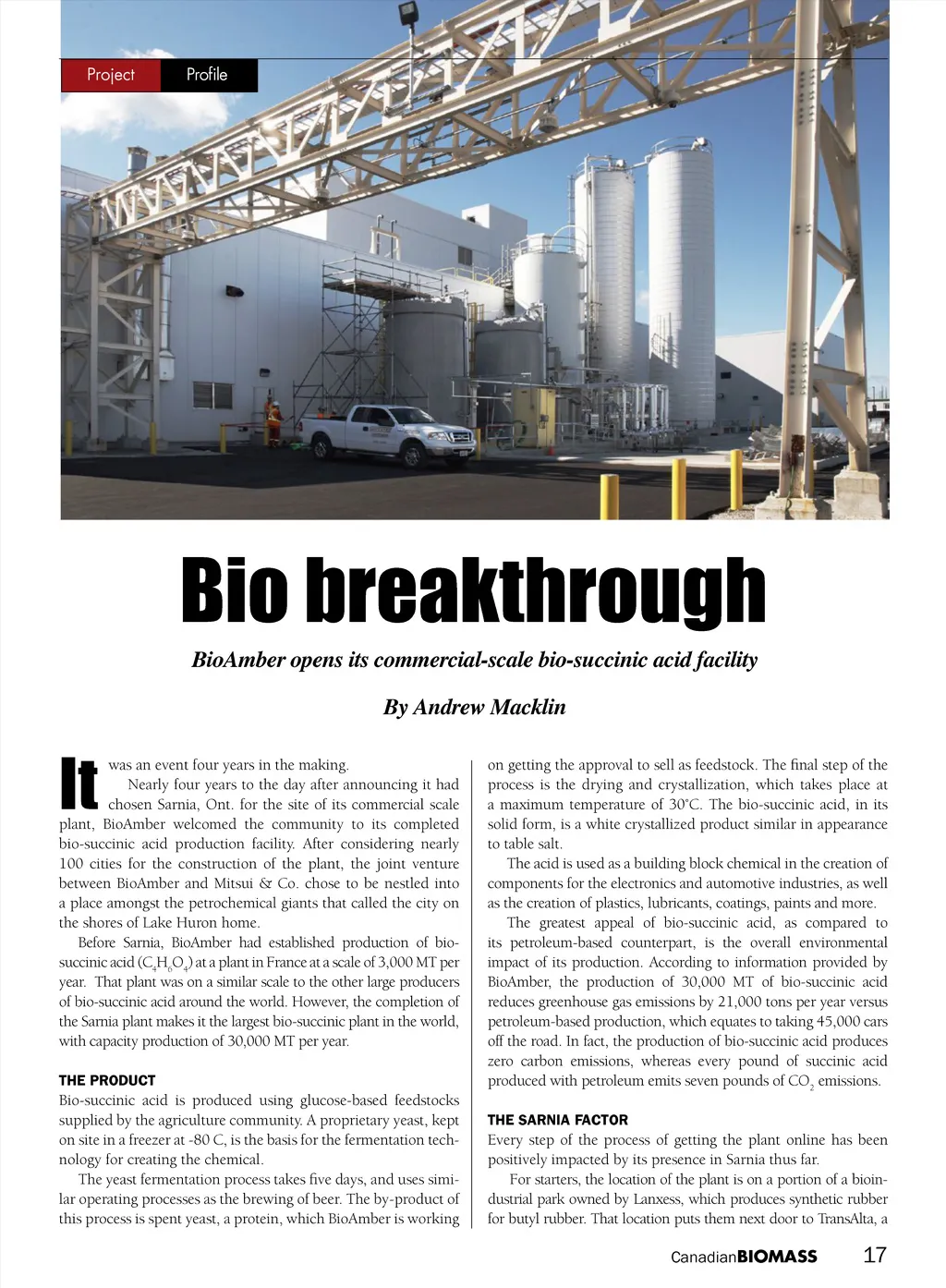
Project Profile Bio breakthrough BioAmber opens its commercial-scale bio-succinic acid facility By Andrew Macklin It was an event four years in the making. Nearly four years to the day after announcing it had chosen Sarnia, Ont. for the site of its commercial scale plant, BioAmber welcomed the community to its completed bio-succinic acid production facility. After considering nearly 100 cities for the construction of the plant, the joint venture between BioAmber and Mitsui & Co. chose to be nestled into a place amongst the petrochemical giants that called the city on the shores of Lake Huron home. Before Sarnia, BioAmber had established production of bio-succinic acid (C 4 H 6 O 4 ) at a plant in France at a scale of 3,000 MT per year. That plant was on a similar scale to the other large producers of bio-succinic acid around the world. However, the completion of the Sarnia plant makes it the largest bio-succinic plant in the world, with capacity production of 30,000 MT per year. THE PRODUCT Bio-succinic acid is produced using glucose-based feedstocks supplied by the agriculture community. A proprietary yeast, kept on site in a freezer at -80 C, is the basis for the fermentation tech-nology for creating the chemical. The yeast fermentation process takes five days, and uses simi-lar operating processes as the brewing of beer. The by-product of this process is spent yeast, a protein, which BioAmber is working on getting the approval to sell as feedstock. The final step of the process is the drying and crystallization, which takes place at a maximum temperature of 30˚C. The bio-succinic acid, in its solid form, is a white crystallized product similar in appearance to table salt. The acid is used as a building block chemical in the creation of components for the electronics and automotive industries, as well as the creation of plastics, lubricants, coatings, paints and more. The greatest appeal of bio-succinic acid, as compared to its petroleum-based counterpart, is the overall environmental impact of its production. According to information provided by BioAmber, the production of 30,000 MT of bio-succinic acid reduces greenhouse gas emissions by 21,000 tons per year versus petroleum-based production, which equates to taking 45,000 cars off the road. In fact, the production of bio-succinic acid produces zero carbon emissions, whereas every pound of succinic acid produced with petroleum emits seven pounds of CO 2 emissions. THE SARNIA FACTOR Every step of the process of getting the plant online has been positively impacted by its presence in Sarnia thus far. For starters, the location of the plant is on a portion of a bioin-dustrial park owned by Lanxess, which produces synthetic rubber for butyl rubber. That location puts them next door to TransAlta, a Canadian BIOMASS 17
Canadian Biomass November/December 2015: Page 17