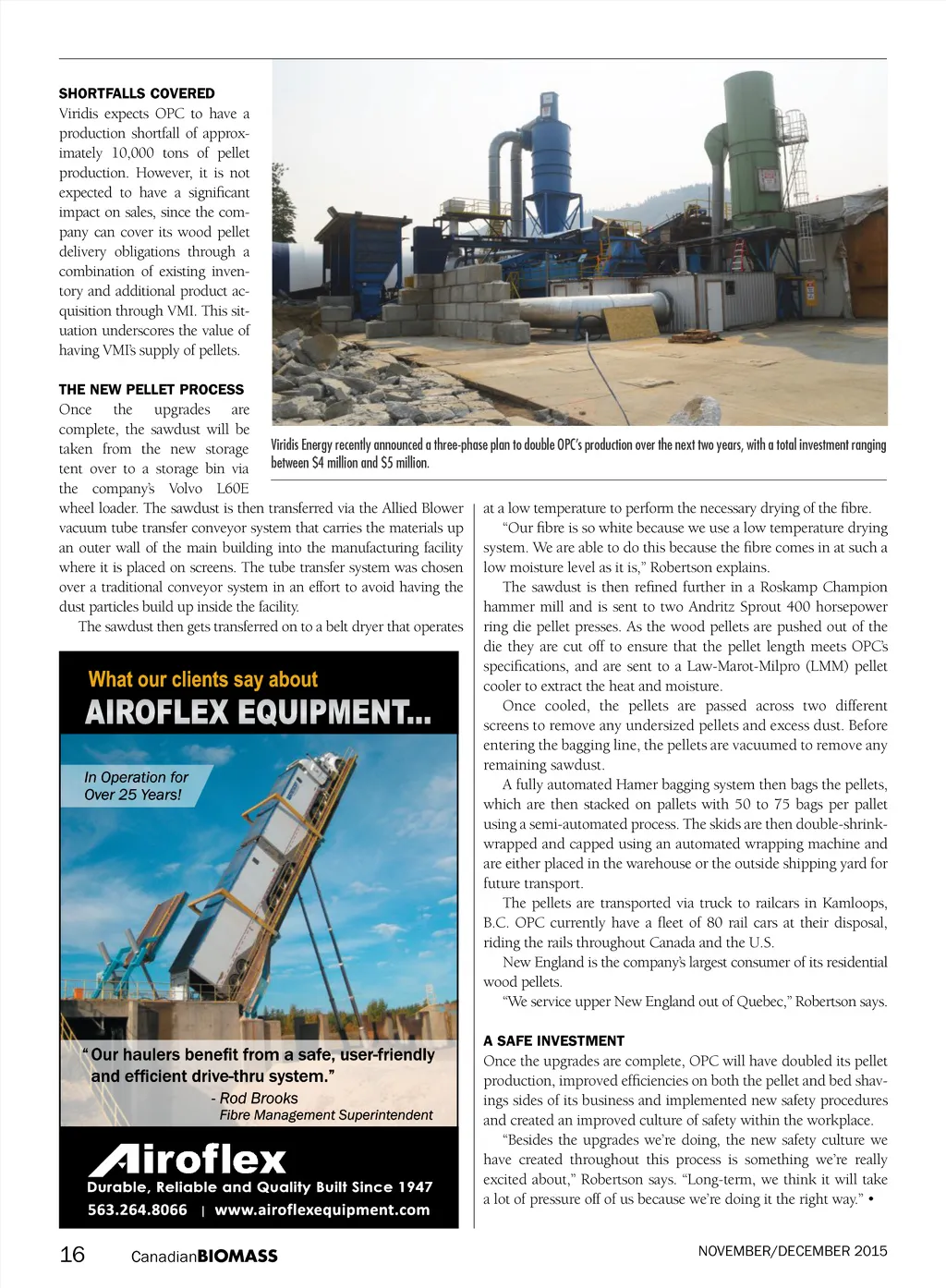
SHORTFALLS COVERED Viridis expects OPC to have a production shortfall of approx-imately 10,000 tons of pellet production. However, it is not expected to have a significant impact on sales, since the com-pany can cover its wood pellet delivery obligations through a combination of existing inven-tory and additional product ac-quisition through VMI. This sit-uation underscores the value of having VMI’s supply of pellets. THE NEW PELLET PROCESS Once the upgrades are complete, the sawdust will be taken from the new storage Viridis Energy recently announced a three-phase plan to double OPC’s production over the next two years, with a total investment ranging tent over to a storage bin via between $4 million and $5 million. the company’s Volvo L60E wheel loader. The sawdust is then transferred via the Allied Blower at a low temperature to perform the necessary drying of the fibre. “Our fibre is so white because we use a low temperature drying vacuum tube transfer conveyor system that carries the materials up an outer wall of the main building into the manufacturing facility system. We are able to do this because the fibre comes in at such a where it is placed on screens. The tube transfer system was chosen low moisture level as it is,” Robertson explains. The sawdust is then refined further in a Roskamp Champion over a traditional conveyor system in an effort to avoid having the hammer mill and is sent to two Andritz Sprout 400 horsepower dust particles build up inside the facility. The sawdust then gets transferred on to a belt dryer that operates ring die pellet presses. As the wood pellets are pushed out of the die they are cut off to ensure that the pellet length meets OPC’s specifications, and are sent to a Law-Marot-Milpro (LMM) pellet cooler to extract the heat and moisture. Once cooled, the pellets are passed across two different screens to remove any undersized pellets and excess dust. Before entering the bagging line, the pellets are vacuumed to remove any remaining sawdust. A fully automated Hamer bagging system then bags the pellets, which are then stacked on pallets with 50 to 75 bags per pallet using a semi-automated process. The skids are then double-shrink-wrapped and capped using an automated wrapping machine and are either placed in the warehouse or the outside shipping yard for future transport. The pellets are transported via truck to railcars in Kamloops, B.C. OPC currently have a fleet of 80 rail cars at their disposal, riding the rails throughout Canada and the U.S. New England is the company’s largest consumer of its residential wood pellets. “We service upper New England out of Quebec,” Robertson says. A SAFE INVESTMENT Once the upgrades are complete, OPC will have doubled its pellet production, improved efficiencies on both the pellet and bed shav-ings sides of its business and implemented new safety procedures and created an improved culture of safety within the workplace. “Besides the upgrades we’re doing, the new safety culture we have created throughout this process is something we’re really excited about,” Robertson says. “Long-term, we think it will take a lot of pressure off of us because we’re doing it the right way.” • 16 Canadian BIOMASS NOVEMBER/DECEMBER 2015
Canadian Biomass November/December 2015: Page 16