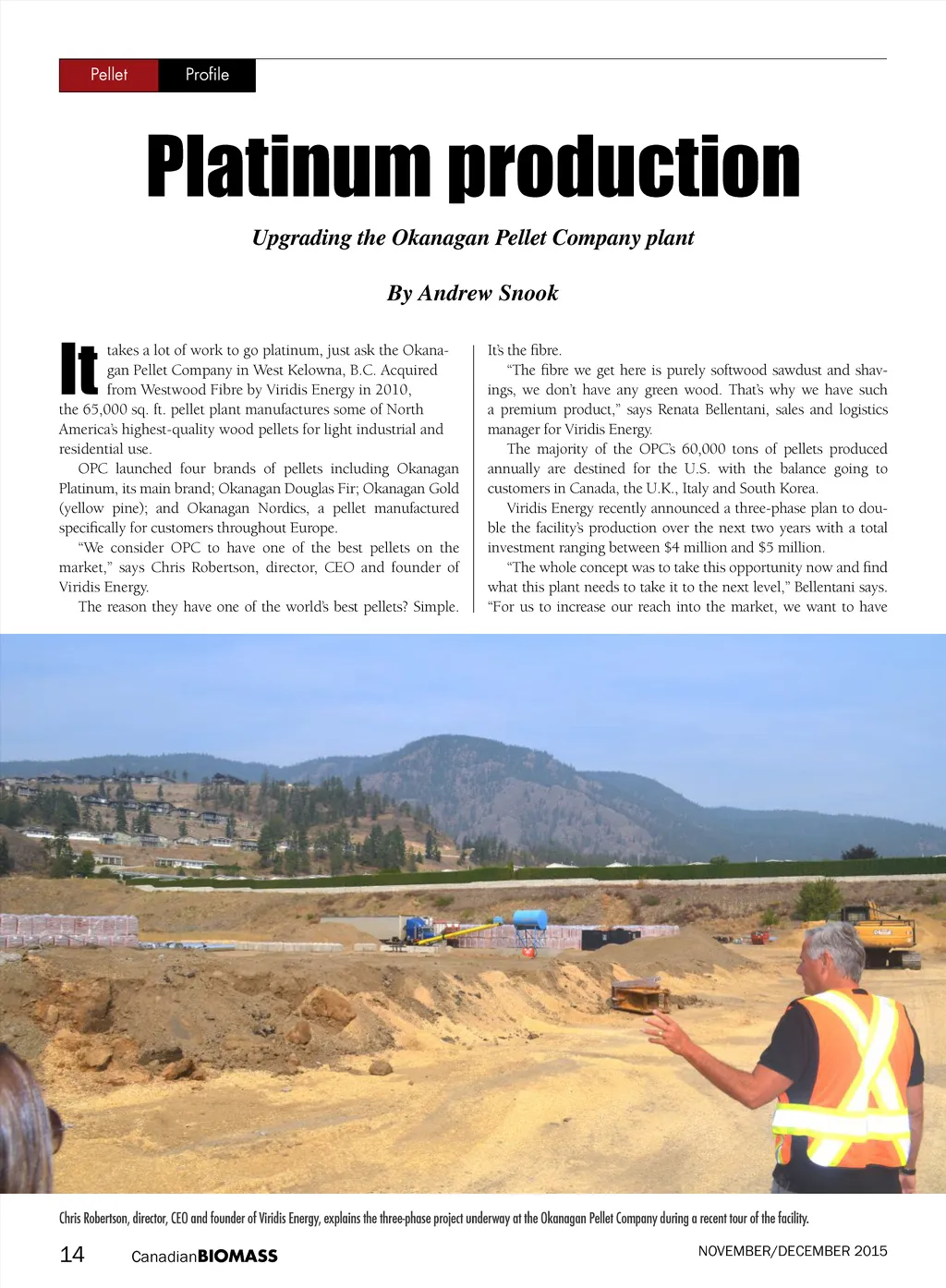
more of our own product. And we have access to the fibre so it’s a no-brainer for us.” The company has secured long-term deals with suppliers of fibre and high-quality wood pellets to ensure OPC’s customers never experience a shortage, through its subsidiary Viridis Merchants (VMI). VMI serves as an aggregation and trading service of wood pel-lets and other alternative energy sources. It also offers smaller pro-ducers services such as logistics management through its fleet of leased rail cars. PHASE 1 The first phase of the upgrades is the separation of the facility’s two production lines, which were running simultaneously – the wood pellet press and a manufacturing line that converts shavings into high-end horse bedding. This phase is now complete and came in under the budgeted $1 million. “This plant is sort of unique in that it has two lines: a horse bed-ding line on one side and the pellet side on the other, two entirely separate businesses,” Robertson explains. “What we did was break those two manufacturing sides apart. The reason we did that was so if either line breaks down, we’ve still got the other line up and running.” The OPC plant upgrades are also designed to address new reg-ulatory requirements for safe storage and management of wood pellets and to ensure the plant complies with the National Fire Protection Association and B.C. Fire Safety codes. One of the upgrades installed in late September to help OPC meet these requirements was a 12,000-sq.-ft. tent built for outdoor fibre storage, which was part of the company’s efforts to decommis-sion a barn that was previously being used to store the fibre. “Everything will be stored in a separate building now,” Robertson says. “One of our problems we had here was having a raw product room right beside our manufacturing building.” The tent for housing the sawmill residuals was designed by Spanmaster Structures. It is constructed out of galvanized steel and a fire-resistant fabric. The tent has the capacity to house between 300 and 400 metric tonnes of dry fibre, which is approximately five days worth of production. During the separation of the lines, the company also installed a new dust containment system designed and built by Allied Blower. “Safety has become a clear focus in this industry,” Robertson says. In addition to the new dust system, OPC has hired a safety com-pany called Free Spirit Ventures, who developed OPC’s new safety manuals and procedures and trained all of the company’s staff. The training is part of a safety initiative Viridis Energy started up called “Empower.” “It’s all about safety and procedures,” Robertson says. “While we’re doing the retrofit, we’re taking the time to train our staff on the importance of safety in this business because we are manufac-turing fuel. We want to become the leaders in this industry. We want to create a roadmap for safety.” With the upgrades taking place, the timing couldn’t have been better for training staff. “You’ve got everyone’s attention,” Robertson says. PHASE 2 The second phase of the upgrades will involve the restructuring of the pellet side of the facility. During this phase, the tube system used to transfer the fibre into the manufacturing building will be moved into the new, semi-per-manent tent structure outside, and the current storage building will be decommissioned. The emphasis will be on ensuring the place-ment of equipment is modified for optimal efficiency and safety. The engineering company hired is Williams Engineering. The lead on the project will be George Hutchinson who is known in B.C. for his knowledge of combustible dust management and safety. This phase will cost approximately $1 million to complete. PHASE 3 The third and final phase of the project will involve the installation of the second press and a state-of-the-art dryer, which will cost approximately $3 million. This phase will begin in the latter half of 2016. This phase will increase the plant’s capacity by 50 per cent. Seeing iS Believing Our FOreSTS Are AlwAyS grOwing At Resolute, we not only respect Canada’s rigorous forestry policies, we go beyond them. As part of our firm commitment to sustainable forest management, every area we harvest is promptly regenerated. That’s why the Canadian boreal is among the most carefully managed forests on earth. We protect and preserve the natural resources in our care and fully support our other valuable resources — our employees and the communities where we live and work. To learn more, visit resolutefp.com/sustainability. Canadian BIOMASS 15
Canadian Biomass November/December 2015: Page 15