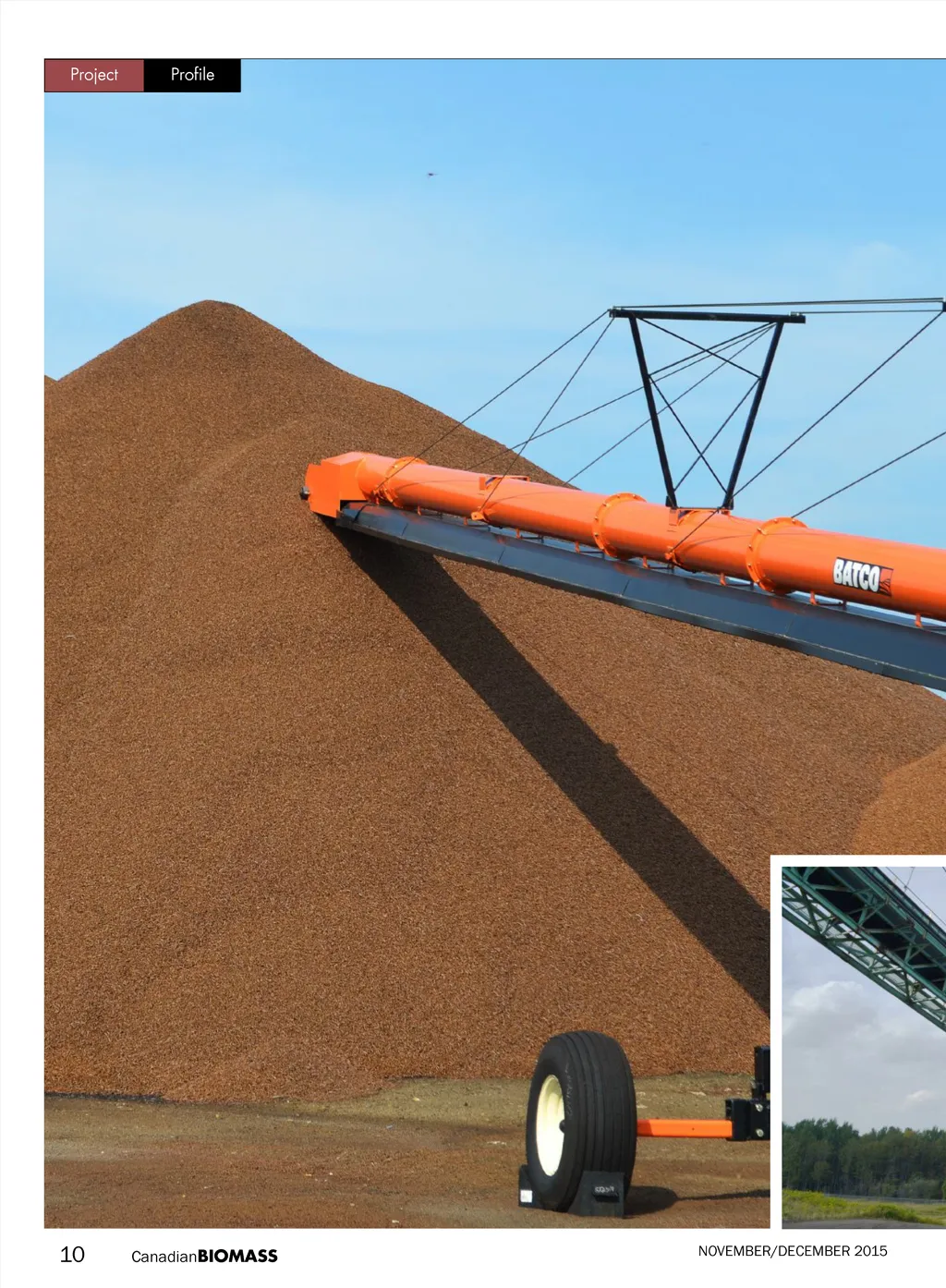
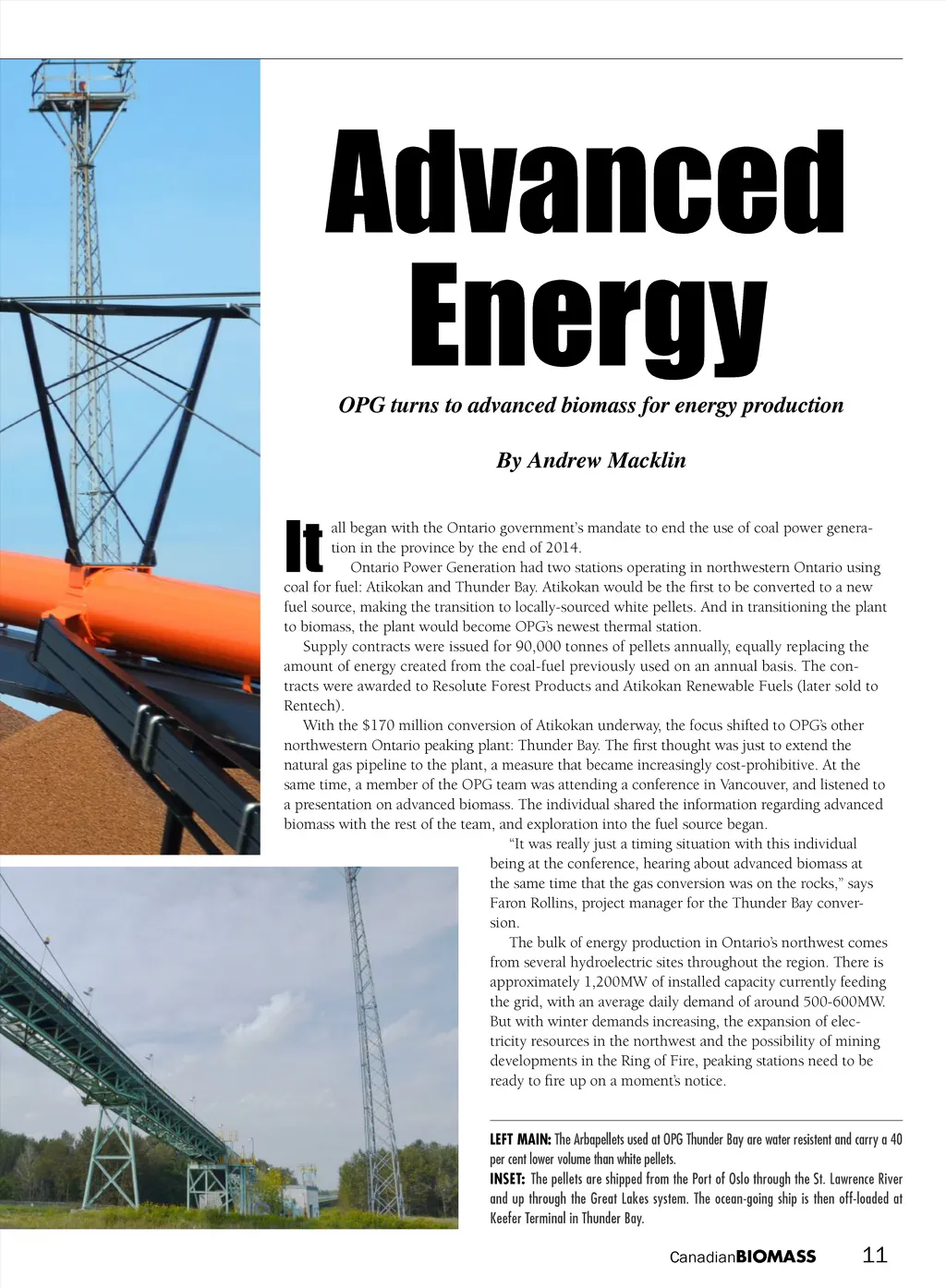
Advanced Energy OPG turns to advanced biomass for energy production By Andrew Macklin It all began with the Ontario government’s mandate to end the use of coal power genera-tion in the province by the end of 2014. Ontario Power Generation had two stations operating in northwestern Ontario using coal for fuel: Atikokan and Thunder Bay. Atikokan would be the first to be converted to a new fuel source, making the transition to locally-sourced white pellets. And in transitioning the plant to biomass, the plant would become OPG’s newest thermal station. Supply contracts were issued for 90,000 tonnes of pellets annually, equally replacing the amount of energy created from the coal-fuel previously used on an annual basis. The con-tracts were awarded to Resolute Forest Products and Atikokan Renewable Fuels (later sold to Rentech). With the $170 million conversion of Atikokan underway, the focus shifted to OPG’s other northwestern Ontario peaking plant: Thunder Bay. The first thought was just to extend the natural gas pipeline to the plant, a measure that became increasingly cost-prohibitive. At the same time, a member of the OPG team was attending a conference in Vancouver, and listened to a presentation on advanced biomass. The individual shared the information regarding advanced biomass with the rest of the team, and exploration into the fuel source began. “It was really just a timing situation with this individual being at the conference, hearing about advanced biomass at the same time that the gas conversion was on the rocks,” says Faron Rollins, project manager for the Thunder Bay conver-sion. The bulk of energy production in Ontario’s northwest comes from several hydroelectric sites throughout the region. There is approximately 1,200MW of installed capacity currently feeding the grid, with an average daily demand of around 500-600MW. But with winter demands increasing, the expansion of elec-tricity resources in the northwest and the possibility of mining developments in the Ring of Fire, peaking stations need to be ready to fire up on a moment’s notice. LEFT MAIN: The Arbapellets used at OPG Thunder Bay are water resistent and carry a 40 per cent lower volume than white pellets. INSET: The pellets are shipped from the Port of Oslo through the St. Lawrence River and up through the Great Lakes system. The ocean-going ship is then off-loaded at Keefer Terminal in Thunder Bay. Canadian BIOMASS 11
Canadian Biomass November/December 2015: Page 11