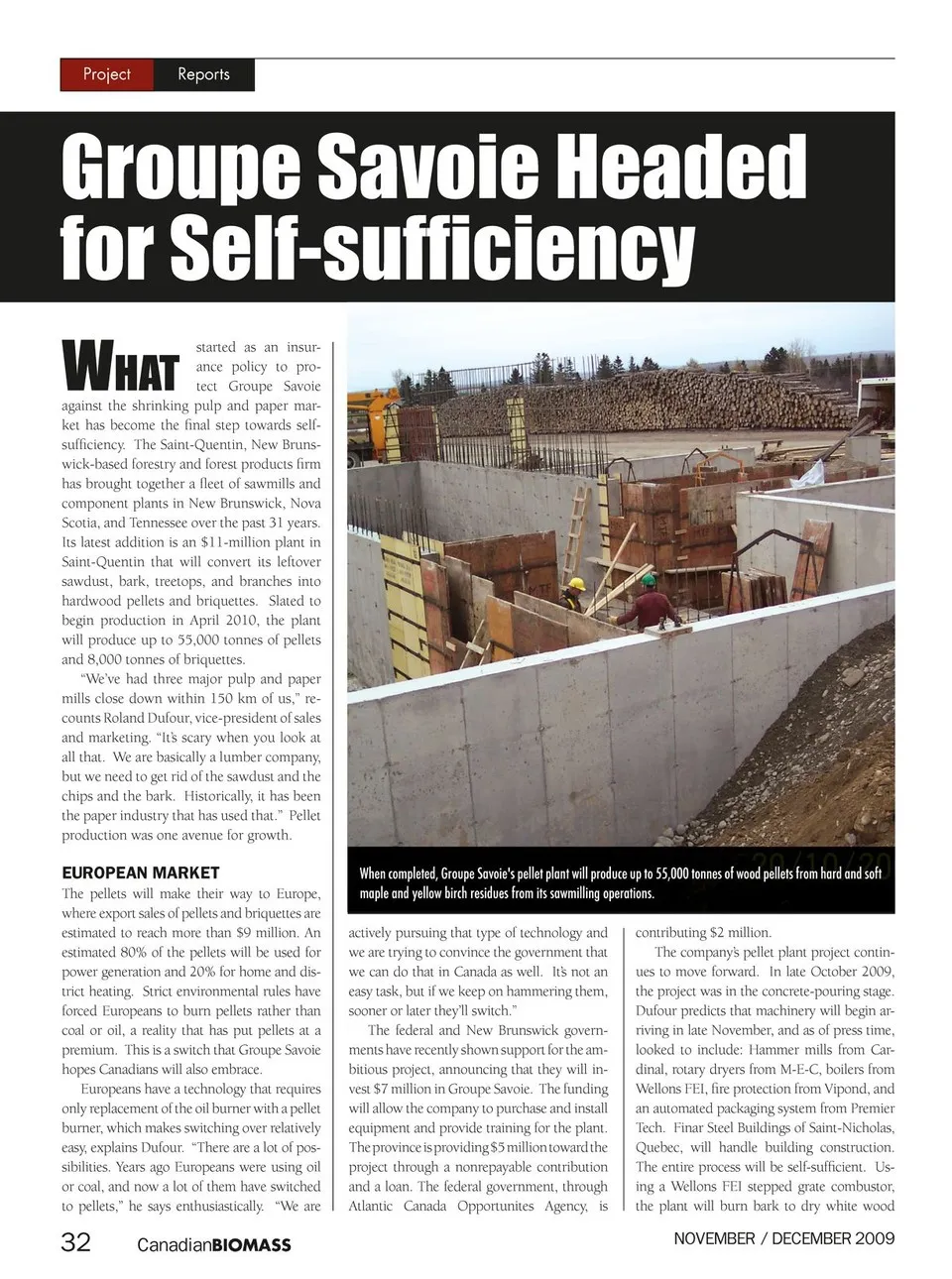
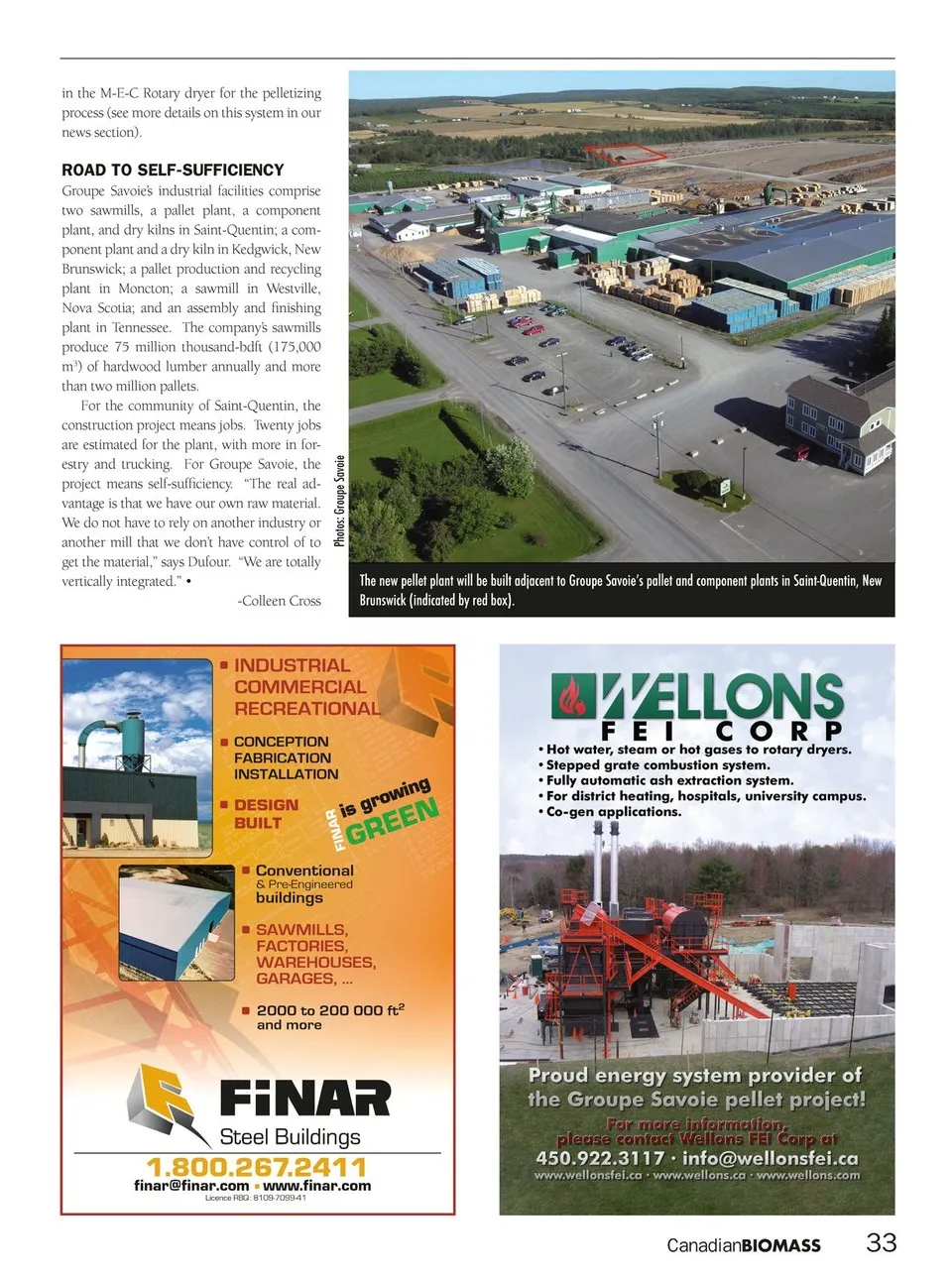
Project Reports Groupe Savoie Headed for Self-sufficiency against the shrinking pulp and paper mar- ket has become the final step towards self- sufficiency. The Saint-Quentin, New Bruns- wick-based forestry and forest products firm has brought together a fleet of sawmills and component plants in New Brunswick, Nova Scotia, and Tennessee over the past 31 years. Its latest addition is an $11-million plant in Saint-Quentin that will convert its leftover sawdust, bark, treetops, and branches into hardwood pellets and briquettes. Slated to begin production in April 2010, the plant will produce up to 55,000 tonnes of pellets and 8,000 tonnes of briquettes. “We’ve had three major pulp and paper WhAt mills close down within 150 km of us,” re- counts Roland Dufour, vice-president of sales and marketing. “It’s scary when you look at all that. We are basically a lumber company, but we need to get rid of the sawdust and the chips and the bark. Historically, it has been the paper industry that has used that.” Pellet production was one avenue for growth. european market The pellets will make their way to Europe, where export sales of pellets and briquettes are estimated to reach more than $9 million. An estimated 80% of the pellets will be used for power generation and 20% for home and dis- trict heating. Strict environmental rules have forced Europeans to burn pellets rather than coal or oil, a reality that has put pellets at a premium. This is a switch that Groupe Savoie hopes Canadians will also embrace. Europeans have a technology that requires only replacement of the oil burner with a pellet burner, which makes switching over relatively easy, explains Dufour. “There are a lot of pos- sibilities. Years ago Europeans were using oil or coal, and now a lot of them have switched to pellets,” he says enthusiastically. “We are 32 CanadianBIOMASS When completed, Groupe Savoie's pellet plant will produce up to 55,000 tonnes of wood pellets from hard and soft maple and yellow birch residues from its sawmilling operations. actively pursuing that type of technology and we are trying to convince the government that we can do that in Canada as well. It’s not an easy task, but if we keep on hammering them, sooner or later they’ll switch.” The federal and New Brunswick govern- ments have recently shown support for the am- bitious project, announcing that they will in- vest $7 million in Groupe Savoie. The funding will allow the company to purchase and install equipment and provide training for the plant. The province is providing $5 million toward the project through a nonrepayable contribution and a loan. The federal government, through Atlantic Canada Opportunites Agency, is contributing $2 million. The company’s pellet plant project contin- ues to move forward. In late October 2009, the project was in the concrete-pouring stage. Dufour predicts that machinery will begin ar- riving in late November, and as of press time, looked to include: Hammer mills from Car- dinal, rotary dryers from M-E-C, boilers from Wellons FEI, fire protection from Vipond, and an automated packaging system from Premier Tech. Finar Steel Buildings of Saint-Nicholas, Quebec, will handle building construction. The entire process will be self-sufficient. Us- ing a Wellons FEI stepped grate combustor, the plant will burn bark to dry white wood NOVEMBER / DECEMBER 2009 started as an insur- ance policy to pro- tect Groupe Savoie
Canadian Biomass November/December 2009: Page 32