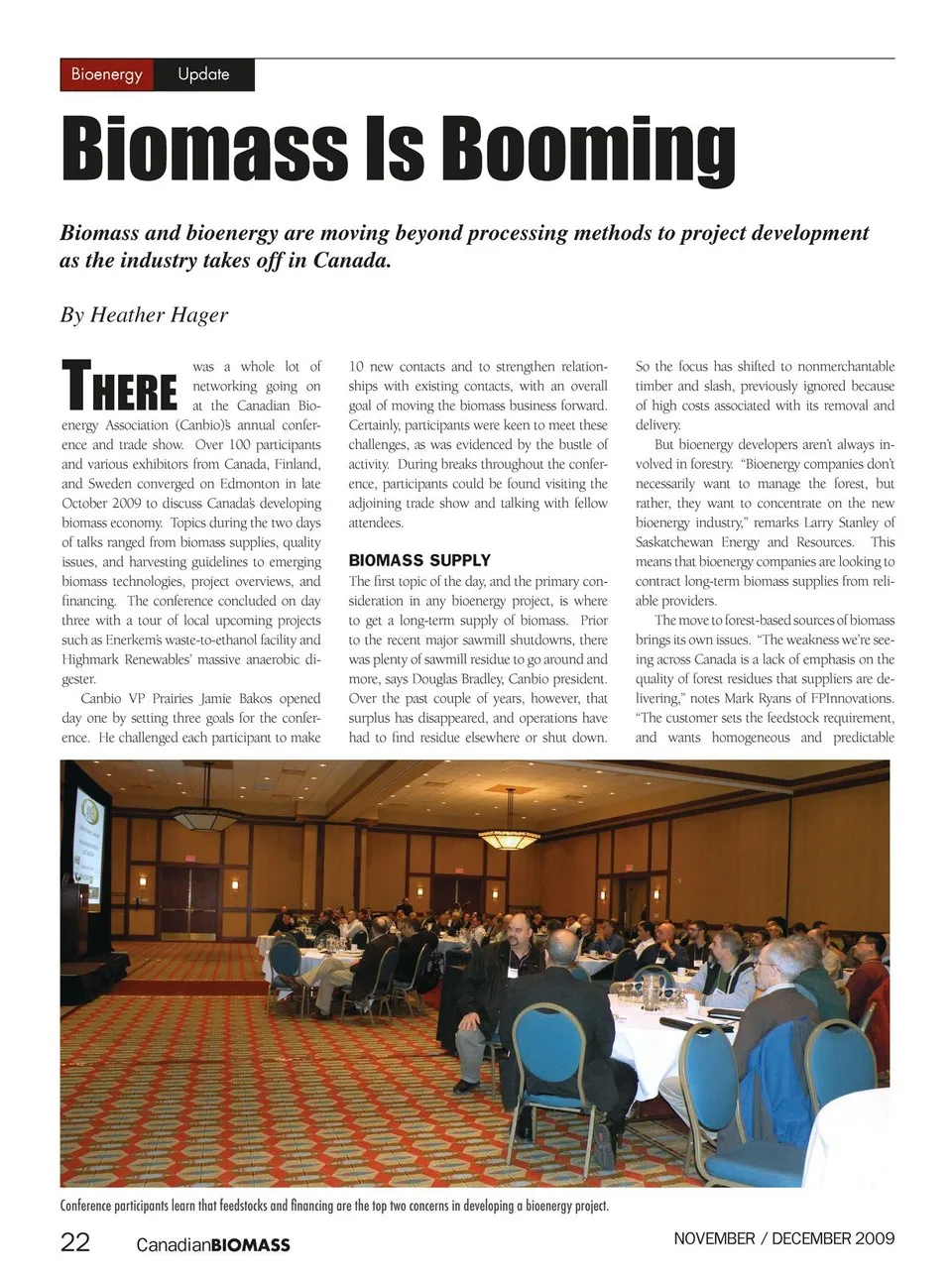
Bioenergy Update Biomass Is Booming Biomass and bioenergy are moving beyond processing methods to project development as the industry takes off in Canada. By Heather Hager energy Association (Canbio)’s annual confer- ence and trade show. Over 100 participants and various exhibitors from Canada, Finland, and Sweden converged on Edmonton in late October 2009 to discuss Canada’s developing biomass economy. Topics during the two days of talks ranged from biomass supplies, quality issues, and harvesting guidelines to emerging biomass technologies, project overviews, and financing. The conference concluded on day three with a tour of local upcoming projects such as Enerkem’s waste-to-ethanol facility and Highmark Renewables’ massive anaerobic di- gester. Canbio VP Prairies Jamie Bakos opened there day one by setting three goals for the confer- ence. He challenged each participant to make was a whole lot of networking going on at the Canadian Bio- 10 new contacts and to strengthen relation- ships with existing contacts, with an overall goal of moving the biomass business forward. Certainly, participants were keen to meet these challenges, as was evidenced by the bustle of activity. During breaks throughout the confer- ence, participants could be found visiting the adjoining trade show and talking with fellow attendees. biomaSS Supply The first topic of the day, and the primary con- sideration in any bioenergy project, is where to get a long-term supply of biomass. Prior to the recent major sawmill shutdowns, there was plenty of sawmill residue to go around and more, says Douglas Bradley, Canbio president. Over the past couple of years, however, that surplus has disappeared, and operations have had to find residue elsewhere or shut down. So the focus has shifted to nonmerchantable timber and slash, previously ignored because of high costs associated with its removal and delivery. But bioenergy developers aren’t always in- volved in forestry. “Bioenergy companies don’t necessarily want to manage the forest, but rather, they want to concentrate on the new bioenergy industry,” remarks Larry Stanley of Saskatchewan Energy and Resources. This means that bioenergy companies are looking to contract long-term biomass supplies from reli- able providers. The move to forest-based sources of biomass brings its own issues. “The weakness we’re see- ing across Canada is a lack of emphasis on the quality of forest residues that suppliers are de- livering,” notes Mark Ryans of FPInnovations. “The customer sets the feedstock requirement, and wants homogeneous and predictable Conference participants learn that feedstocks and financing are the top two concerns in developing a bioenergy project. 22 CanadianBIOMASS NOVEMBER / DECEMBER 2009
Canadian Biomass November/December 2009: Page 22