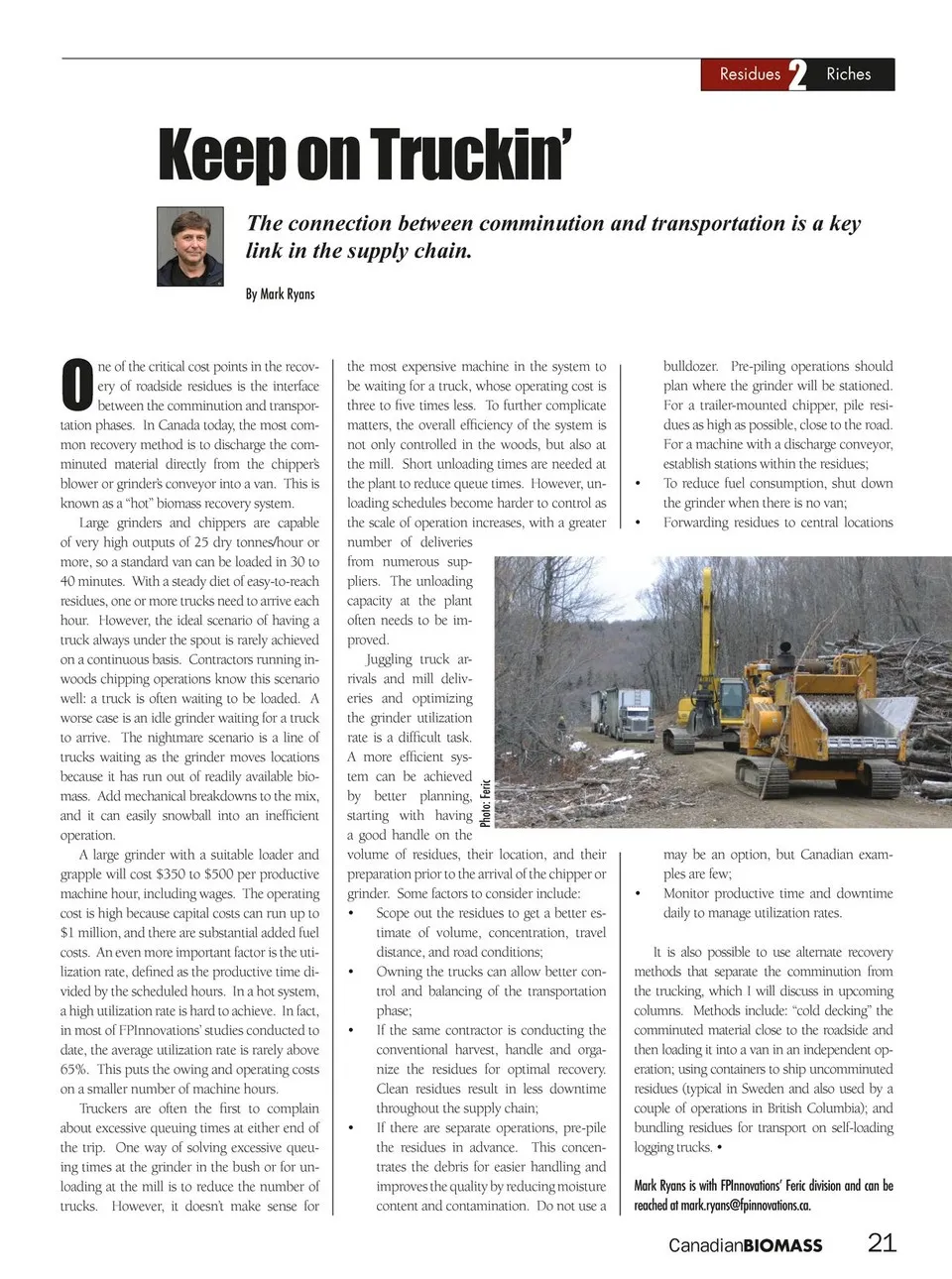
Residues 2 Riches Keep on Truckin’ The connection between comminution and transportation is a key link in the supply chain. By Mark Ryans tation phases. In Canada today, the most com- mon recovery method is to discharge the com- minuted material directly from the chipper’s blower or grinder’s conveyor into a van. This is known as a “hot” biomass recovery system. Large grinders and chippers are capable O of very high outputs of 25 dry tonnes/hour or more, so a standard van can be loaded in 30 to 40 minutes. With a steady diet of easy-to-reach residues, one or more trucks need to arrive each hour. However, the ideal scenario of having a truck always under the spout is rarely achieved on a continuous basis. Contractors running in- woods chipping operations know this scenario well: a truck is often waiting to be loaded. A worse case is an idle grinder waiting for a truck to arrive. The nightmare scenario is a line of trucks waiting as the grinder moves locations because it has run out of readily available bio- mass. Add mechanical breakdowns to the mix, and it can easily snowball into an inefficient operation. A large grinder with a suitable loader and grapple will cost $350 to $500 per productive machine hour, including wages. The operating cost is high because capital costs can run up to $1 million, and there are substantial added fuel costs. An even more important factor is the uti- lization rate, defined as the productive time di- vided by the scheduled hours. In a hot system, a high utilization rate is hard to achieve. In fact, in most of FPInnovations’ studies conducted to date, the average utilization rate is rarely above 65%. This puts the owing and operating costs on a smaller number of machine hours. Truckers are often the first to complain about excessive queuing times at either end of the trip. One way of solving excessive queu- ing times at the grinder in the bush or for un- loading at the mill is to reduce the number of trucks. However, it doesn’t make sense for ne of the critical cost points in the recov- ery of roadside residues is the interface between the comminution and transpor- the most expensive machine in the system to be waiting for a truck, whose operating cost is three to five times less. To further complicate matters, the overall efficiency of the system is not only controlled in the woods, but also at the mill. Short unloading times are needed at the plant to reduce queue times. However, un- loading schedules become harder to control as the scale of operation increases, with a greater number of deliveries from numerous sup- pliers. The unloading capacity at the plant often needs to be im- proved. Juggling truck ar- rivals and mill deliv- eries and optimizing the grinder utilization rate is a difficult task. A more efficient sys- tem can be achieved by better planning, starting with having a good handle on the volume of residues, their location, and their preparation prior to the arrival of the chipper or grinder. Some factors to consider include: • Scope out the residues to get a better es- timate of volume, concentration, travel distance, and road conditions; • Owning the trucks can allow better con- trol and balancing of the transportation phase; • If the same contractor is conducting the conventional harvest, handle and orga- nize the residues for optimal recovery. Clean residues result in less downtime throughout the supply chain; • If there are separate operations, pre-pile the residues in advance. This concen- trates the debris for easier handling and improves the quality by reducing moisture content and contamination. Do not use a bulldozer. Pre-piling operations should plan where the grinder will be stationed. For a trailer-mounted chipper, pile resi- dues as high as possible, close to the road. For a machine with a discharge conveyor, establish stations within the residues; • To reduce fuel consumption, shut down the grinder when there is no van; • Forwarding residues to central locations may be an option, but Canadian exam- ples are few; • Monitor productive time and downtime daily to manage utilization rates. It is also possible to use alternate recovery methods that separate the comminution from the trucking, which I will discuss in upcoming columns. Methods include: “cold decking” the comminuted material close to the roadside and then loading it into a van in an independent op- eration; using containers to ship uncomminuted residues (typical in Sweden and also used by a couple of operations in British Columbia); and bundling residues for transport on self-loading logging trucks. • Mark Ryans is with FPInnovations’ Feric division and can be reached at [email protected]. CanadianBIOMASS 21 Photo: Feric
Canadian Biomass November/December 2009: Page 21