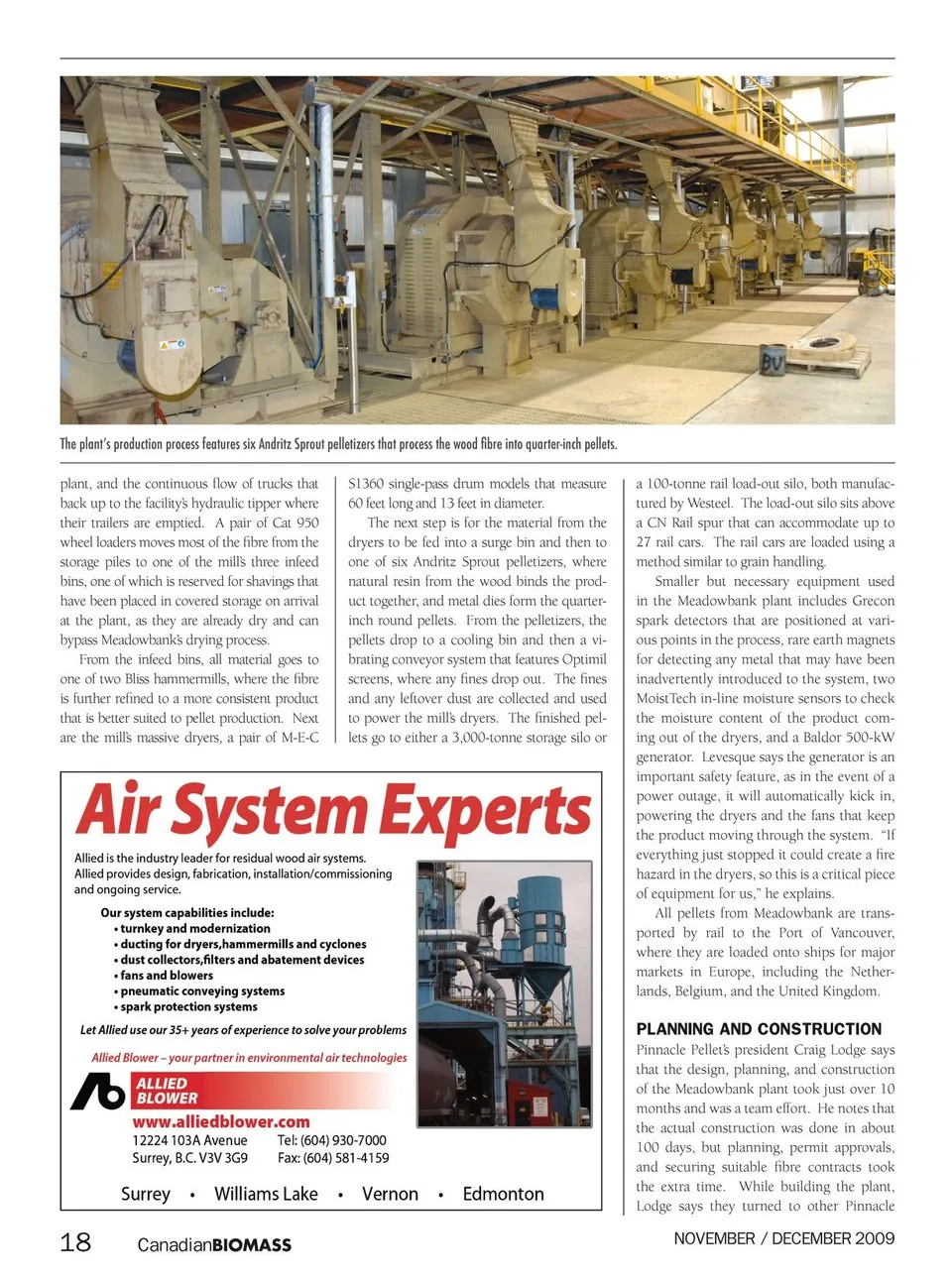
The plant’s production process features six Andritz Sprout pelletizers that process the wood fibre into quarter-inch pellets. plant, and the continuous flow of trucks that back up to the facility’s hydraulic tipper where their trailers are emptied. A pair of Cat 950 wheel loaders moves most of the fibre from the storage piles to one of the mill’s three infeed bins, one of which is reserved for shavings that have been placed in covered storage on arrival at the plant, as they are already dry and can bypass Meadowbank’s drying process. From the infeed bins, all material goes to one of two Bliss hammermills, where the fibre is further refined to a more consistent product that is better suited to pellet production. Next are the mill’s massive dryers, a pair of M-E-C S1360 single-pass drum models that measure 60 feet long and 13 feet in diameter. The next step is for the material from the dryers to be fed into a surge bin and then to one of six Andritz Sprout pelletizers, where natural resin from the wood binds the prod- uct together, and metal dies form the quarter- inch round pellets. From the pelletizers, the pellets drop to a cooling bin and then a vi- brating conveyor system that features Optimil screens, where any fines drop out. The fines and any leftover dust are collected and used to power the mill’s dryers. The finished pel- lets go to either a 3,000-tonne storage silo or a 100-tonne rail load-out silo, both manufac- tured by Westeel. The load-out silo sits above a CN Rail spur that can accommodate up to 27 rail cars. The rail cars are loaded using a method similar to grain handling. Smaller but necessary equipment used ant’s production process features six Andritz Sprout pelletizers that process the wood fibre into quarter-i e plant’s production process features six Andritz Sprout pelletizers that process the wood fibre into quarter-inch pellets. plant, and the continuous flow of trucks that back up to the facility’s hydraulic tipper where their trailers are emptied. A pair of Cat 950 wheel loaders moves most of the fibre from the storage piles to one of the mill’s three infeed bins, one of which is reserved for shavings that have been placed in covered storage on arrival at the plant, as they are already dry and can bypass Meadowbank’s drying process. From the infeed bins, all material goes to one of two Bliss hammermills, where the fibre is further refined to a more consistent product that is better suited to pellet production. Next are the mill’s massive dryers, a pair of M-E-C S1360 single-pass drum models that measure 60 feet long and 13 feet in diameter. The next step is for the material from the dryers to be fed into a surge bin and then to one of six Andritz Sprout pelletizers, where natural resin from the wood binds the prod- uct together, and metal dies form the quarter- inch round pellets. From the pelletizers, the pellets drop to a cooling bin and then a vi- brating conveyor system that features Optimil screens, where any fines drop out. The fines and any leftover dust are collected and used to power the mill’s dryers. The finished pel- lets go to either a 3,000-tonne storage silo or a 100-tonne rail load-out silo, both manufac- tured by Westeel. The load-out silo sits above a CN Rail spur that can accommodate up to 27 rail cars. The rail cars are loaded using a method similar to grain handling. Smaller but necessary equipment used in in the Meadowbank plant includes Grecon spark detectors that are positioned at vari- ous points in the process, rare earth magnets for detecting any metal that may have been inadvertently introduced to the system, two MoistTech in-line moisture sensors to check the moisture content of the product com- ing out of the dryers, and a Baldor 500-kW generator. Levesque says the generator is an important safety feature, as in the event of a power outage, it will automatically kick in, powering the dryers and the fans that keep the product moving through the system. “If everything just stopped it could create a fire hazard in the dryers, so this is a critical piece of equipment for us,” he explains. All pellets from Meadowbank are trans- ported by rail to the Port of Vancouver, where they are loaded onto ships for major markets in Europe, including the Nether- lands, Belgium, and the United Kingdom. planninG and conStruction Pinnacle Pellet’s president Craig Lodge says that the design, planning, and construction of the Meadowbank plant took just over 10 months and was a team effort. He notes that the actual construction was done in about 100 days, but planning, permit approvals, and securing suitable fibre contracts took the extra time. While building the plant, Lodge says they turned to other Pinnacle 18 CanadianBIOMASS NOVEMBER / DECEMBER 2009
Canadian Biomass November/December 2009: Page 18