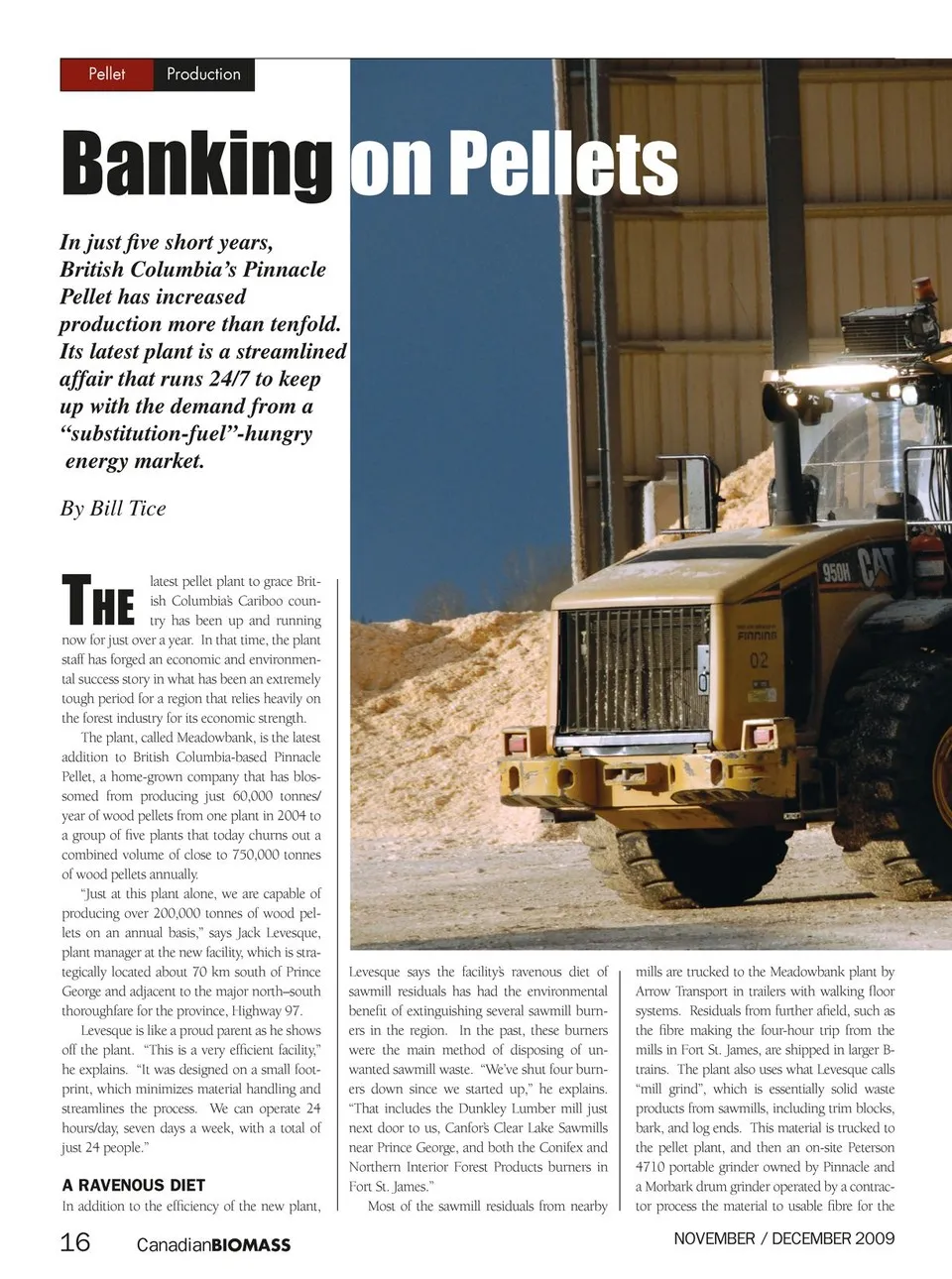
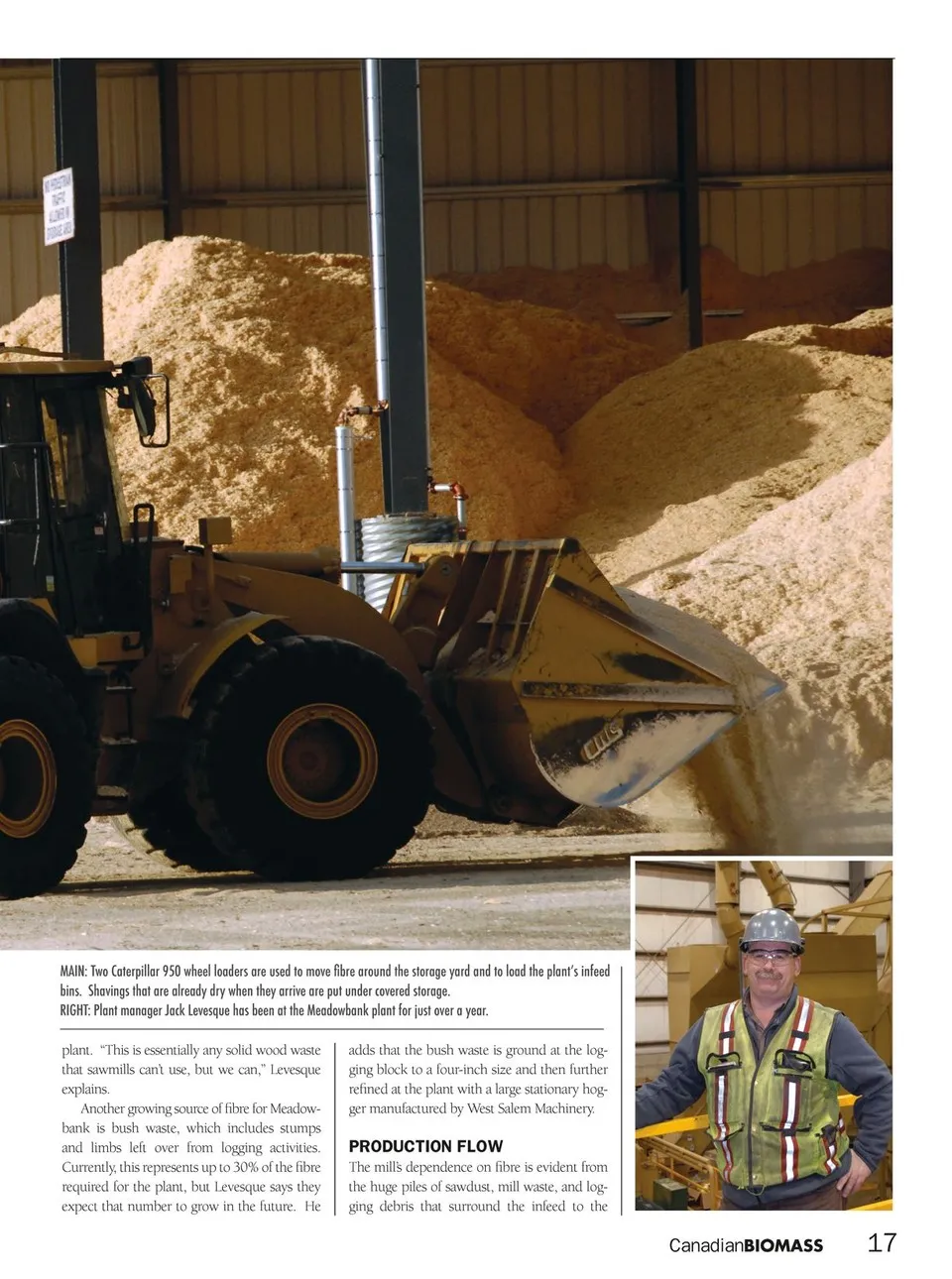
Pellet Production Banking on Pellets In just five short years, British Columbia’s Pinnacle Pellet has increased production more than tenfold. Its latest plant is a streamlined affair that runs 24/7 to keep up with the demand from a “substitution-fuel”-hungry energy market. By Bill Tice the latest pellet plant to grace Brit- ish Columbia’s Cariboo coun- try has been up and running now for just over a year. In that time, the plant staff has forged an economic and environmen- tal success story in what has been an extremely tough period for a region that relies heavily on the forest industry for its economic strength. The plant, called Meadowbank, is the latest addition to British Columbia-based Pinnacle Pellet, a home-grown company that has blos- somed from producing just 60,000 tonnes/ year of wood pellets from one plant in 2004 to a group of five plants that today churns out a combined volume of close to 750,000 tonnes of wood pellets annually. “Just at this plant alone, we are capable of producing over 200,000 tonnes of wood pel- lets on an annual basis,” says Jack Levesque, plant manager at the new facility, which is stra- tegically located about 70 km south of Prince George and adjacent to the major north–south thoroughfare for the province, Highway 97. Levesque is like a proud parent as he shows off the plant. “This is a very efficient facility,” he explains. “It was designed on a small foot- print, which minimizes material handling and streamlines the process. We can operate 24 hours/day, seven days a week, with a total of just 24 people.” a ravenouS diet In addition to the efficiency of the new plant, 16 CanadianBIOMASS Levesque says the facility’s ravenous diet of sawmill residuals has had the environmental benefit of extinguishing several sawmill burn- ers in the region. In the past, these burners were the main method of disposing of un- wanted sawmill waste. “We’ve shut four burn- ers down since we started up,” he explains. “That includes the Dunkley Lumber mill just next door to us, Canfor’s Clear Lake Sawmills near Prince George, and both the Conifex and Northern Interior Forest Products burners in Fort St. James.” Most of the sawmill residuals from nearby mills are trucked to the Meadowbank plant by Arrow Transport in trailers with walking floor systems. Residuals from further afield, such as the fibre making the four-hour trip from the mills in Fort St. James, are shipped in larger B- trains. The plant also uses what Levesque calls “mill grind”, which is essentially solid waste products from sawmills, including trim blocks, bark, and log ends. This material is trucked to the pellet plant, and then an on-site Peterson 4710 portable grinder owned by Pinnacle and a Morbark drum grinder operated by a contrac- tor process the material to usable fibre for the NOVEMBER / DECEMBER 2009
Canadian Biomass November/December 2009: Page 16