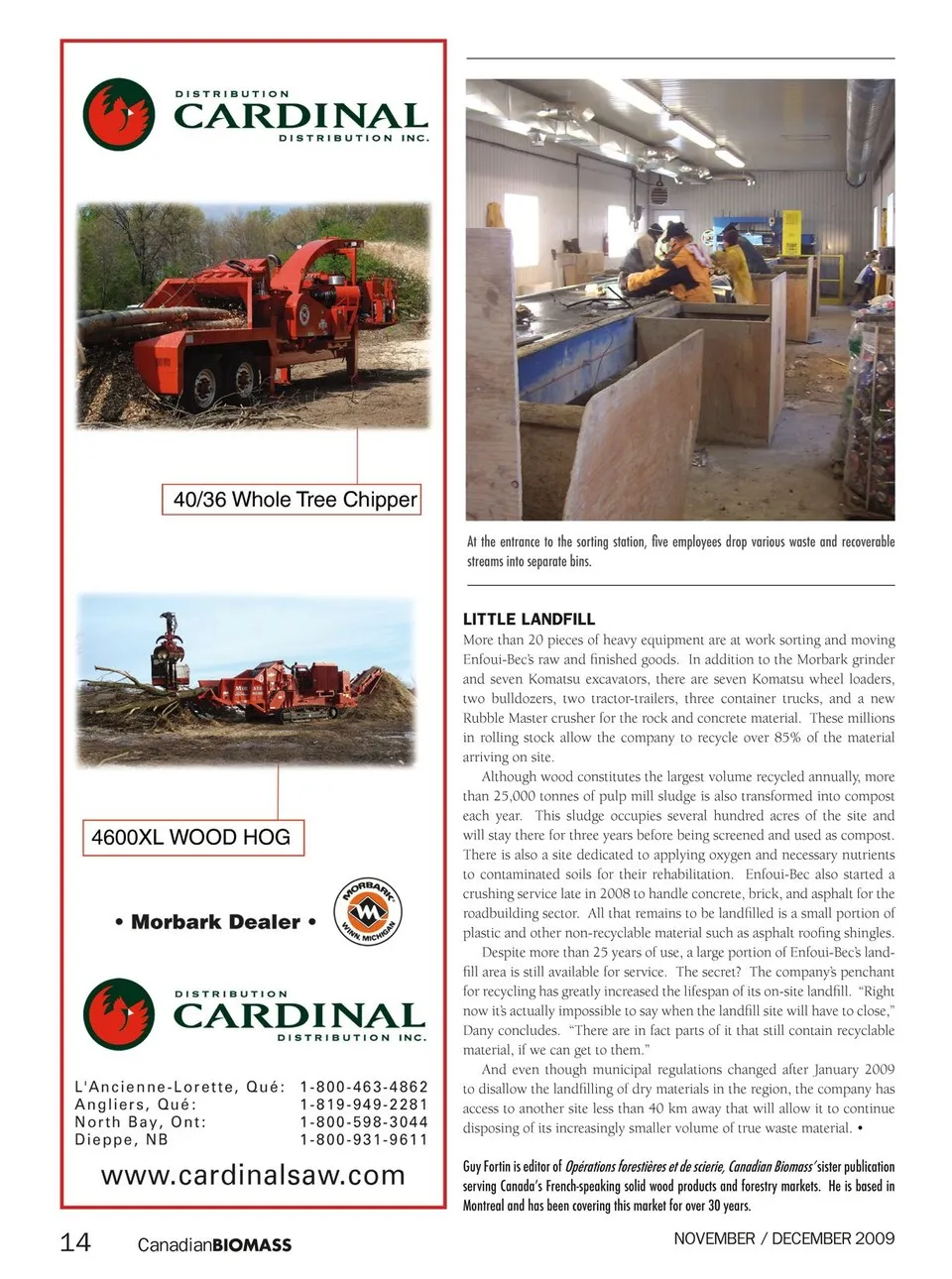
At the entrance to the sorting station, five employees drop various waste and recoverable streams into separate bins. little landfill More than 20 pieces of heavy equipment are at work sorting and moving Enfoui-Bec’s raw and finished goods. In addition to the Morbark grinder and seven Komatsu excavators, there are seven Komatsu wheel loaders, two bulldozers, two tractor-trailers, three container trucks, and a new Rubble Master crusher for the rock and concrete material. These millions in rolling stock allow the company to recycle over 85% of the material arriving on site. Although wood constitutes the largest volume recycled annually, more than 25,000 tonnes of pulp mill sludge is also transformed into compost each year. This sludge occupies several hundred acres of the site and will stay there for three years before being screened and used as compost. There is also a site dedicated to applying oxygen and necessary nutrients to contaminated soils for their rehabilitation. Enfoui-Bec also started a crushing service late in 2008 to handle concrete, brick, and asphalt for the roadbuilding sector. All that remains to be landfilled is a small portion of plastic and other non-recyclable material such as asphalt roofing shingles. Despite more than 25 years of use, a large portion of Enfoui-Bec’s land- fill area is still available for service. The secret? The company’s penchant for recycling has greatly increased the lifespan of its on-site landfill. “Right now it’s actually impossible to say when the landfill site will have to close,” Dany concludes. “There are in fact parts of it that still contain recyclable material, if we can get to them.” And even though municipal regulations changed after January 2009 to disallow the landfilling of dry materials in the region, the company has access to another site less than 40 km away that will allow it to continue disposing of its increasingly smaller volume of true waste material. • Guy Fortin is editor of Opérations forestières et de scierie, Canadian Biomass’ sister publication serving Canada’s French-speaking solid wood products and forestry markets. He is based in Montreal and has been covering this market for over 30 years. 14 CanadianBIOMASS NOVEMBER / DECEMBER 2009
Canadian Biomass November/December 2009: Page 14