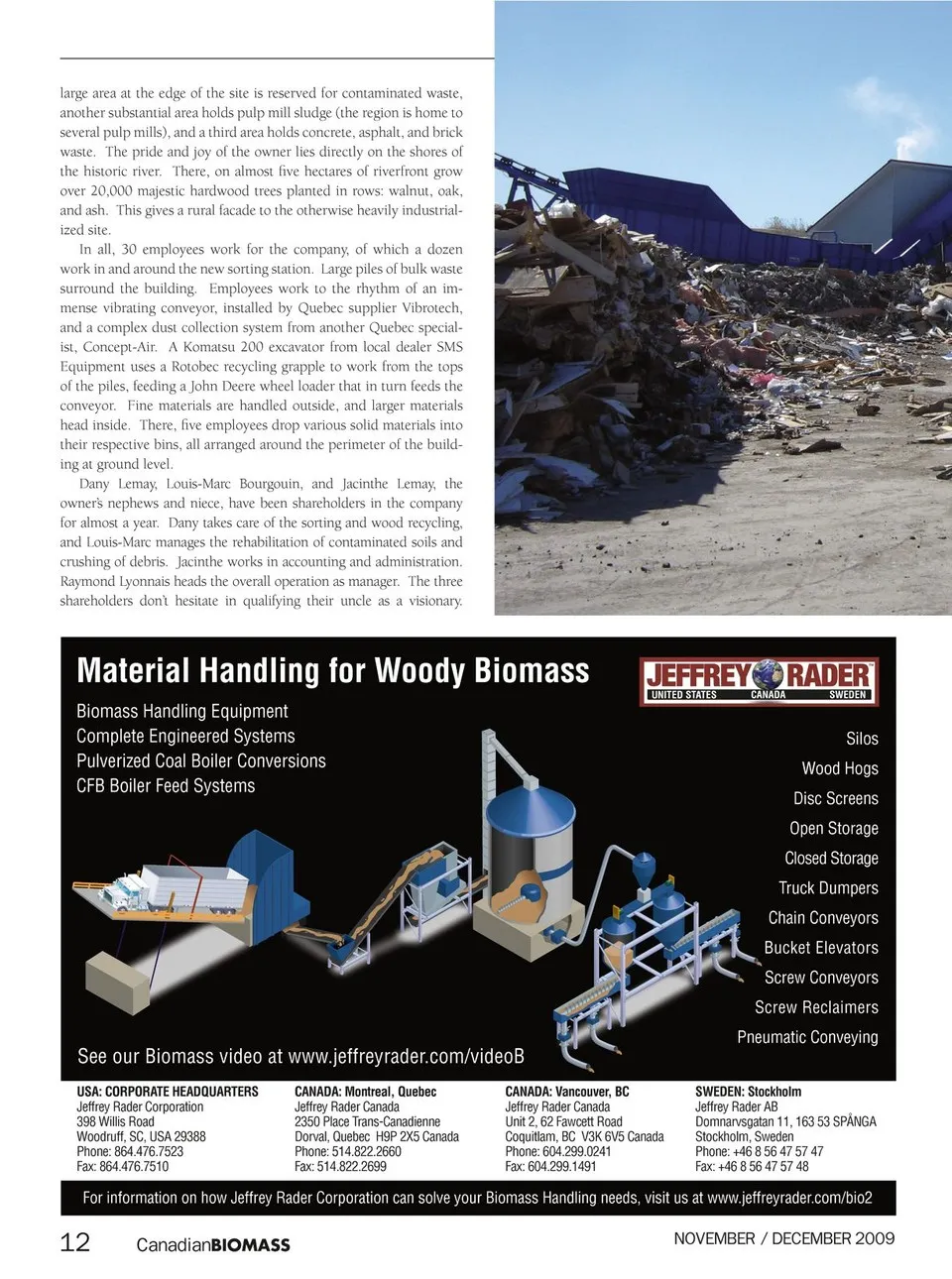
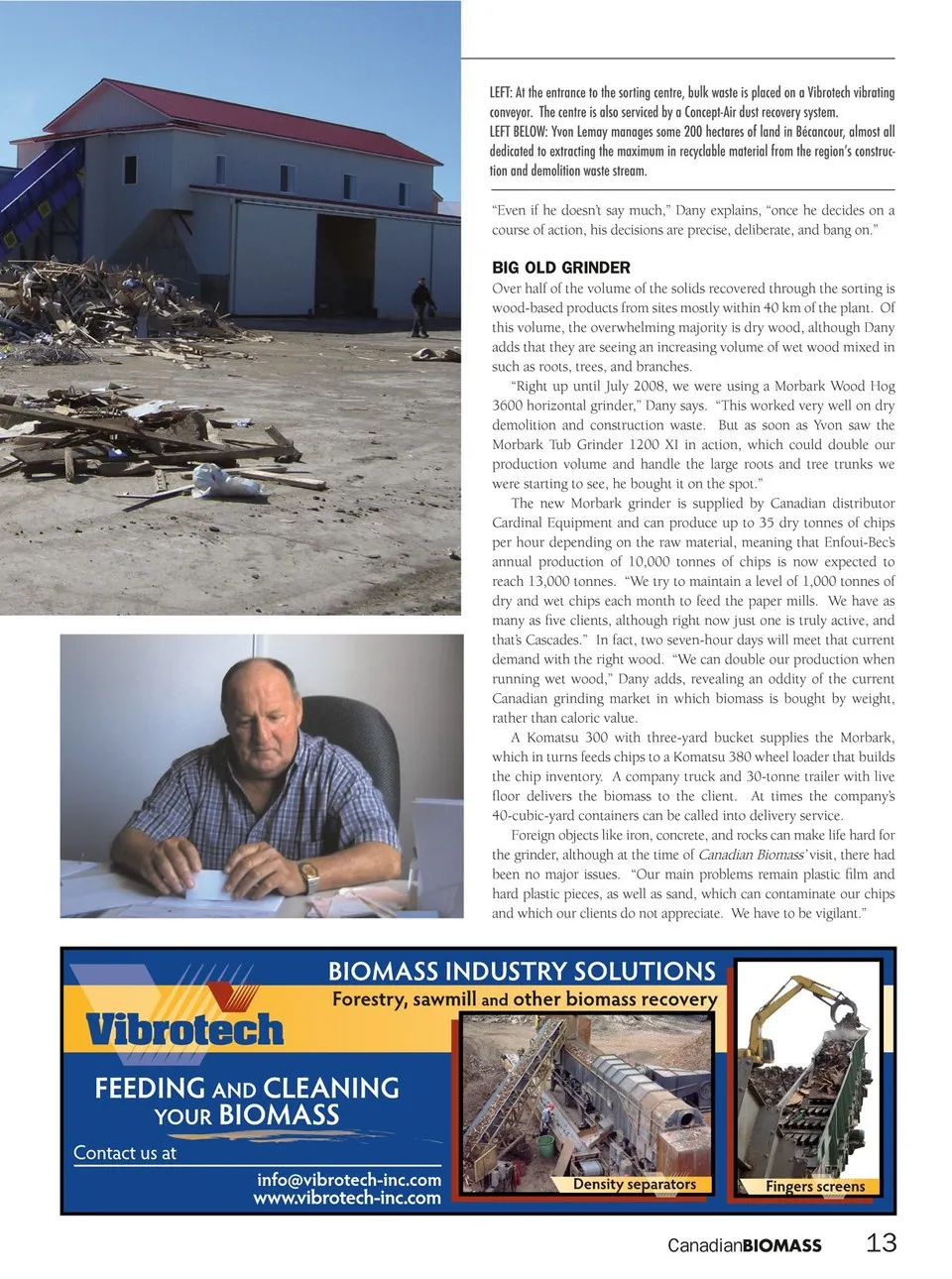
LEFT: At the entrance to the sorting centre, bulk waste is placed on a Vibrotech vibrating conveyor. The centre is also serviced by a Concept-Air dust recovery system. LEFT BELOW: Yvon Lemay manages some 200 hectares of land in Bécancour, almost all dedicated to extracting the maximum in recyclable material from the region’s construc- tion and demolition waste stream. “Even if he doesn’t say much,” Dany explains, “once he decides on a course of action, his decisions are precise, deliberate, and bang on.” biG old Grinder Over half of the volume of the solids recovered through the sorting is wood-based products from sites mostly within 40 km of the plant. Of this volume, the overwhelming majority is dry wood, although Dany adds that they are seeing an increasing volume of wet wood mixed in such as roots, trees, and branches. “Right up until July 2008, we were using a Morbark Wood Hog 3600 horizontal grinder,” Dany says. “This worked very well on dry demolition and construction waste. But as soon as Yvon saw the Morbark Tub Grinder 1200 XI in action, which could double our production volume and handle the large roots and tree trunks we were starting to see, he bought it on the spot.” The new Morbark grinder is supplied by Canadian distributor Cardinal Equipment and can produce up to 35 dry tonnes of chips per hour depending on the raw material, meaning that Enfoui-Bec’s annual production of 10,000 tonnes of chips is now expected to reach 13,000 tonnes. “We try to maintain a level of 1,000 tonnes of dry and wet chips each month to feed the paper mills. We have as many as five clients, although right now just one is truly active, and that’s Cascades.” In fact, two seven-hour days will meet that current demand with the right wood. “We can double our production when running wet wood,” Dany adds, revealing an oddity of the current Canadian grinding market in which biomass is bought by weight, rather than caloric value. A Komatsu 300 with three-yard bucket supplies the Morbark, which in turns feeds chips to a Komatsu 380 wheel loader that builds the chip inventory. A company truck and 30-tonne trailer with live floor delivers the biomass to the client. At times the company’s 40-cubic-yard containers can be called into delivery service. Foreign objects like iron, concrete, and rocks can make life hard for the grinder, although at the time of Canadian Biomass’ visit, there had been no major issues. “Our main problems remain plastic film and hard plastic pieces, as well as sand, which can contaminate our chips and which our clients do not appreciate. We have to be vigilant.” CanadianBIOMASS 13
Canadian Biomass November/December 2009: Page 13