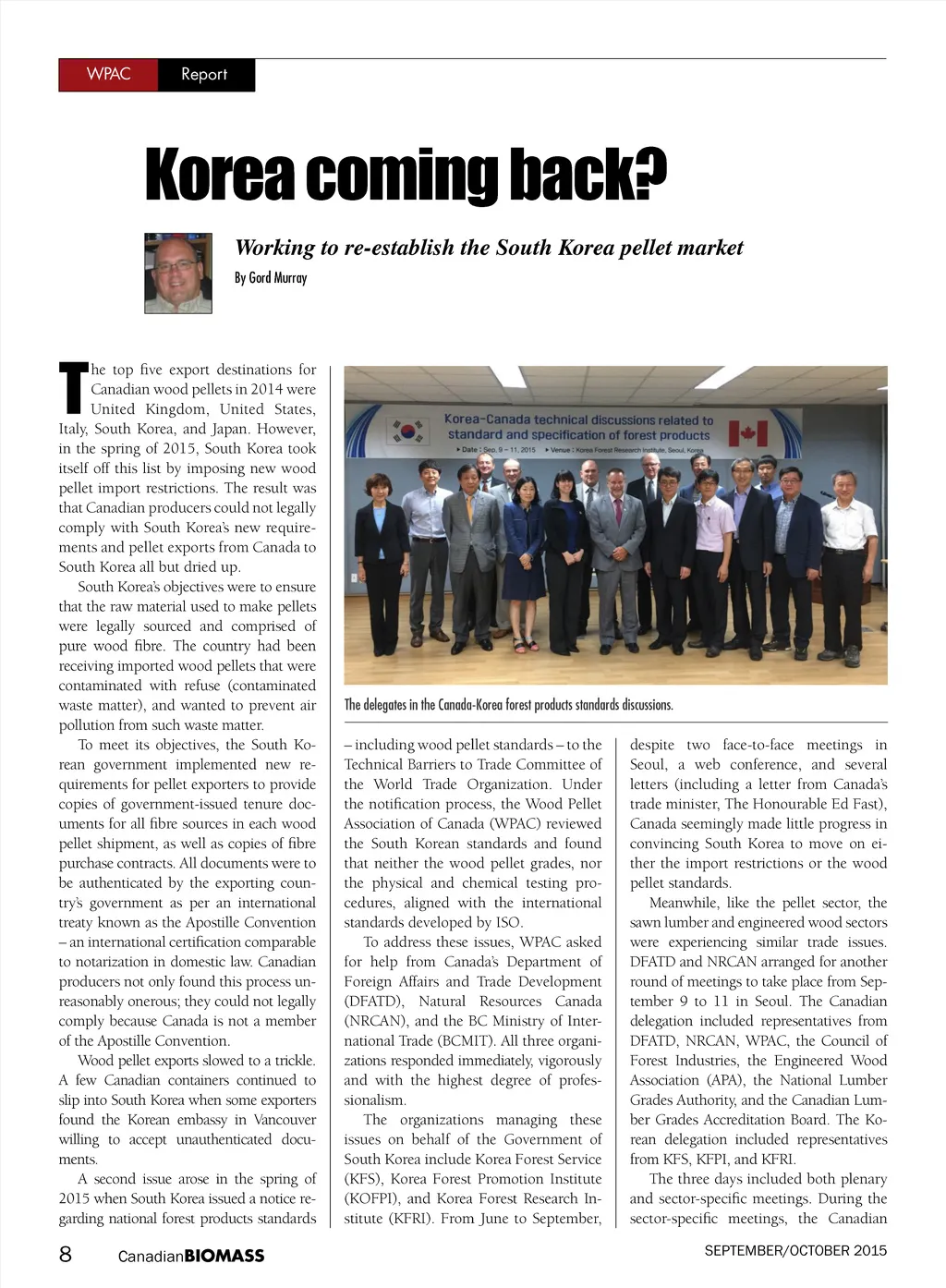
wood pellet sector achieved significant progress. Subject to ratification by KFS management, the parties agreed to the following: • Wood pellets will be made from pure wood and fall under the juris-diction of the Ministry of Forests. • Sawmill residues may be used as a raw material, provided that the sawmill owner states that the saw-mill residues are one of the pri-mary products of the mill (along with lumber and chips) and not a waste product. If the sawmill res-idues are not a primary product, then if used to make pellets, they are considered to be waste and classified as biomass solid refuse. As such, their use is restricted and falls under jurisdiction of the Ministry of Environment. • By mid-October, KFS intends to eliminate the Apostille require-ment for verifying wood pellet fibre sourcing. • The responsibility for verifying fibre sourcing 21.11.14 will shift 10:24 from Seite the 1 CanBiom0915-Kahl-5 exporter to the importer. The • • • • importer will be responsible for verifying the legality and appro-priateness of the source of fibre supply for wood pellets. Data to be collected by the importer will include type of raw material (chips, logs, or sawdust), descrip-tion of storage facilities, descrip-tion of manufacturing facilities, import volumes and dates, the type of packaging (bags, totes, or bulk) and the intended end use. The new verification process will be implemented for a trial period in the month of October. As soon as the process is finalized, Korea Forest Service will provide the Ca-nadian Embassy with more details. KFS will implement a spot-check-ing process to ensure that import-er data is accurate. KFS will re-consider whether to accept third party chain of cus-tody certification as evidence of fibre sourcing. Other than insisting on compliance with local laws, Korea does not in-tend to impose forest management requirements on other countries. Korea’s main forest management concern is to ensure elimination of illegal logging. • Korea will modify its pellet qual-ity and testing standards to align with ISO; while ensuring that agro material and recycled wood are not accepted for wood pellets and are instead classified as Bio-SRF . Korea recently established a mirror committee to consider the ISO standards, to analyze them against Korean law and to adapt the ISO standards to the Korean situation. Korea will provide doc-umentation to Canada once this process is complete. We are pleased with the results of the recent meetings and optimistic that Can-ada will be able to re-establish a mutually beneficial wood pellet trade with South Korea. WPAC would like to express special thanks to NRCAN’s Wendy Vasbinder, Robert Jones, Lesley-Ann Reed and Hyun-Mi Park of the Canadian Embassy and to BCMIT’s Jae-Jung Huh. • KAHL Wood Pelleting Plants Quality worldwide. AMANDUS KAHL GmbH & Co. KG · SARJ Equipment Corp. · Mr. Rick B. MacArthur 29 Golfview Blvd. · Bradford, Ontario L3Z 2A6 Phone: 905-778-0073 · [email protected] www.akahl.de Canadian BIOMASS 9
Canadian Biomass September/October 2015: Page 9