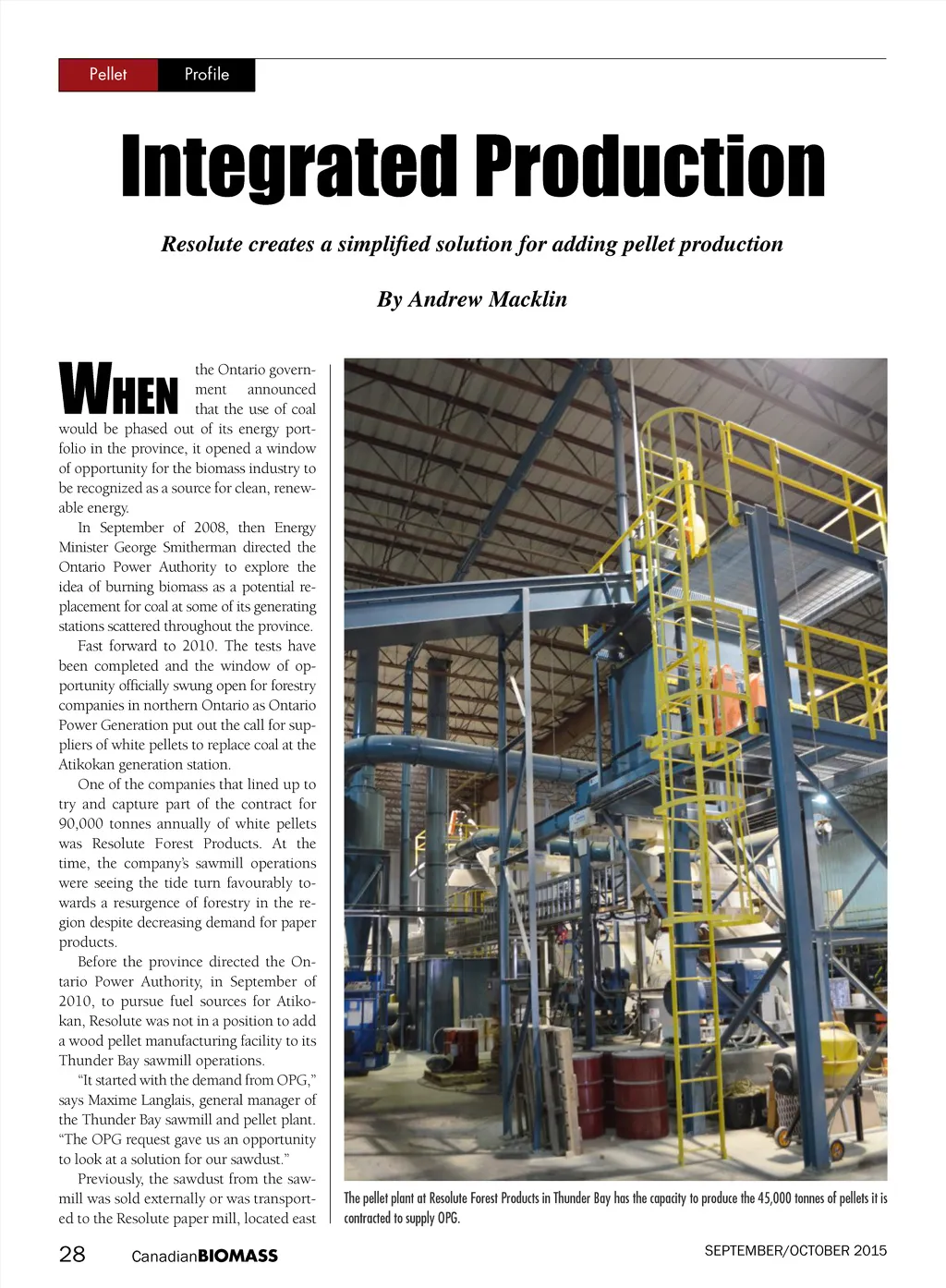
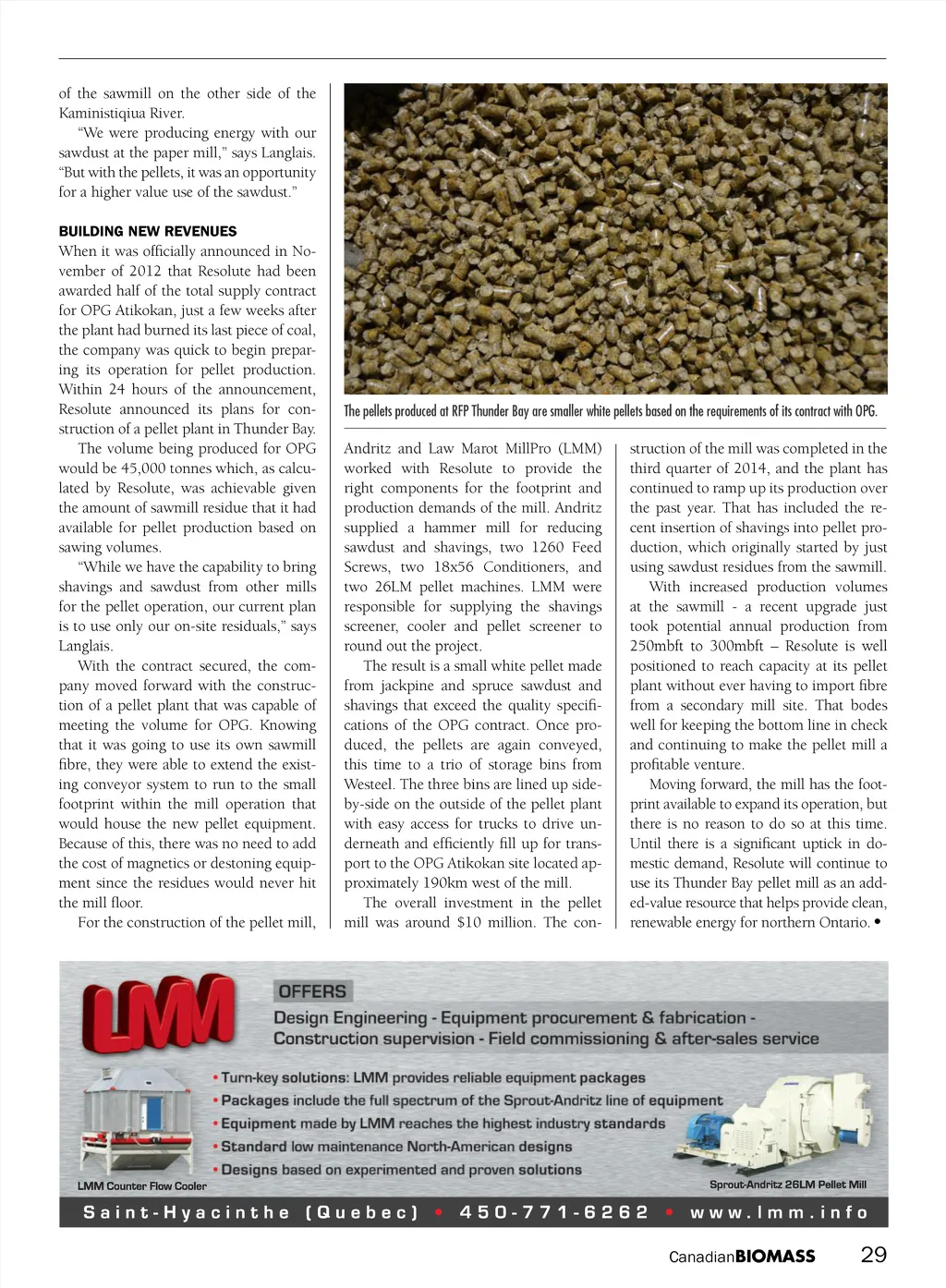
Pellet Profile Integrated Production Resolute creates a simplified solution for adding pellet production By Andrew Macklin W hen the Ontario govern-ment announced that the use of coal would be phased out of its energy port-folio in the province, it opened a window of opportunity for the biomass industry to be recognized as a source for clean, renew-able energy. In September of 2008, then Energy Minister George Smitherman directed the Ontario Power Authority to explore the idea of burning biomass as a potential re-placement for coal at some of its generating stations scattered throughout the province. Fast forward to 2010. The tests have been completed and the window of op-portunity officially swung open for forestry companies in northern Ontario as Ontario Power Generation put out the call for sup-pliers of white pellets to replace coal at the Atikokan generation station. One of the companies that lined up to try and capture part of the contract for 90,000 tonnes annually of white pellets was Resolute Forest Products. At the time, the company’s sawmill operations were seeing the tide turn favourably to-wards a resurgence of forestry in the re-gion despite decreasing demand for paper products. Before the province directed the On-tario Power Authority, in September of 2010, to pursue fuel sources for Atiko-kan, Resolute was not in a position to add a wood pellet manufacturing facility to its Thunder Bay sawmill operations. “It started with the demand from OPG,” says Maxime Langlais, general manager of the Thunder Bay sawmill and pellet plant. “The OPG request gave us an opportunity to look at a solution for our sawdust.” Previously, the sawdust from the saw-mill was sold externally or was transport-ed to the Resolute paper mill, located east The pellet plant at Resolute Forest Products in Thunder Bay has the capacity to produce the 45,000 tonnes of pellets it is contracted to supply OPG. SEPTEMBER/OCTOBER 2015 28 Canadian BIOMASS
Canadian Biomass September/October 2015: Page 28