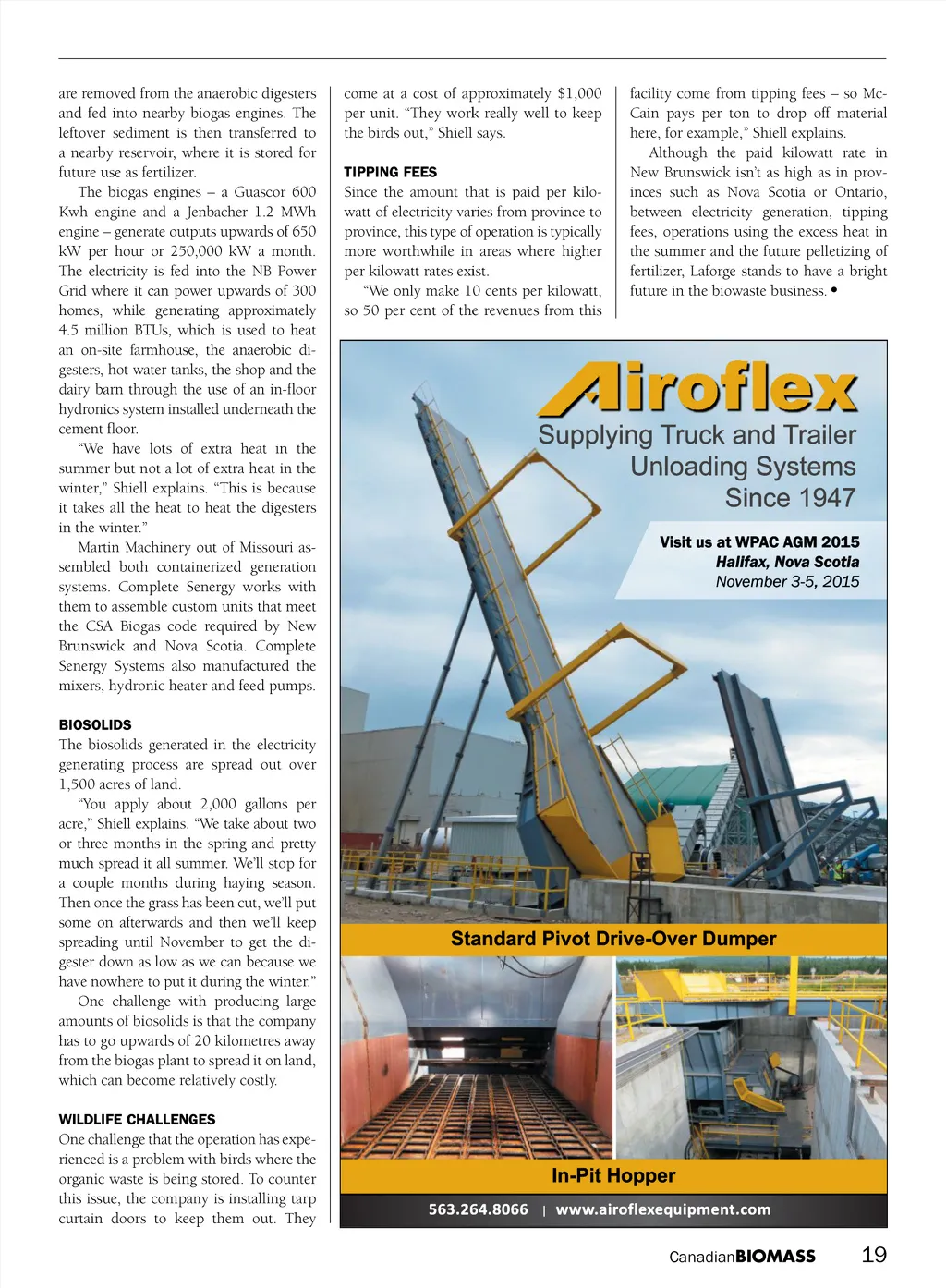
Laforge Bioenvironmental’s anaerobic digester operates on a dairy farm with approximately 90 cows, and is fuelled by a combination of cow manure and organic waste from regional food processors converting it to electrical energy, heat and liquid organic fertilizer. The expected lifespan of the anaerobic digesters is between 20 to 25 years. “But like any infrastructure, if you maintain it, replace parts when needed, you can probably make it last longer than that,” Shiell says. RAW MATERIALS The raw materials used to create the sed-iment sent to the anaerobic digesters is a combination of manure from the 90 cows at the dairy farm; French fries and potato skins from local food processors; slaugh-terhouse waste and sugar beets. “The peels from the potatoes are all steam peeled so the starch is mostly washed off of them. It’s almost all just cel-lulose,” Shiell explains. “There’s not a lot of biogas value to it, but it’s good organic material. The French fries have a lot of energy in them.” Fifty acres of sugar beets were grown on the farm last year and are used as an energy crop for the sediment. However, other projects are being considered for the sugar beets, such as the creation of sugar and ethanol. Two tankers haul dissolved air floatation sludge (DAF) that comes from the slaugh-terhouse that comes off of primary waste. “The liquid DAF sludge has a lot of fat, it’s actually really good stuff,” Shiell ex-plains. “It’s over 115,000 COD, so there’s a lot of gas that comes out of it.” The liquid DAF is mixed with all the dry materials to create a 10 per cent total solids mix, which is then pumped into the anaerobic digesters. The digesters run be-tween five and eight per cent total solids. Manure is only a small part of the mix, mainly used as a dilutant. “If the pH of the digester or the buffer-ing capacity of the digester is a little low, we’ll shovel a little manure into it,” Shiell says. “We’re only putting about 30 tons of manure in a day, and about 150 to 180 tons of other materials.” All of the ingredients are fed into the facility’s two 100-ton receiving tanks that fuel the anaerobic digester system. The floors of the tanks are heated at about 10°C except during the wintertime, when it is heated to the same temperature as the anaerobic digesters. “In the wintertime, all this material is frozen,” Shiell says. “When you mix it up and pump it into your digester at 5°C it’s hard to keep your digester at 40°C.” THE PROCESS The cow manure is collected under the holding pen and is then pumped over to the receiving tanks in measured amounts, where it is mixed with other organic waste and churned into sediment. French fries and other organic waste are then added to the mix. The sediment is then pumped over to the anaerobic digester, where it fills the base of the dome. The sediment in the dome is constantly turned by a motorized mixer and is then heated to 40°C. This process makes the biogases rise up out of the sediment, in-flating the dome. The biogases include carbon diox-ide, methane and hydrogen sulfide. The hydrogen sulfide crystallizes during the process and drops back into the sedi-ment, leaving only the carbon dioxide and methane in the air. Those two gases SEPTEMBER/OCTOBER 2015 18 Canadian BIOMASS
Canadian Biomass September/October 2015: Page 18