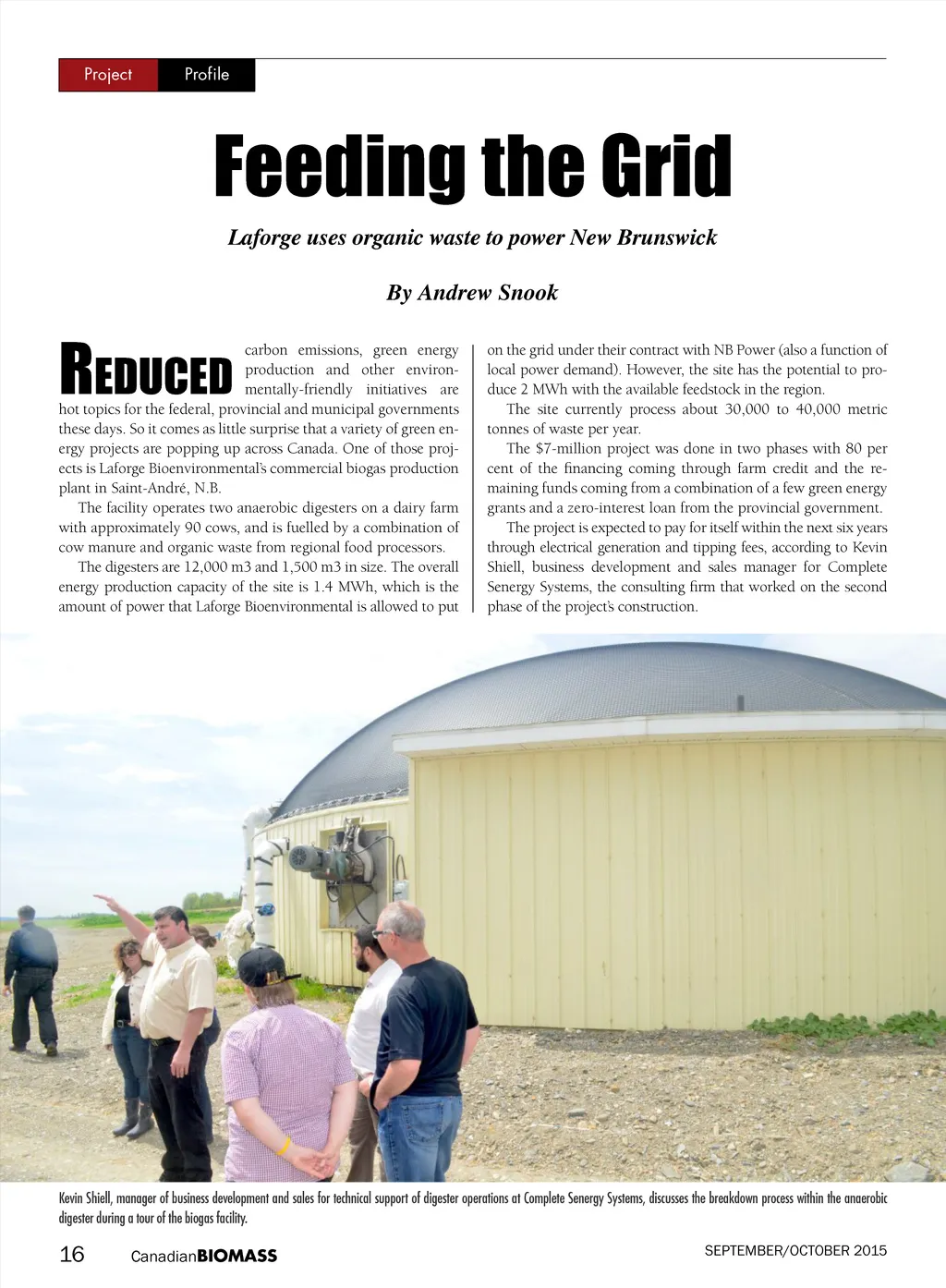
Project Profile Feeding the Grid Laforge uses organic waste to power New Brunswick By Andrew Snook R educed carbon emissions, green energy production and other environ-mentally-friendly initiatives are hot topics for the federal, provincial and municipal governments these days. So it comes as little surprise that a variety of green en-ergy projects are popping up across Canada. One of those proj-ects is Laforge Bioenvironmental’s commercial biogas production plant in Saint-André, N.B. The facility operates two anaerobic digesters on a dairy farm with approximately 90 cows, and is fuelled by a combination of cow manure and organic waste from regional food processors. The digesters are 12,000 m3 and 1,500 m3 in size. The overall energy production capacity of the site is 1.4 MWh, which is the amount of power that Laforge Bioenvironmental is allowed to put on the grid under their contract with NB Power (also a function of local power demand). However, the site has the potential to pro-duce 2 MWh with the available feedstock in the region. The site currently process about 30,000 to 40,000 metric tonnes of waste per year. The $7-million project was done in two phases with 80 per cent of the financing coming through farm credit and the re-maining funds coming from a combination of a few green energy grants and a zero-interest loan from the provincial government. The project is expected to pay for itself within the next six years through electrical generation and tipping fees, according to Kevin Shiell, business development and sales manager for Complete Senergy Systems, the consulting firm that worked on the second phase of the project’s construction. Kevin Shiell, manager of business development and sales for technical support of digester operations at Complete Senergy Systems, discusses the breakdown process within the anaerobic digester during a tour of the biogas facility. 16 Canadian BIOMASS SEPTEMBER/OCTOBER 2015
Canadian Biomass September/October 2015: Page 16