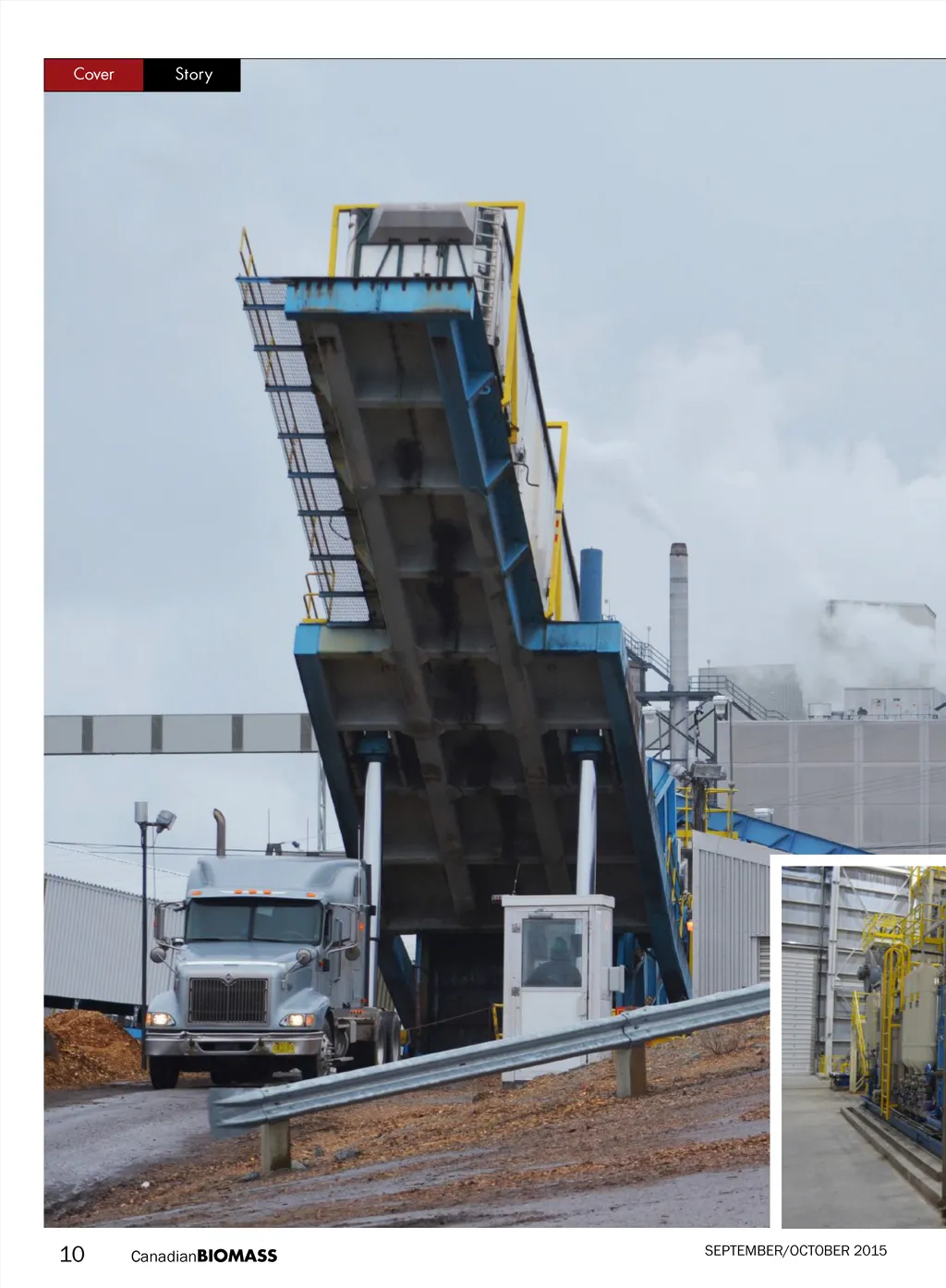
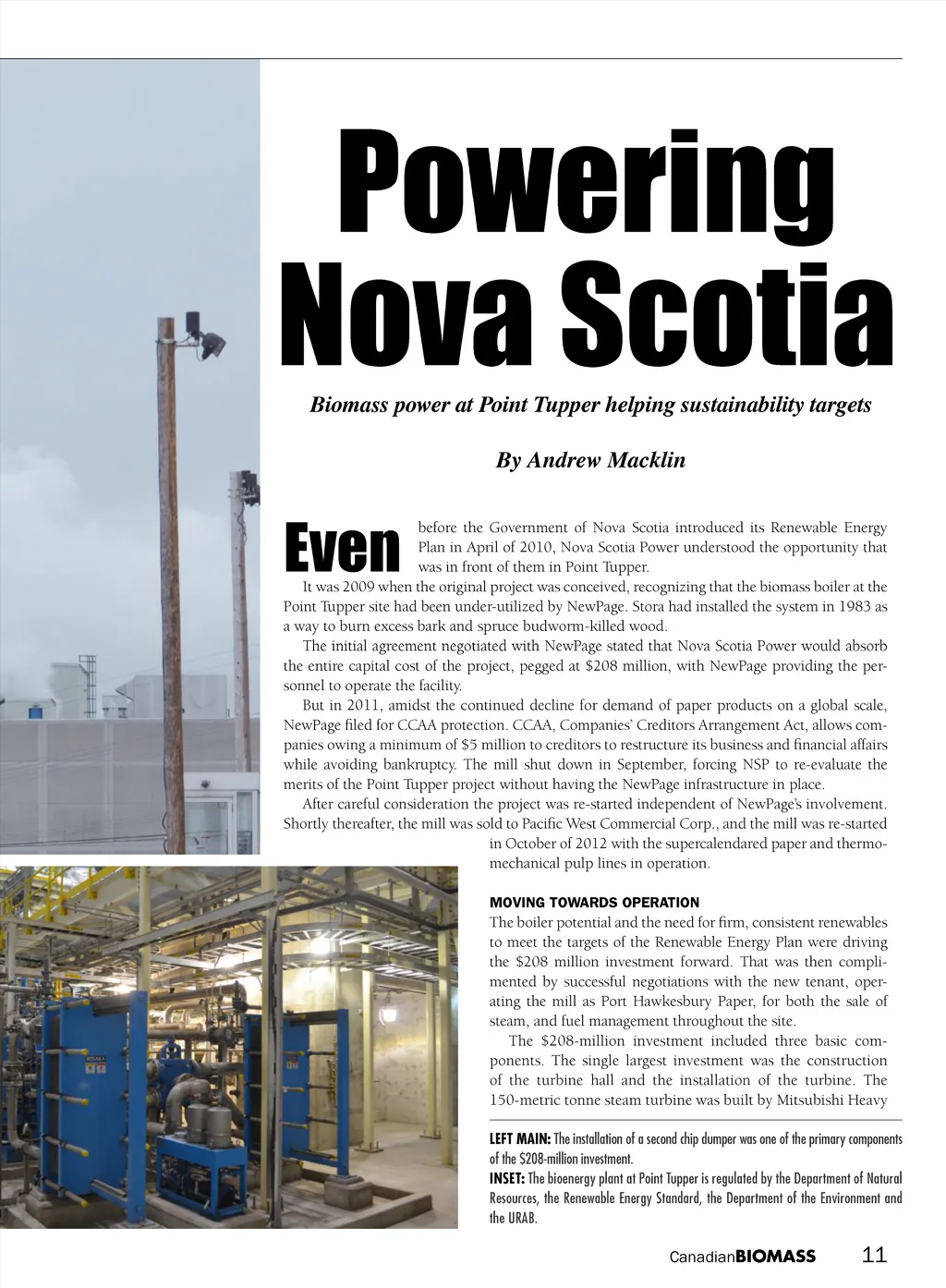
Powering Nova Scotia Biomass power at Point Tupper helping sustainability targets By Andrew Macklin Even before the Government of Nova Scotia introduced its Renewable Energy Plan in April of 2010, Nova Scotia Power understood the opportunity that was in front of them in Point Tupper. It was 2009 when the original project was conceived, recognizing that the biomass boiler at the Point Tupper site had been under-utilized by NewPage. Stora had installed the system in 1983 as a way to burn excess bark and spruce budworm-killed wood. The initial agreement negotiated with NewPage stated that Nova Scotia Power would absorb the entire capital cost of the project, pegged at $208 million, with NewPage providing the per-sonnel to operate the facility. But in 2011, amidst the continued decline for demand of paper products on a global scale, NewPage filed for CCAA protection. CCAA, Companies’ Creditors Arrangement Act, allows com-panies owing a minimum of $5 million to creditors to restructure its business and financial affairs while avoiding bankruptcy. The mill shut down in September, forcing NSP to re-evaluate the merits of the Point Tupper project without having the NewPage infrastructure in place. After careful consideration the project was re-started independent of NewPage’s involvement. Shortly thereafter, the mill was sold to Pacific West Commercial Corp., and the mill was re-started in October of 2012 with the supercalendared paper and thermo-mechanical pulp lines in operation. MOVING TOWARDS OPERATION The boiler potential and the need for firm, consistent renewables to meet the targets of the Renewable Energy Plan were driving the $208 million investment forward. That was then compli-mented by successful negotiations with the new tenant, oper-ating the mill as Port Hawkesbury Paper, for both the sale of steam, and fuel management throughout the site. The $208-million investment included three basic com-ponents. The single largest investment was the construction of the turbine hall and the installation of the turbine. The 150-metric tonne steam turbine was built by Mitsubishi Heavy LEFT MAIN: The installation of a second chip dumper was one of the primary components of the $208-million investment. INSET: The bioenergy plant at Point Tupper is regulated by the Department of Natural Resources, the Renewable Energy Standard, the Department of the Environment and the URAB. Canadian BIOMASS 11
Canadian Biomass September/October 2015: Page 11