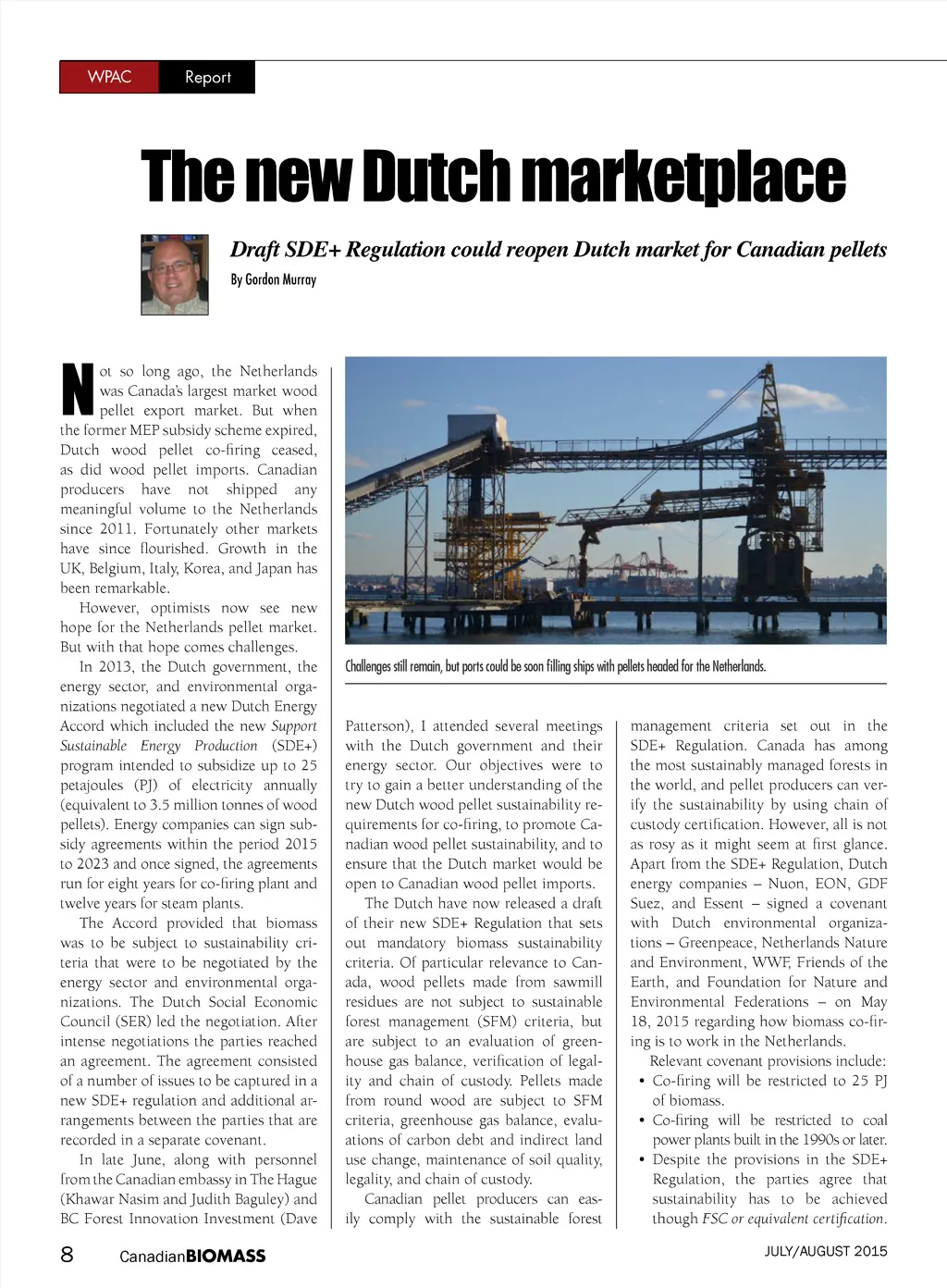
WPAC Report The new Dutch marketplace Draft SDE+ Regulation could reopen Dutch market for Canadian pellets By Gordon Murray ot so long ago, the Netherlands was Canada’s largest market wood pellet export market. But when the former MEP subsidy scheme expired, Dutch wood pellet co-firing ceased, as did wood pellet imports. Canadian producers have not shipped any meaningful volume to the Netherlands since 2011. Fortunately other markets have since flourished. Growth in the UK, Belgium, Italy, Korea, and Japan has been remarkable. However, optimists now see new hope for the Netherlands pellet market. But with that hope comes challenges. In 2013, the Dutch government, the energy sector, and environmental orga-nizations negotiated a new Dutch Energy Accord which included the new Support Sustainable Energy Production (SDE+) program intended to subsidize up to 25 petajoules (PJ) of electricity annually (equivalent to 3.5 million tonnes of wood pellets). Energy companies can sign sub-sidy agreements within the period 2015 to 2023 and once signed, the agreements run for eight years for co-firing plant and twelve years for steam plants. The Accord provided that biomass was to be subject to sustainability cri-teria that were to be negotiated by the energy sector and environmental orga-nizations. The Dutch Social Economic Council (SER) led the negotiation. After intense negotiations the parties reached an agreement. The agreement consisted of a number of issues to be captured in a new SDE+ regulation and additional ar-rangements between the parties that are recorded in a separate covenant. In late June, along with personnel from the Canadian embassy in The Hague (Khawar Nasim and Judith Baguley) and BC Forest Innovation Investment (Dave N Challenges still remain, but ports could be soon filling ships with pellets headed for the Netherlands. Patterson), I attended several meetings with the Dutch government and their energy sector. Our objectives were to try to gain a better understanding of the new Dutch wood pellet sustainability re-quirements for co-firing, to promote Ca-nadian wood pellet sustainability, and to ensure that the Dutch market would be open to Canadian wood pellet imports. The Dutch have now released a draft of their new SDE+ Regulation that sets out mandatory biomass sustainability criteria. Of particular relevance to Can-ada, wood pellets made from sawmill residues are not subject to sustainable forest management (SFM) criteria, but are subject to an evaluation of green-house gas balance, verification of legal-ity and chain of custody. Pellets made from round wood are subject to SFM criteria, greenhouse gas balance, evalu-ations of carbon debt and indirect land use change, maintenance of soil quality, legality, and chain of custody. Canadian pellet producers can eas-ily comply with the sustainable forest management criteria set out in the SDE+ Regulation. Canada has among the most sustainably managed forests in the world, and pellet producers can ver-ify the sustainability by using chain of custody certification. However, all is not as rosy as it might seem at first glance. Apart from the SDE+ Regulation, Dutch energy companies – Nuon, EON, GDF Suez, and Essent – signed a covenant with Dutch environmental organiza-tions – Greenpeace, Netherlands Nature and Environment, WWF, Friends of the Earth, and Foundation for Nature and Environmental Federations – on May 18, 2015 regarding how biomass co-fir-ing is to work in the Netherlands. Relevant covenant provisions include: • Co-firing will be restricted to 25 PJ of biomass. • Co-firing will be restricted to coal power plants built in the 1990s or later. • Despite the provisions in the SDE+ Regulation, the parties agree that sustainability has to be achieved though FSC or equivalent certification . JULY/AUGUST 2015 8 Canadian BIOMASS
Canadian Biomass July August 2015: Page 8