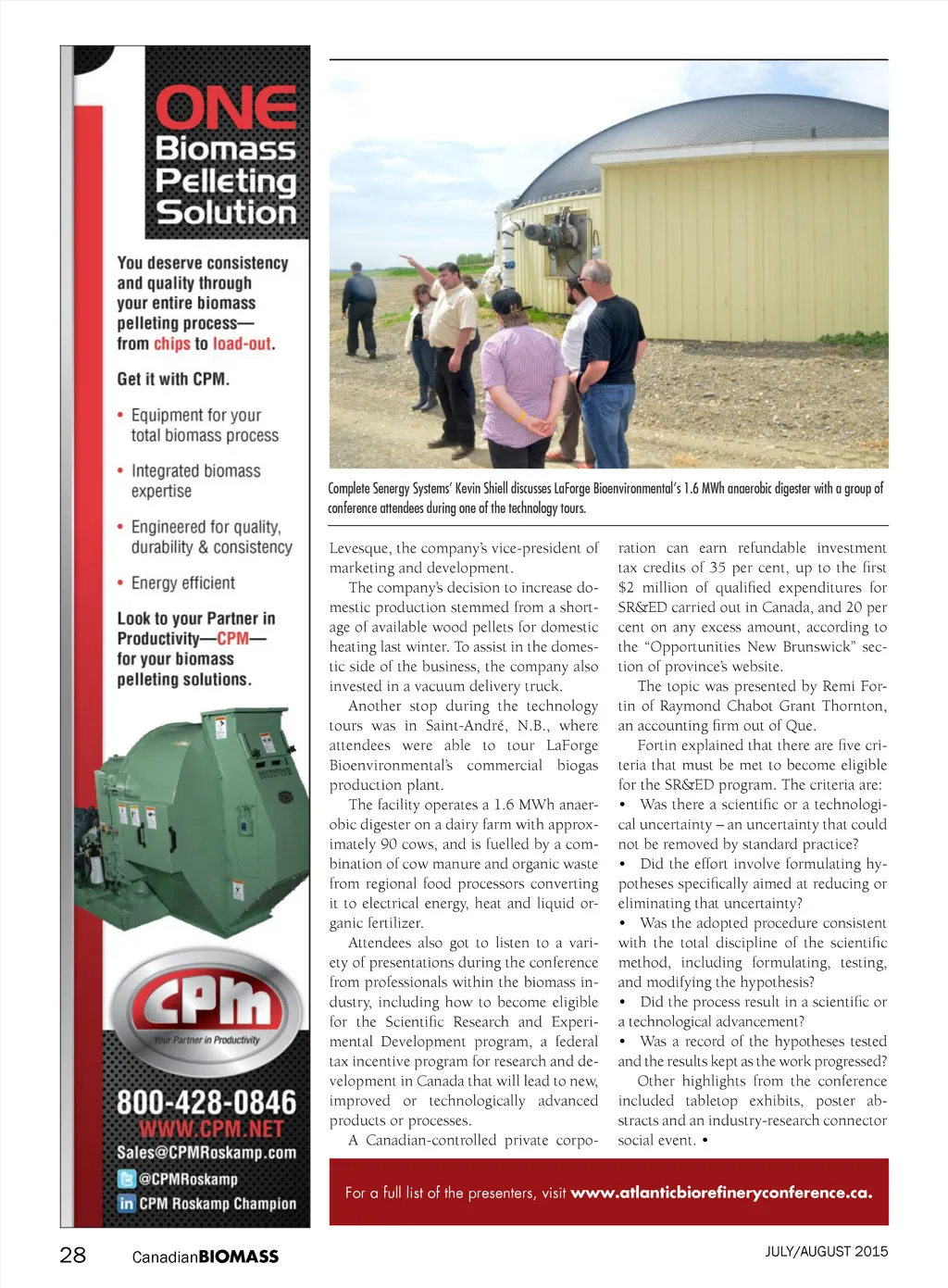
Complete Senergy Systems’ Kevin Shiell discusses LaForge Bioenvironmental’s 1.6 MWh anaerobic digester with a group of conference attendees during one of the technology tours. Levesque, the company’s vice-president of marketing and development. The company’s decision to increase do-mestic production stemmed from a short-age of available wood pellets for domestic heating last winter. To assist in the domes-tic side of the business, the company also invested in a vacuum delivery truck. Another stop during the technology tours was in Saint-André, N.B., where attendees were able to tour LaForge Bioenvironmental’s commercial biogas production plant. The facility operates a 1.6 MWh anaer-obic digester on a dairy farm with approx-imately 90 cows, and is fuelled by a com-bination of cow manure and organic waste from regional food processors converting it to electrical energy, heat and liquid or-ganic fertilizer. Attendees also got to listen to a vari-ety of presentations during the conference from professionals within the biomass in-dustry, including how to become eligible for the Scientific Research and Experi-mental Development program, a federal tax incentive program for research and de-velopment in Canada that will lead to new, improved or technologically advanced products or processes. A Canadian-controlled private corpo-ration can earn refundable investment tax credits of 35 per cent, up to the first $2 million of qualified expenditures for SR&ED carried out in Canada, and 20 per cent on any excess amount, according to the “Opportunities New Brunswick” sec-tion of province’s website. The topic was presented by Remi For-tin of Raymond Chabot Grant Thornton, an accounting firm out of Que. Fortin explained that there are five cri-teria that must be met to become eligible for the SR&ED program. The criteria are: • Was there a scientific or a technologi-cal uncertainty – an uncertainty that could not be removed by standard practice? • Did the effort involve formulating hy-potheses specifically aimed at reducing or eliminating that uncertainty? • Was the adopted procedure consistent with the total discipline of the scientific method, including formulating, testing, and modifying the hypothesis? • Did the process result in a scientific or a technological advancement? • Was a record of the hypotheses tested and the results kept as the work progressed? Other highlights from the conference included tabletop exhibits, poster ab-stracts and an industry-research connector social event. • For a full list of the presenters, visit www.atlanticbiorefineryconference.ca. 28 Canadian BIOMASS JULY/AUGUST 2015
Canadian Biomass July August 2015: Page 28