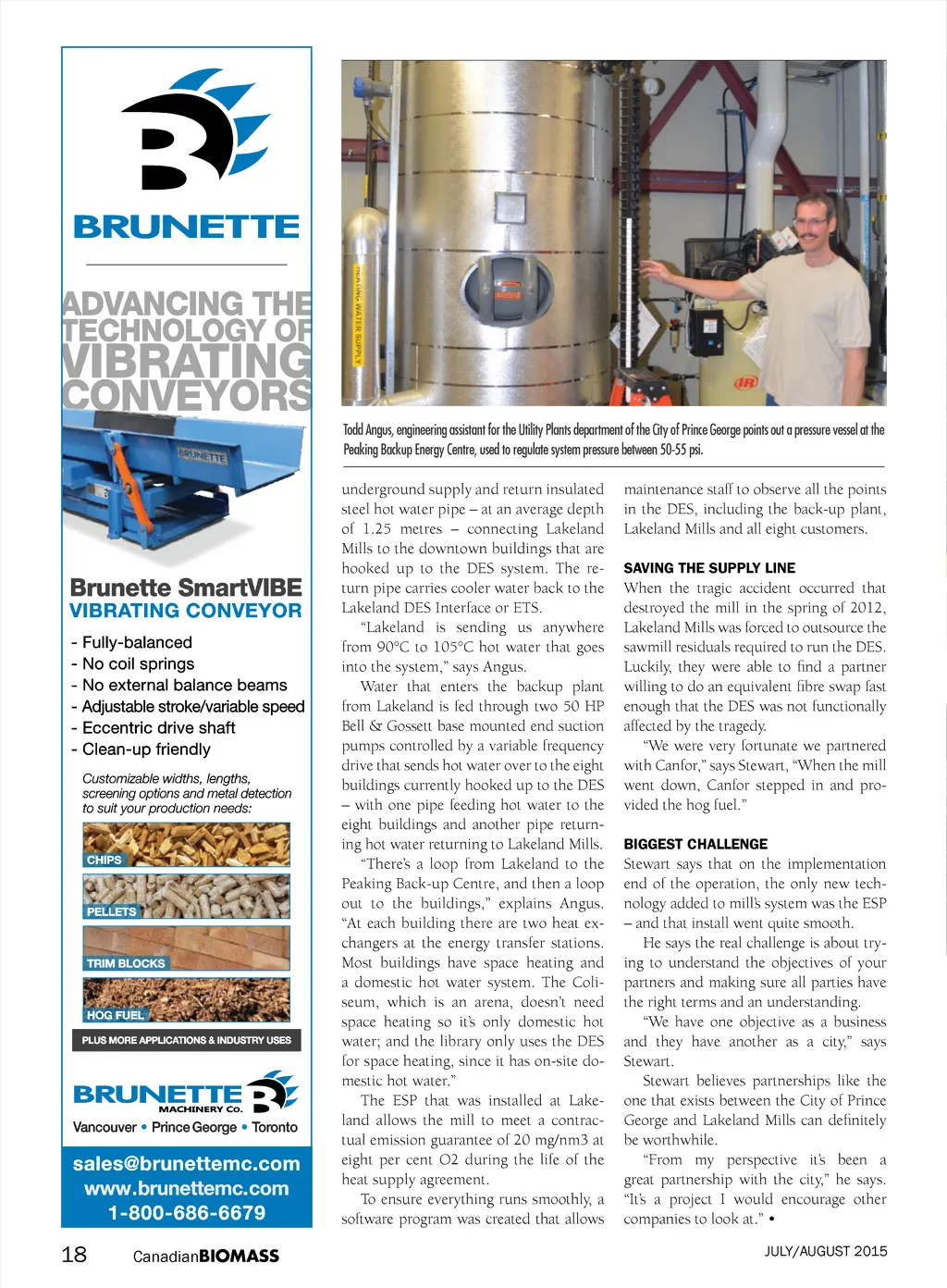
Todd Angus, engineering assistant for the Utility Plants department of the City of Prince George points out a pressure vessel at the Peaking Backup Energy Centre, used to regulate system pressure between 50-55 psi. underground supply and return insulated steel hot water pipe – at an average depth of 1.25 metres – connecting Lakeland Mills to the downtown buildings that are hooked up to the DES system. The re-turn pipe carries cooler water back to the Lakeland DES Interface or ETS. “Lakeland is sending us anywhere from 90°C to 105°C hot water that goes into the system,” says Angus. Water that enters the backup plant from Lakeland is fed through two 50 HP Bell & Gossett base mounted end suction pumps controlled by a variable frequency drive that sends hot water over to the eight buildings currently hooked up to the DES – with one pipe feeding hot water to the eight buildings and another pipe return-ing hot water returning to Lakeland Mills. “There’s a loop from Lakeland to the Peaking Back-up Centre, and then a loop out to the buildings,” explains Angus. “At each building there are two heat ex-changers at the energy transfer stations. Most buildings have space heating and a domestic hot water system. The Coli-seum, which is an arena, doesn’t need space heating so it’s only domestic hot water; and the library only uses the DES for space heating, since it has on-site do-mestic hot water.” The ESP that was installed at Lake-land allows the mill to meet a contrac-tual emission guarantee of 20 mg/nm3 at eight per cent O2 during the life of the heat supply agreement. To ensure everything runs smoothly, a software program was created that allows maintenance staff to observe all the points in the DES, including the back-up plant, Lakeland Mills and all eight customers. SAVING THE SUPPLY LINE When the tragic accident occurred that destroyed the mill in the spring of 2012, Lakeland Mills was forced to outsource the sawmill residuals required to run the DES. Luckily, they were able to find a partner willing to do an equivalent fibre swap fast enough that the DES was not functionally affected by the tragedy. “We were very fortunate we partnered with Canfor,” says Stewart, “When the mill went down, Canfor stepped in and pro-vided the hog fuel.” BIGGEST CHALLENGE Stewart says that on the implementation end of the operation, the only new tech-nology added to mill’s system was the ESP – and that install went quite smooth. He says the real challenge is about try-ing to understand the objectives of your partners and making sure all parties have the right terms and an understanding. “We have one objective as a business and they have another as a city,” says Stewart. Stewart believes partnerships like the one that exists between the City of Prince George and Lakeland Mills can definitely be worthwhile. “From my perspective it’s been a great partnership with the city,” he says. “It’s a project I would encourage other companies to look at.” • JULY/AUGUST 2015 18 Canadian BIOMASS
Canadian Biomass July August 2015: Page 18