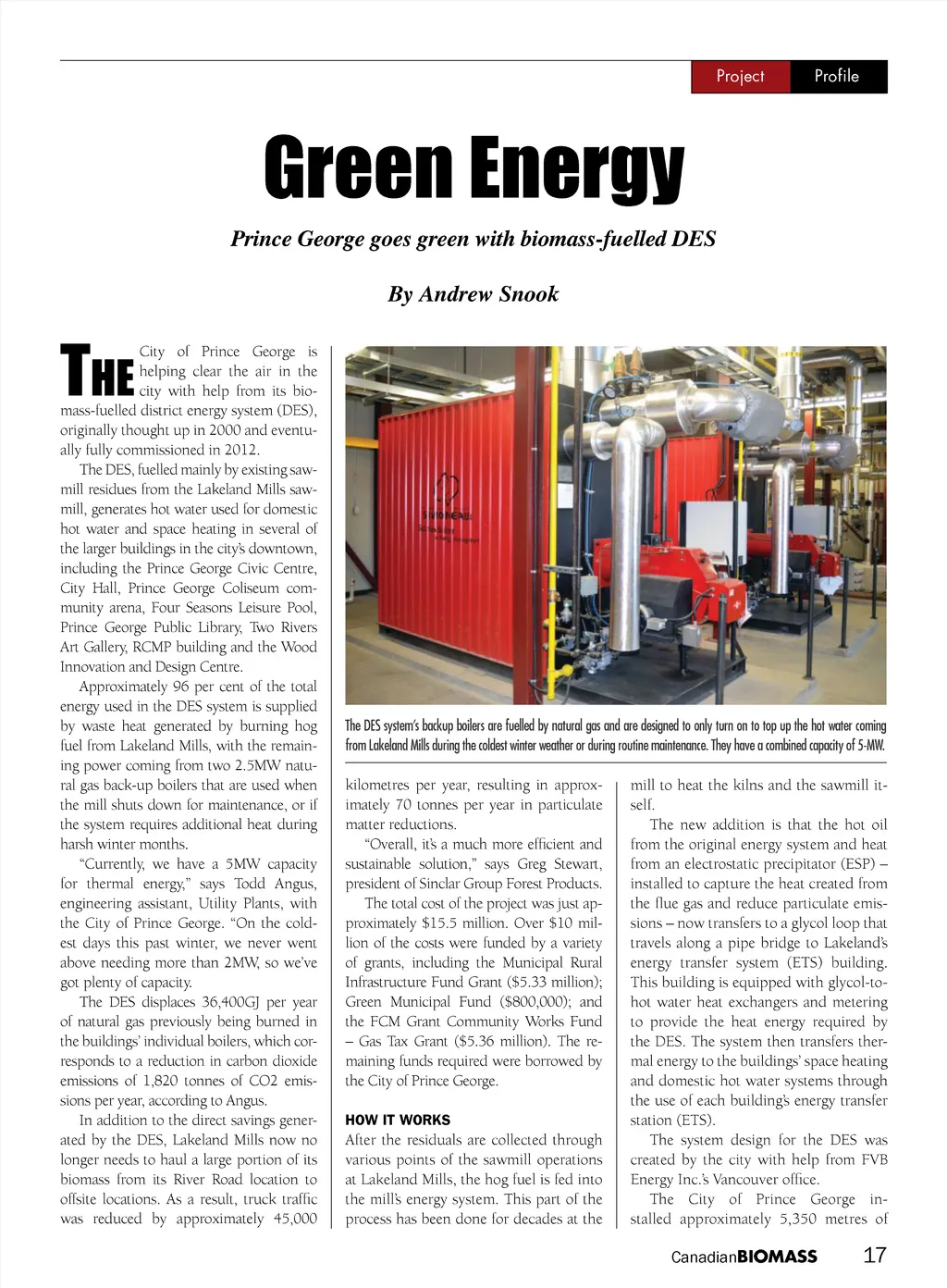
Project Profile Green Energy Prince George goes green with biomass-fuelled DES By Andrew Snook City of Prince George is helping clear the air in the city with help from its bio-mass-fuelled district energy system (DES), originally thought up in 2000 and eventu-ally fully commissioned in 2012. The DES, fuelled mainly by existing saw-mill residues from the Lakeland Mills saw-mill, generates hot water used for domestic hot water and space heating in several of the larger buildings in the city’s downtown, including the Prince George Civic Centre, City Hall, Prince George Coliseum com-munity arena, Four Seasons Leisure Pool, Prince George Public Library, Two Rivers Art Gallery, RCMP building and the Wood Innovation and Design Centre. Approximately 96 per cent of the total energy used in the DES system is supplied by waste heat generated by burning hog fuel from Lakeland Mills, with the remain-ing power coming from two 2.5MW natu-ral gas back-up boilers that are used when the mill shuts down for maintenance, or if the system requires additional heat during harsh winter months. “Currently, we have a 5MW capacity for thermal energy,” says Todd Angus, engineering assistant, Utility Plants, with the City of Prince George. “On the cold-est days this past winter, we never went above needing more than 2MW, so we’ve got plenty of capacity. The DES displaces 36,400GJ per year of natural gas previously being burned in the buildings’ individual boilers, which cor-responds to a reduction in carbon dioxide emissions of 1,820 tonnes of CO2 emis-sions per year, according to Angus. In addition to the direct savings gener-ated by the DES, Lakeland Mills now no longer needs to haul a large portion of its biomass from its River Road location to offsite locations. As a result, truck traffic was reduced by approximately 45,000 T he The DES system’s backup boilers are fuelled by natural gas and are designed to only turn on to top up the hot water coming from Lakeland Mills during the coldest winter weather or during routine maintenance. They have a combined capacity of 5-MW. kilometres per year, resulting in approx-imately 70 tonnes per year in particulate matter reductions. “Overall, it’s a much more efficient and sustainable solution,” says Greg Stewart, president of Sinclar Group Forest Products. The total cost of the project was just ap-proximately $15.5 million. Over $10 mil-lion of the costs were funded by a variety of grants, including the Municipal Rural Infrastructure Fund Grant ($5.33 million); Green Municipal Fund ($800,000); and the FCM Grant Community Works Fund – Gas Tax Grant ($5.36 million). The re-maining funds required were borrowed by the City of Prince George. HOW IT WORKS After the residuals are collected through various points of the sawmill operations at Lakeland Mills, the hog fuel is fed into the mill’s energy system. This part of the process has been done for decades at the mill to heat the kilns and the sawmill it-self. The new addition is that the hot oil from the original energy system and heat from an electrostatic precipitator (ESP) – installed to capture the heat created from the flue gas and reduce particulate emis-sions – now transfers to a glycol loop that travels along a pipe bridge to Lakeland’s energy transfer system (ETS) building. This building is equipped with glycol-to-hot water heat exchangers and metering to provide the heat energy required by the DES. The system then transfers ther-mal energy to the buildings’ space heating and domestic hot water systems through the use of each building’s energy transfer station (ETS). The system design for the DES was created by the city with help from FVB Energy Inc.’s Vancouver office. The City of Prince George in-stalled approximately 5,350 metres of Canadian BIOMASS 17
Canadian Biomass July August 2015: Page 17