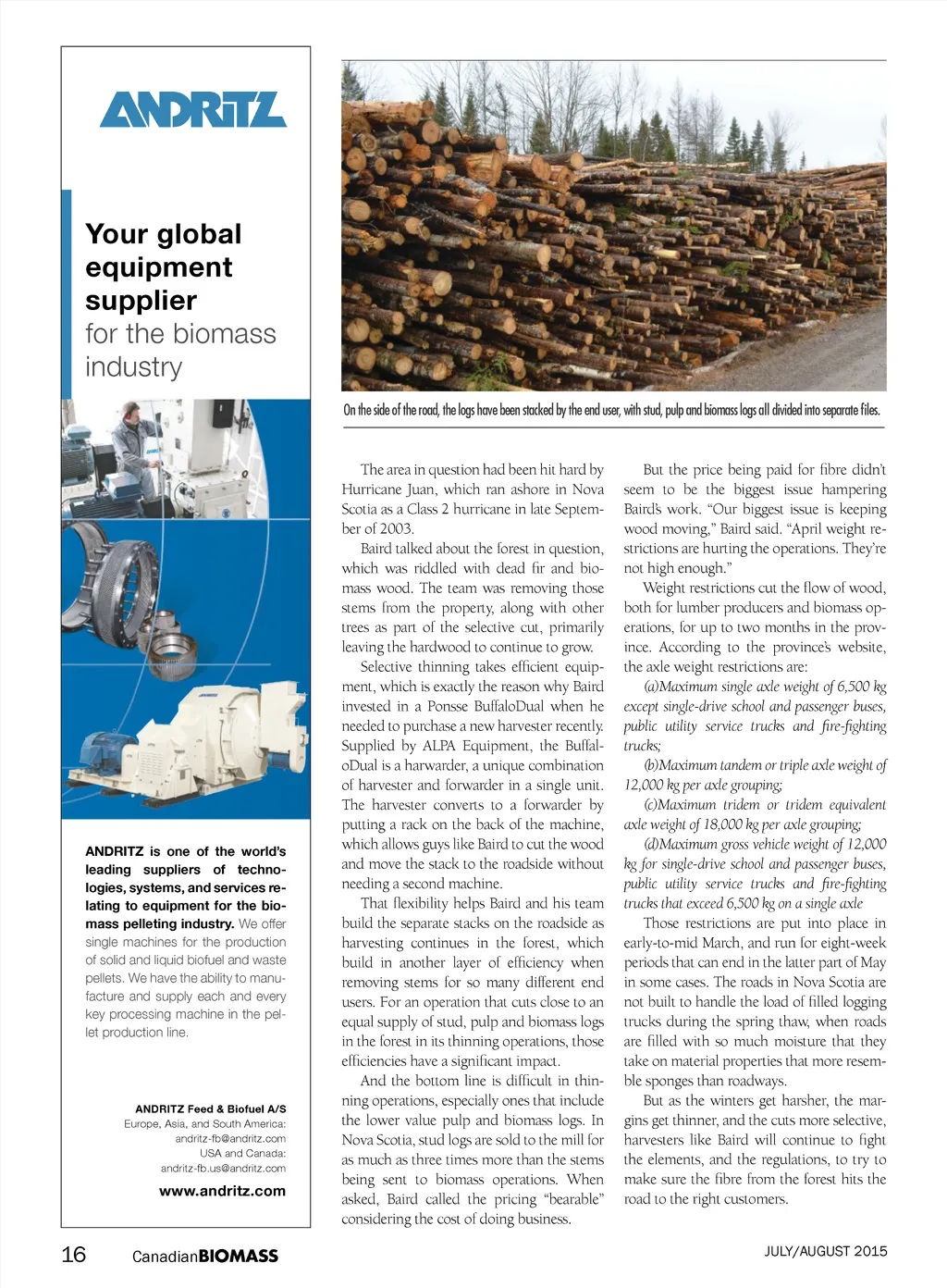
Your global equipment supplier for the biomass industry On the side of the road, the logs have been stacked by the end user, with stud, pulp and biomass logs all divided into separate files. ANDRITZ is one of the world’s leading suppliers of techno logies, systems, and services re lating to equipment for the bio mass pelleting industry. We offer single machines for the production of solid and liquid biofuel and waste pellets. We have the abili ty to manu-facture and supply each and every key processing machine in the pel-let production line. ANDRITZ Feed & Biofuel A/S Europe, Asia, and South America: [email protected] USA and Canada: [email protected] www.andritz.com The area in question had been hit hard by Hurricane Juan, which ran ashore in Nova Scotia as a Class 2 hurricane in late Septem-ber of 2003. Baird talked about the forest in question, which was riddled with dead fir and bio-mass wood. The team was removing those stems from the property, along with other trees as part of the selective cut, primarily leaving the hardwood to continue to grow. Selective thinning takes efficient equip-ment, which is exactly the reason why Baird invested in a Ponsse BuffaloDual when he needed to purchase a new harvester recently. Supplied by ALPA Equipment, the Buffal-oDual is a harwarder, a unique combination of harvester and forwarder in a single unit. The harvester converts to a forwarder by putting a rack on the back of the machine, which allows guys like Baird to cut the wood and move the stack to the roadside without needing a second machine. That flexibility helps Baird and his team build the separate stacks on the roadside as harvesting continues in the forest, which build in another layer of efficiency when removing stems for so many different end users. For an operation that cuts close to an equal supply of stud, pulp and biomass logs in the forest in its thinning operations, those efficiencies have a significant impact. And the bottom line is difficult in thin-ning operations, especially ones that include the lower value pulp and biomass logs. In Nova Scotia, stud logs are sold to the mill for as much as three times more than the stems being sent to biomass operations. When asked, Baird called the pricing “bearable” considering the cost of doing business. But the price being paid for fibre didn’t seem to be the biggest issue hampering Baird’s work. “Our biggest issue is keeping wood moving,” Baird said. “April weight re-strictions are hurting the operations. They’re not high enough.” Weight restrictions cut the flow of wood, both for lumber producers and biomass op-erations, for up to two months in the prov-ince. According to the province’s website, the axle weight restrictions are: (a)Maximum single axle weight of 6,500 kg except single-drive school and passenger buses, public utility service trucks and fire-fighting trucks; (b)Maximum tandem or triple axle weight of 12,000 kg per axle grouping; (c)Maximum tridem or tridem equivalent axle weight of 18,000 kg per axle grouping; (d)Maximum gross vehicle weight of 12,000 kg for single-drive school and passenger buses, public utility service trucks and fire-fighting trucks that exceed 6,500 kg on a single axle Those restrictions are put into place in early-to-mid March, and run for eight-week periods that can end in the latter part of May in some cases. The roads in Nova Scotia are not built to handle the load of filled logging trucks during the spring thaw, when roads are filled with so much moisture that they take on material properties that more resem-ble sponges than roadways. But as the winters get harsher, the mar-gins get thinner, and the cuts more selective, harvesters like Baird will continue to fight the elements, and the regulations, to try to make sure the fibre from the forest hits the road to the right customers. JULY/AUGUST 2015 16 Canadian BIOMASS
Canadian Biomass July August 2015: Page 16