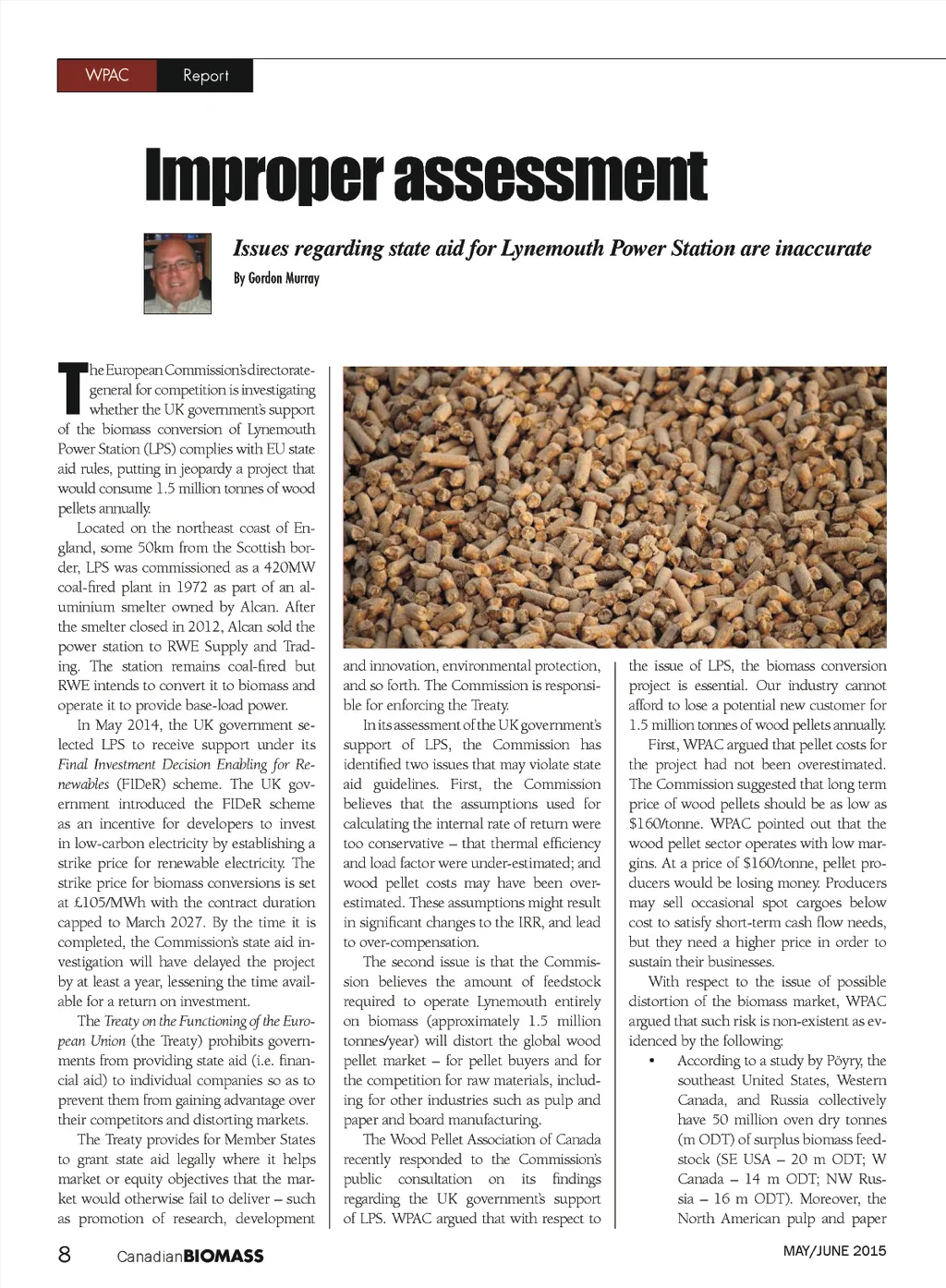
WPAC Report Improper assessment Issues regarding state aid for Lynemouth Power Station are inaccurate By Gordon Murray he European Commission’s directorate-general for competition is investigating whether the UK government’s support of the biomass conversion of Lynemouth Power Station (LPS) complies with EU state aid rules, putting in jeopardy a project that would consume 1.5 million tonnes of wood pellets annually. Located on the northeast coast of En-gland, some 50km from the Scottish bor-der, LPS was commissioned as a 420MW coal-fired plant in 1972 as part of an al-uminium smelter owned by Alcan. After the smelter closed in 2012, Alcan sold the power station to RWE Supply and Trad-ing. The station remains coal-fired but RWE intends to convert it to biomass and operate it to provide base-load power. In May 2014, the UK government se-lected LPS to receive support under its Final Investment Decision Enabling for Re-newables (FIDeR) scheme. The UK gov-ernment introduced the FIDeR scheme as an incentive for developers to invest in low-carbon electricity by establishing a strike price for renewable electricity. The strike price for biomass conversions is set at £105/MWh with the contract duration capped to March 2027. By the time it is completed, the Commission’s state aid in-vestigation will have delayed the project by at least a year, lessening the time avail-able for a return on investment. The Treaty on the Functioning of the Euro-pean Union (the Treaty) prohibits govern-ments from providing state aid (i.e. finan-cial aid) to individual companies so as to prevent them from gaining advantage over their competitors and distorting markets. The Treaty provides for Member States to grant state aid legally where it helps market or equity objectives that the mar-ket would otherwise fail to deliver – such as promotion of research, development T and innovation, environmental protection, and so forth. The Commission is responsi-ble for enforcing the Treaty. In its assessment of the UK government’s support of LPS, the Commission has identified two issues that may violate state aid guidelines. First, the Commission believes that the assumptions used for calculating the internal rate of return were too conservative – that thermal efficiency and load factor were under-estimated; and wood pellet costs may have been over-estimated. These assumptions might result in significant changes to the IRR, and lead to over-compensation. The second issue is that the Commis-sion believes the amount of feedstock required to operate Lynemouth entirely on biomass (approximately 1.5 million tonnes/year) will distort the global wood pellet market – for pellet buyers and for the competition for raw materials, includ-ing for other industries such as pulp and paper and board manufacturing. The Wood Pellet Association of Canada recently responded to the Commission’s public consultation on its findings regarding the UK government’s support of LPS. WPAC argued that with respect to the issue of LPS, the biomass conversion project is essential. Our industry cannot afford to lose a potential new customer for 1.5 million tonnes of wood pellets annually. First, WPAC argued that pellet costs for the project had not been overestimated. The Commission suggested that long term price of wood pellets should be as low as $160/tonne. WPAC pointed out that the wood pellet sector operates with low mar-gins. At a price of $160/tonne, pellet pro-ducers would be losing money. Producers may sell occasional spot cargoes below cost to satisfy short-term cash flow needs, but they need a higher price in order to sustain their businesses. With respect to the issue of possible distortion of the biomass market, WPAC argued that such risk is non-existent as ev-idenced by the following: • According to a study by Pöyry, the southeast United States, Western Canada, and Russia collectively have 50 million oven dry tonnes (m ODT) of surplus biomass feed-stock (SE USA – 20 m ODT; W Canada – 14 m ODT; NW Rus-sia – 16 m ODT). Moreover, the North American pulp and paper MAY/JUNE 2015 8 Canadian BIOMASS
Canadian Biomass May-June 2015: Page 8