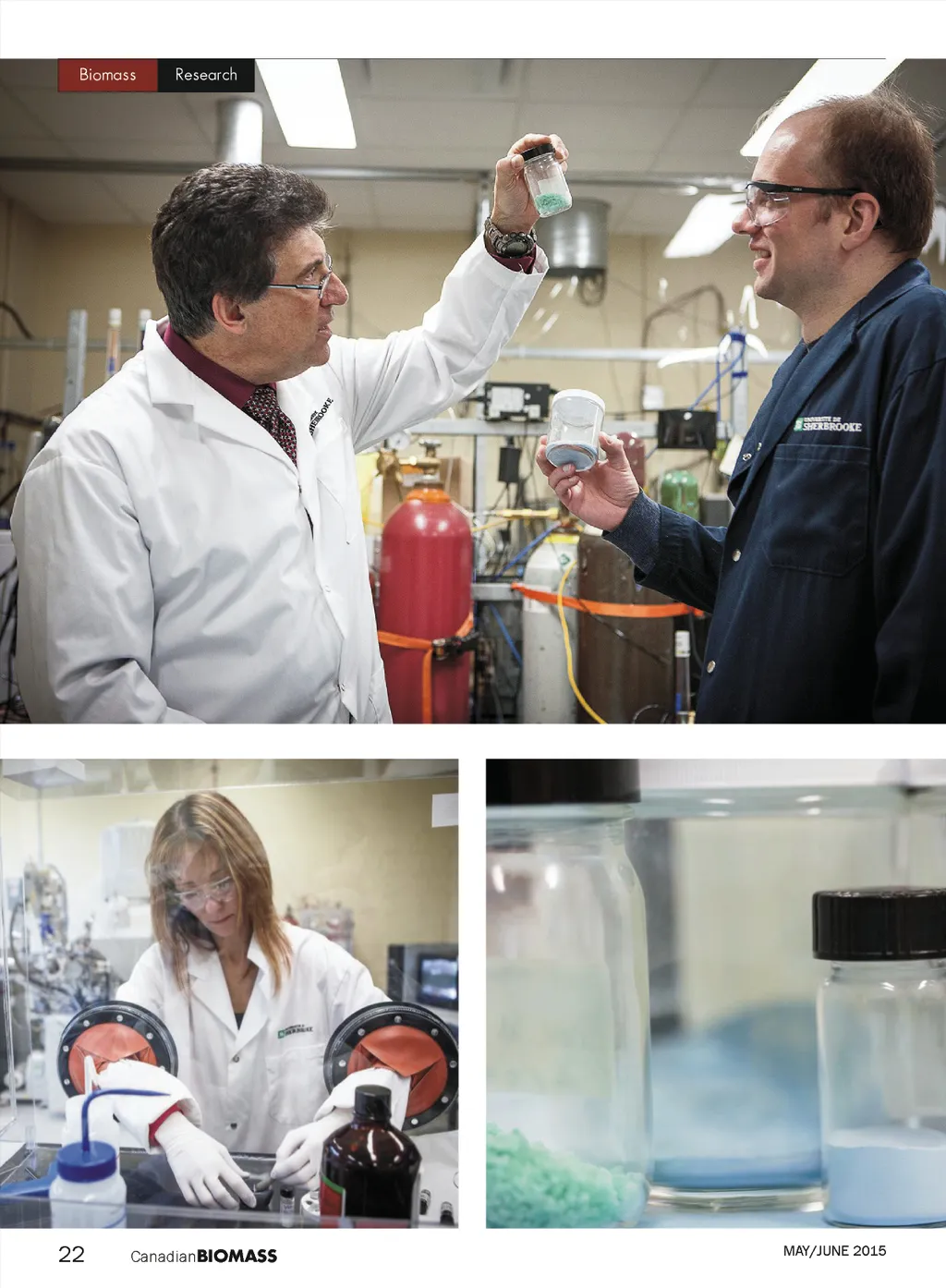
Molecular Marvel A novel catalyst greases the wheels of biofuel production By Gabrielle Bauer on how many years separate you from your last chemistry class, you may or may not remember the definition of a catalyst: a compound that facilitates a chemical reaction without being consumed by the reaction. Many reactions can’t happen efficiently – or at all – without catalysts. One such reaction is the conversion of hydrocarbons, such as the methane found in natural gas, to hydrogen and “syngas,” a gaseous mixture used to pro-duce liquid biofuels. The catalysts typ-ically used for this conversion process have two strikes against them: they’re quite costly, and they get deactivated during the chemical reaction. This means “you have to continually supply more catalyst to keep the reaction going, which further increases the cost,” says Nicolas Abatzoglou, director of chemical engi-neering and biotechnology at the Univer-sity of Sherbrooke. In business terms, this means less efficient production. For the past several years, Abatzoglou, who also serves as BioFuelNet’s Conver-sion Theme Leader, has been working to make the conversion reaction, called “reforming of natural gas,” more efficient and thus commercially viable. At the heart of his mission: creating a better catalyst. After the requisite trial and error at the lab bench, he and his research team hit pay dirt in 2010, with a “more robust and resistant compound than the products used in the indus-try,” he says. When he compared his new catalyst to commercially available alternatives, he found it not only in-creased yields but stayed active for lon-ger periods of time. That’s because his Depending catalyst is much more resistant to “cat-alytic fouling,” a process that gradually degrades the compound. As Abatzoglou explains, a longer-lasting catalyst has the two-pronged benefit of saving costs and sparing the environment from the im-pact of discarding fouled catalyst. The US patent for his creation came through in 2012. With the basic research behind them, the researchers set out to test the new catalyst on a wider scale. They found the perfect testing ground in Enerkem Inc., a green chemical company that uses ad-vanced gasification technology to con-vert a variety of feedstocks into biofuels and other chemicals. Enerkem’s laboratory in Edmonton, the company’s first full-scale commer-cial “waste-to-alcohols” facility, is in the midst of testing the novel catalyst, and results to date do not disappoint. “The catalyst did just as well at the Enerken laboratory facilities as it did in our lab,” Abatzoglou says, adding that “we’ve now established, in our own laboratories, the high yield and stability of the catalyst for over 500 hours of operation within a range of conditions which result in no coke formation” Although Abatzoglou has no plans to market the product himself – as a re-searcher, he finds his greatest comfort zone in the process lab and in technol-ogy transfer – he says that BioFuelNet could play an important role in bringing his work to industry’s attention. “Any company that makes biofuel is a poten-tial client, as well as companies produc-ing hydrogen,” he says. Given that more than 80 per cent of hydrogen production worldwide comes from natural gas, the catalyst’s use can extend to this sector. Better yet, “the added efficiency of our catalyst could make it commercially viable to produce hydrogen and syngas not just from natural gas, but from almost any methane-rich gas,” Abatzoglou says. He includes biogases produced by anaerobic fermentation, such as landfill gas, in this category. “Methane-rich gases can often be environmental nuisances, and finding ways to transform them into useful fuels and products is a very important research priority right now,” he notes. If the cost of using biogas as a “starter” becomes comparable with the cost of starting from fossil fuels, the possibilities for green biofuel production multiply – an obvious boon for the environment. Industrial applications could include solid oxide fuel cells (SOFC) for efficient production of electricity and third-generation liquid biofuels like green diesel and gasoline. In the meantime, Abatzoglou and his research associates are back at the lab bench, exploring the mechanisms that allow the novel catalyst to work so well. He has enlisted several of his students to work on the effort, and takes his role as their mentor very seriously. “They’re soci-ety’s future technological leaders,” he says. If his catalyst yields its chemical se-crets, Abatzoglou hopes to keep tweak-ing the molecule to achieve still greater improvements in efficiency. “There’s no reason to stop where we are now.” • For more information about current industry research projects, visit: www. canadianbiomassmagazine.ca MAIN: If his catalyst yields its chemical secrets, Abatzoglou hopes to keep tweaking the molecule to achieve still greater improvements in efficiency. BOTTOM LEFT: Abatzoglou has recruited some of his students to help explore what allows the novel catalyst to work so well. BOTTOM RIGHT: Abatzoglou’s research paid off in 2010, when he discovered a ‘more robust and resistant compound’ than what was available in the industry. Canadian BIOMASS 23
Canadian Biomass May-June 2015: Page 23