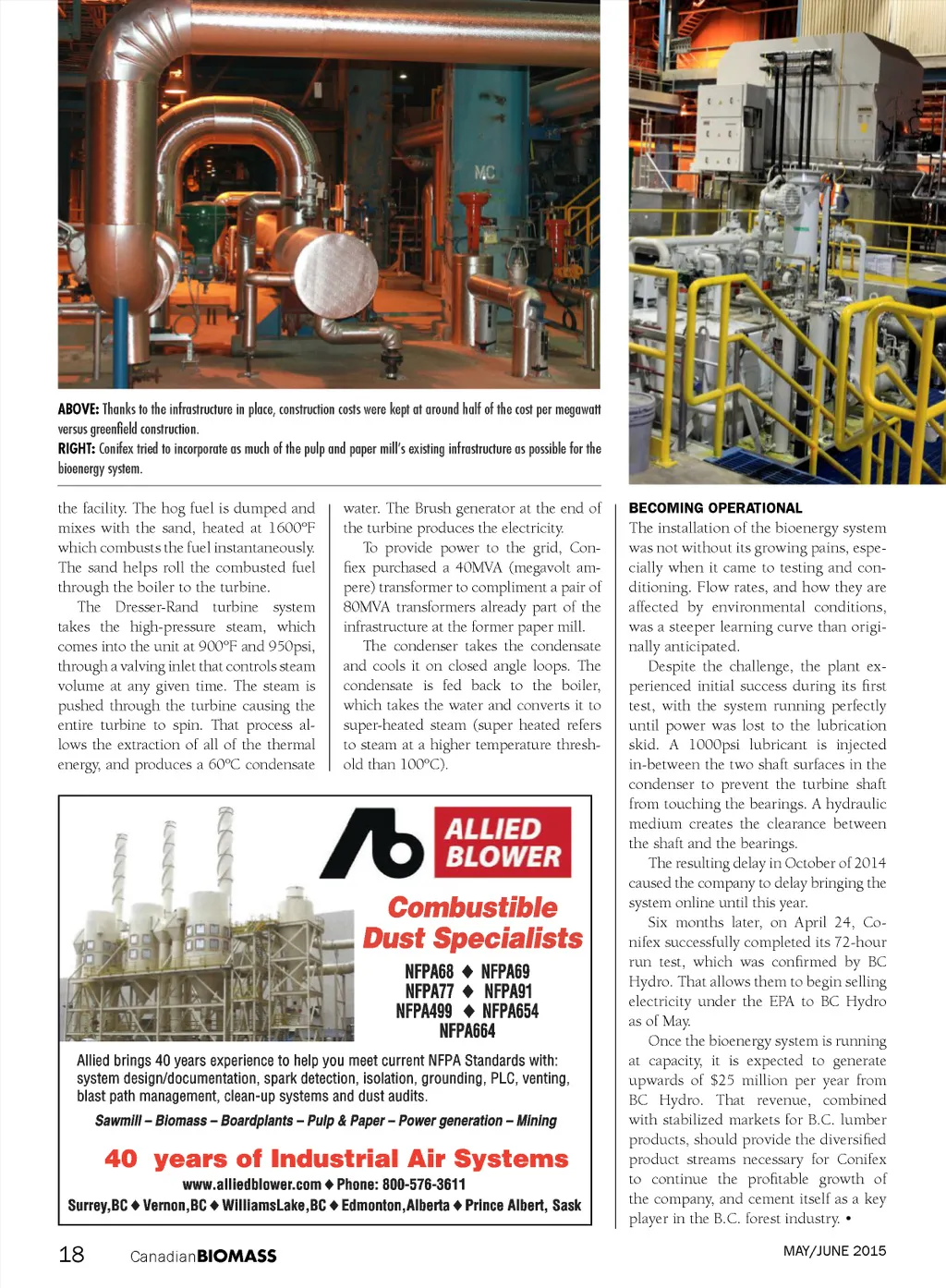
ABOVE: Thanks to the infrastructure in place, construction costs were kept at around half of the cost per megawatt versus greenfield construction. RIGHT: Conifex tried to incorporate as much of the pulp and paper mill’s existing infrastructure as possible for the bioenergy system. the facility. The hog fuel is dumped and mixes with the sand, heated at 1600°F which combusts the fuel instantaneously. The sand helps roll the combusted fuel through the boiler to the turbine. The Dresser-Rand turbine system takes the high-pressure steam, which comes into the unit at 900°F and 950psi, through a valving inlet that controls steam volume at any given time. The steam is pushed through the turbine causing the entire turbine to spin. That process al-lows the extraction of all of the thermal energy, and produces a 60°C condensate water. The Brush generator at the end of the turbine produces the electricity. To provide power to the grid, Con-fiex purchased a 40MVA (megavolt am-pere) transformer to compliment a pair of 80MVA transformers already part of the infrastructure at the former paper mill. The condenser takes the condensate and cools it on closed angle loops. The condensate is fed back to the boiler, which takes the water and converts it to super-heated steam (super heated refers to steam at a higher temperature thresh-old than 100°C). BECOMING OPERATIONAL The installation of the bioenergy system was not without its growing pains, espe-cially when it came to testing and con-ditioning. Flow rates, and how they are affected by environmental conditions, was a steeper learning curve than origi-nally anticipated. Despite the challenge, the plant ex-perienced initial success during its first test, with the system running perfectly until power was lost to the lubrication skid. A 1000psi lubricant is injected in-between the two shaft surfaces in the condenser to prevent the turbine shaft from touching the bearings. A hydraulic medium creates the clearance between the shaft and the bearings. The resulting delay in October of 2014 caused the company to delay bringing the system online until this year. Six months later, on April 24, Co-nifex successfully completed its 72-hour run test, which was confirmed by BC Hydro. That allows them to begin selling electricity under the EPA to BC Hydro as of May. Once the bioenergy system is running at capacity, it is expected to generate upwards of $25 million per year from BC Hydro. That revenue, combined with stabilized markets for B.C. lumber products, should provide the diversified product streams necessary for Conifex to continue the profitable growth of the company, and cement itself as a key player in the B.C. forest industry. • MAY/JUNE 2015 18 Canadian BIOMASS 2014-11-18 2:22 PM allied blower biomass novdec14.indd 1
Canadian Biomass May-June 2015: Page 18