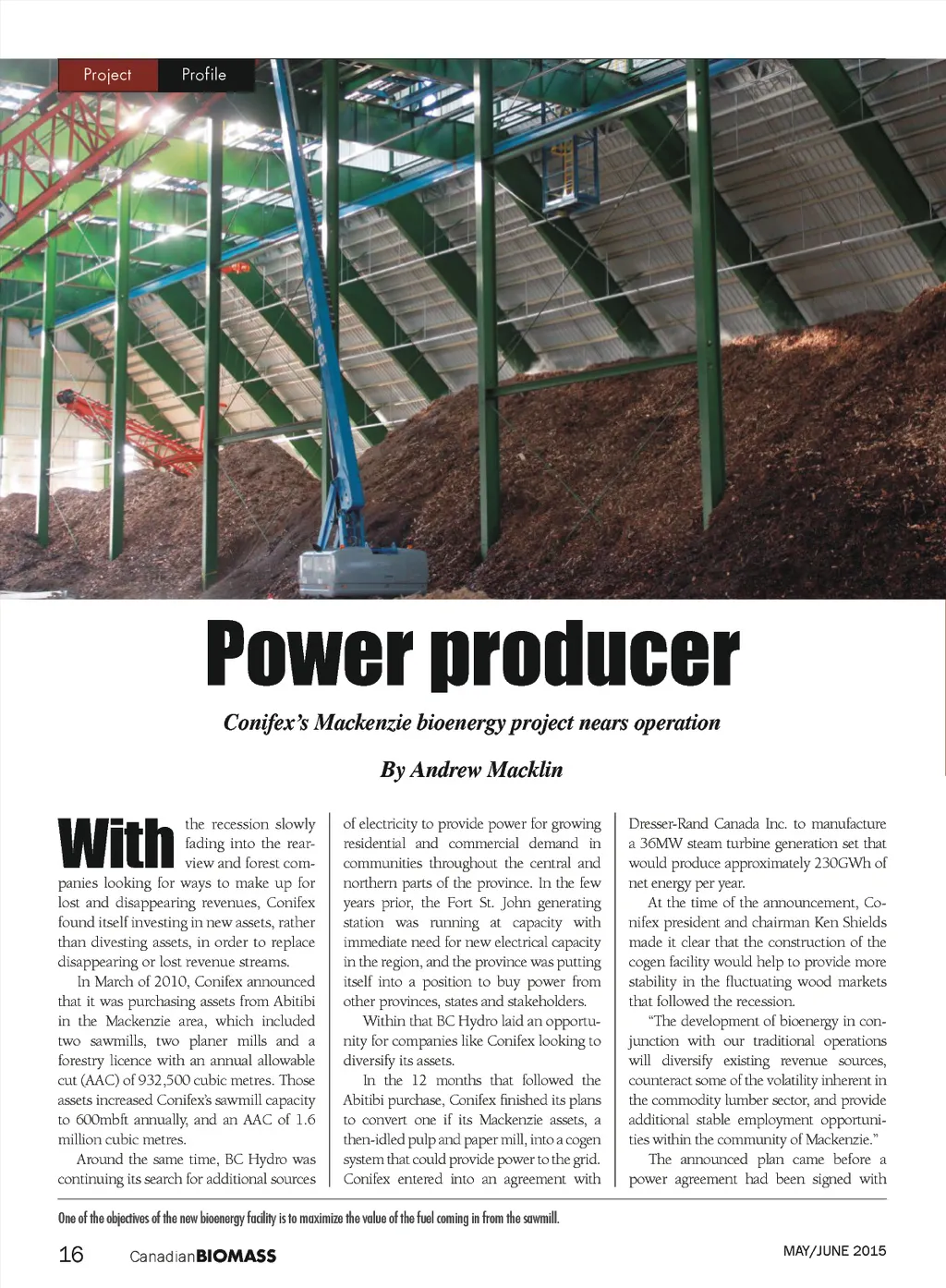
Project Profile Power producer Conifex’s Mackenzie bioenergy project nears operation By Andrew Macklin With the recession slowly fading into the rear-view and forest com-panies looking for ways to make up for lost and disappearing revenues, Conifex found itself investing in new assets, rather than divesting assets, in order to replace disappearing or lost revenue streams. In March of 2010, Conifex announced that it was purchasing assets from Abitibi in the Mackenzie area, which included two sawmills, two planer mills and a forestry licence with an annual allowable cut (AAC) of 932,500 cubic metres. Those assets increased Conifex’s sawmill capacity to 600mbft annually, and an AAC of 1.6 million cubic metres. Around the same time, BC Hydro was continuing its search for additional sources of electricity to provide power for growing residential and commercial demand in communities throughout the central and northern parts of the province. In the few years prior, the Fort St. John generating station was running at capacity with immediate need for new electrical capacity in the region, and the province was putting itself into a position to buy power from other provinces, states and stakeholders. Within that BC Hydro laid an opportu-nity for companies like Conifex looking to diversify its assets. In the 12 months that followed the Abitibi purchase, Conifex finished its plans to convert one if its Mackenzie assets, a then-idled pulp and paper mill, into a cogen system that could provide power to the grid. Conifex entered into an agreement with Dresser-Rand Canada Inc. to manufacture a 36MW steam turbine generation set that would produce approximately 230GWh of net energy per year. At the time of the announcement, Co-nifex president and chairman Ken Shields made it clear that the construction of the cogen facility would help to provide more stability in the fluctuating wood markets that followed the recession. “The development of bioenergy in con-junction with our traditional operations will diversify existing revenue sources, counteract some of the volatility inherent in the commodity lumber sector, and provide additional stable employment opportuni-ties within the community of Mackenzie.” The announced plan came before a power agreement had been signed with One of the objectives of the new bioenergy facility is to maximize the value of the fuel coming in from the sawmill. 16 Canadian BIOMASS MAY/JUNE 2015
Canadian Biomass May-June 2015: Page 16