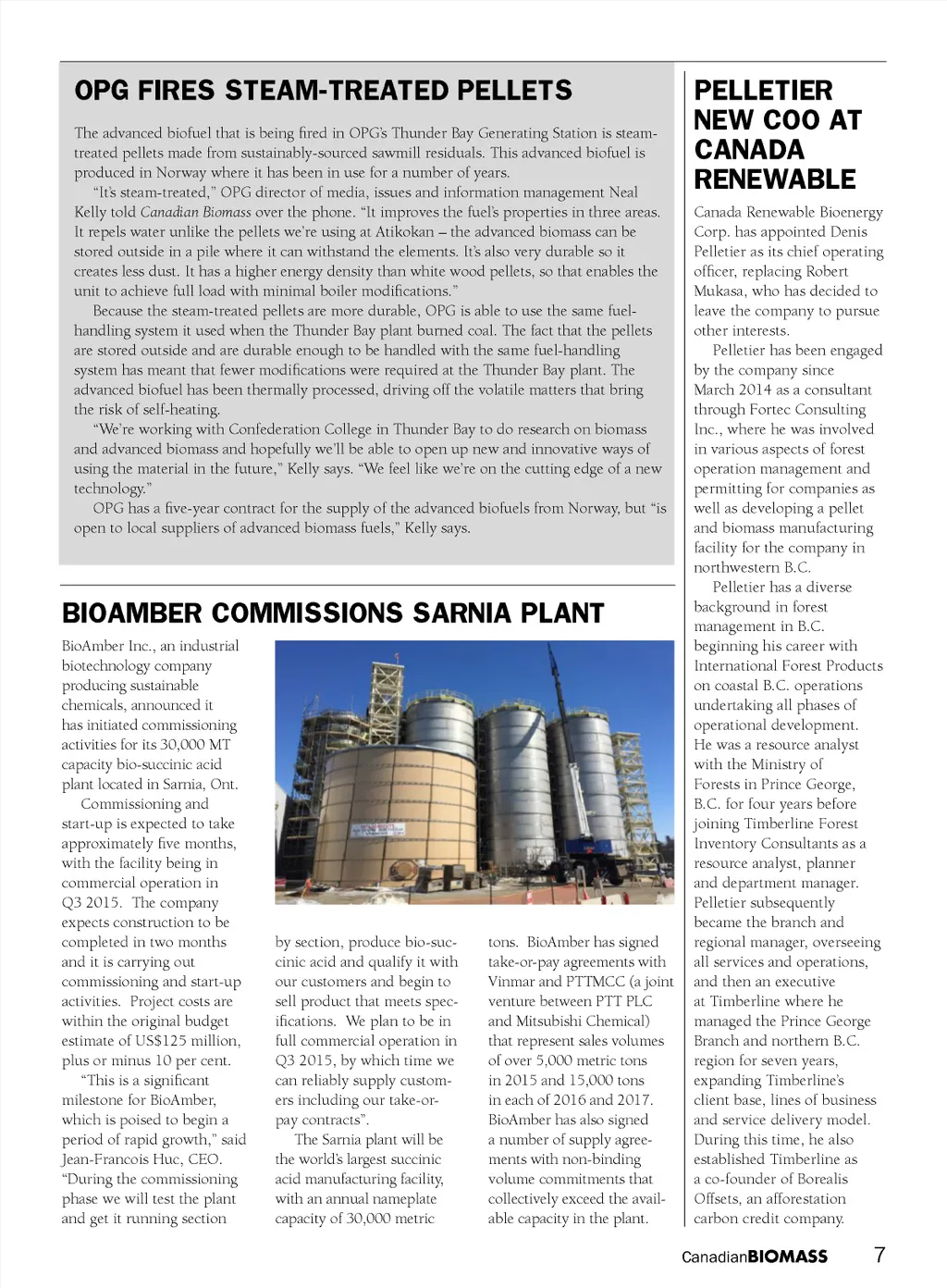
OPG FIRES STEAM-TREATED PELLETS The advanced biofuel that is being fired in OPG’s Thunder Bay Generating Station is steam-treated pellets made from sustainably-sourced sawmill residuals. This advanced biofuel is produced in Norway where it has been in use for a number of years. “It’s steam-treated,” OPG director of media, issues and information management Neal Kelly told Canadian Biomass over the phone. “It improves the fuel’s properties in three areas. It repels water unlike the pellets we’re using at Atikokan – the advanced biomass can be stored outside in a pile where it can withstand the elements. It’s also very durable so it creates less dust. It has a higher energy density than white wood pellets, so that enables the unit to achieve full load with minimal boiler modifications.” Because the steam-treated pellets are more durable, OPG is able to use the same fuel-handling system it used when the Thunder Bay plant burned coal. The fact that the pellets are stored outside and are durable enough to be handled with the same fuel-handling system has meant that fewer modifications were required at the Thunder Bay plant. The advanced biofuel has been thermally processed, driving off the volatile matters that bring the risk of self-heating. “We’re working with Confederation College in Thunder Bay to do research on biomass and advanced biomass and hopefully we’ll be able to open up new and innovative ways of using the material in the future,” Kelly says. “We feel like we’re on the cutting edge of a new technology.” OPG has a five-year contract for the supply of the advanced biofuels from Norway, but “is open to local suppliers of advanced biomass fuels,” Kelly says. PELLETIER NEW COO AT CANADA RENEWABLE Canada Renewable Bioenergy Corp. has appointed Denis Pelletier as its chief operating officer, replacing Robert Mukasa, who has decided to leave the company to pursue other interests. Pelletier has been engaged by the company since March 2014 as a consultant through Fortec Consulting Inc., where he was involved in various aspects of forest operation management and permitting for companies as well as developing a pellet and biomass manufacturing facility for the company in northwestern B.C. Pelletier has a diverse background in forest management in B.C. beginning his career with International Forest Products on coastal B.C. operations undertaking all phases of operational development. He was a resource analyst with the Ministry of Forests in Prince George, B.C. for four years before joining Timberline Forest Inventory Consultants as a resource analyst, planner and department manager. Pelletier subsequently became the branch and regional manager, overseeing all services and operations, and then an executive at Timberline where he managed the Prince George Branch and northern B.C. region for seven years, expanding Timberline’s client base, lines of business and service delivery model. During this time, he also established Timberline as a co-founder of Borealis Offsets, an afforestation carbon credit company. BIOAMBER COMMISSIONS SARNIA PLANT BioAmber Inc., an industrial biotechnology company producing sustainable chemicals, announced it has initiated commissioning activities for its 30,000 MT capacity bio-succinic acid plant located in Sarnia, Ont. Commissioning and start-up is expected to take approximately five months, with the facility being in commercial operation in Q3 2015. The company expects construction to be completed in two months and it is carrying out commissioning and start-up activities. Project costs are within the original budget estimate of US$125 million, plus or minus 10 per cent. “This is a significant milestone for BioAmber, which is poised to begin a period of rapid growth,” said Jean-Francois Huc, CEO. “During the commissioning phase we will test the plant and get it running section by section, produce bio-suc-cinic acid and qualify it with our customers and begin to sell product that meets spec-ifications. We plan to be in full commercial operation in Q3 2015, by which time we can reliably supply custom-ers including our take-or-pay contracts”. The Sarnia plant will be the world’s largest succinic acid manufacturing facility, with an annual nameplate capacity of 30,000 metric tons. BioAmber has signed take-or-pay agreements with Vinmar and PTTMCC (a joint venture between PTT PLC and Mitsubishi Chemical) that represent sales volumes of over 5,000 metric tons in 2015 and 15,000 tons in each of 2016 and 2017. BioAmber has also signed a number of supply agree-ments with non-binding volume commitments that collectively exceed the avail-able capacity in the plant. Canadian BIOMASS 7
Canadian Biomass March-April 2015: Page 7