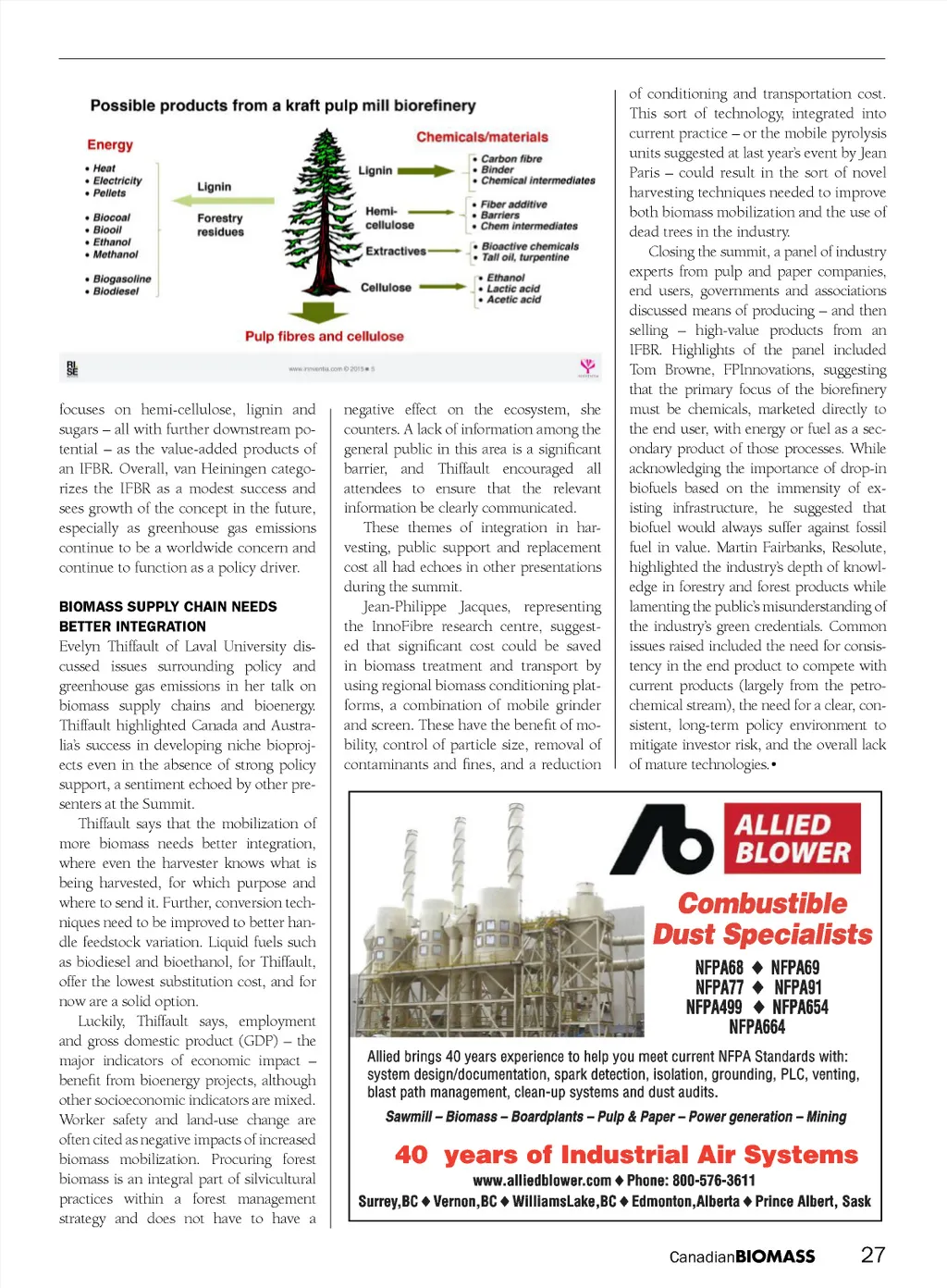
focuses on hemi-cellulose, lignin and sugars – all with further downstream po-tential – as the value-added products of an IFBR. Overall, van Heiningen catego-rizes the IFBR as a modest success and sees growth of the concept in the future, especially as greenhouse gas emissions continue to be a worldwide concern and continue to function as a policy driver. BIOMASS SUPPLY CHAIN NEEDS BETTER INTEGRATION Evelyn Thiffault of Laval University dis-cussed issues surrounding policy and greenhouse gas emissions in her talk on biomass supply chains and bioenergy. Thiffault highlighted Canada and Austra-lia’s success in developing niche bioproj-ects even in the absence of strong policy support, a sentiment echoed by other pre-senters at the Summit. Thiffault says that the mobilization of more biomass needs better integration, where even the harvester knows what is being harvested, for which purpose and where to send it. Further, conversion tech-niques need to be improved to better han-dle feedstock variation. Liquid fuels such as biodiesel and bioethanol, for Thiffault, offer the lowest substitution cost, and for now are a solid option. Luckily, Thiffault says, employment and gross domestic product (GDP) – the major indicators of economic impact – benefit from bioenergy projects, although other socioeconomic indicators are mixed. Worker safety and land-use change are often cited as negative impacts of increased biomass mobilization. Procuring forest biomass is an integral part of silvicultural practices within a forest management strategy and does not have to have a negative effect on the ecosystem, she counters. A lack of information among the general public in this area is a significant barrier, and Thiffault encouraged all attendees to ensure that the relevant information be clearly communicated. These themes of integration in har-vesting, public support and replacement cost all had echoes in other presentations during the summit. Jean-Philippe Jacques, representing the InnoFibre research centre, suggest-ed that significant cost could be saved in biomass treatment and transport by using regional biomass conditioning plat-forms, a combination of mobile grinder and screen. These have the benefit of mo-bility, control of particle size, removal of contaminants and fines, and a reduction of conditioning and transportation cost. This sort of technology, integrated into current practice – or the mobile pyrolysis units suggested at last year’s event by Jean Paris – could result in the sort of novel harvesting techniques needed to improve both biomass mobilization and the use of dead trees in the industry. Closing the summit, a panel of industry experts from pulp and paper companies, end users, governments and associations discussed means of producing – and then selling – high-value products from an IFBR. Highlights of the panel included Tom Browne, FPInnovations, suggesting that the primary focus of the biorefinery must be chemicals, marketed directly to the end user, with energy or fuel as a sec-ondary product of those processes. While acknowledging the importance of drop-in biofuels based on the immensity of ex-isting infrastructure, he suggested that biofuel would always suffer against fossil fuel in value. Martin Fairbanks, Resolute, highlighted the industry’s depth of knowl-edge in forestry and forest products while lamenting the public’s misunderstanding of the industry’s green credentials. Common issues raised included the need for consis-tency in the end product to compete with current products (largely from the petro-chemical stream), the need for a clear, con-sistent, long-term policy environment to mitigate investor risk, and the overall lack of mature technologies.• Canadian BIOMASS allied blower biomass novdec14.indd 1 27 2014-11-18 2:22 PM
Canadian Biomass March-April 2015: Page 27