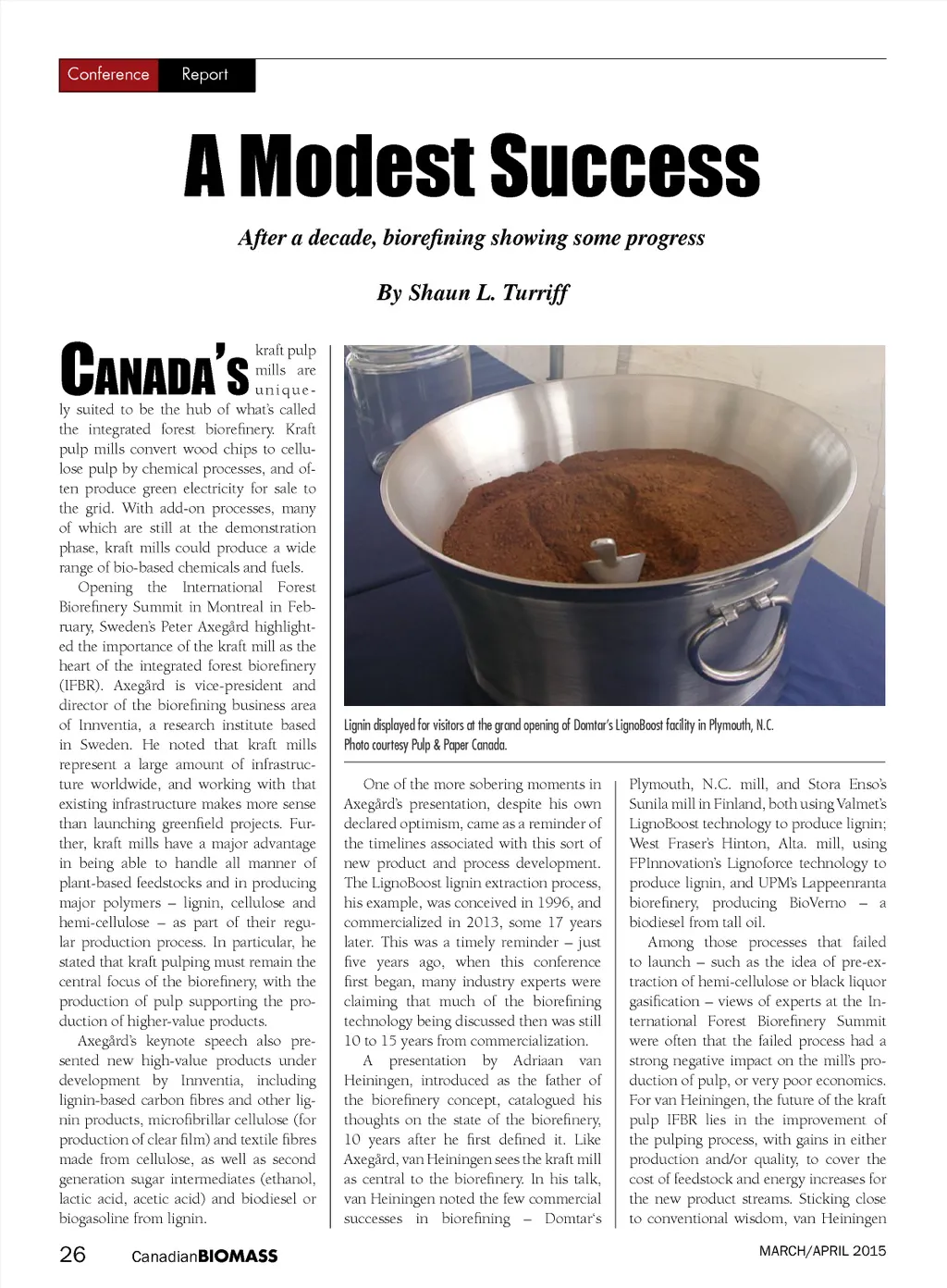
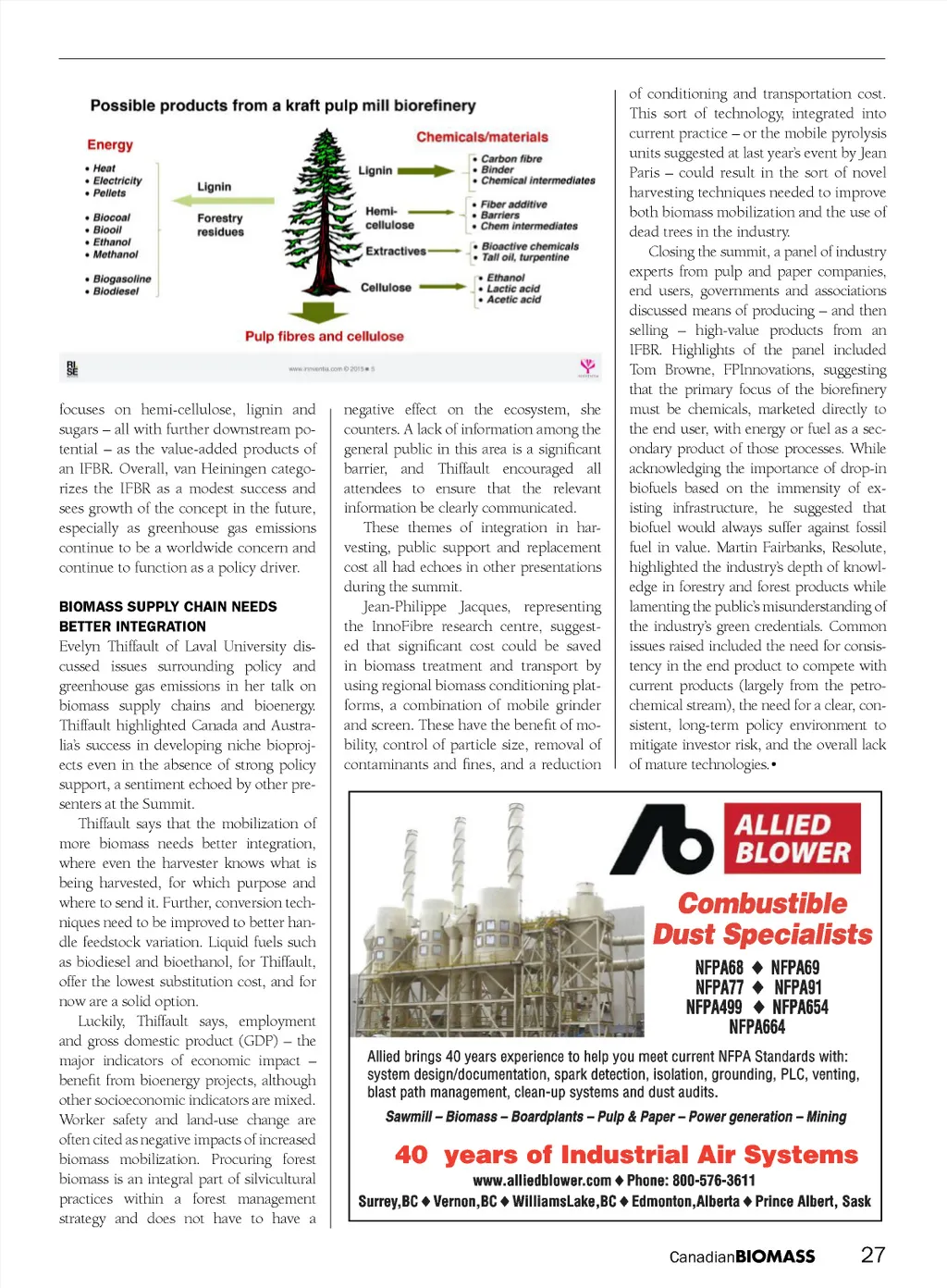
Conference Report A Modest Success After a decade, biorefining showing some progress By Shaun L. Turriff C anada ’ s kraft pulp mills are unique -ly suited to be the hub of what’s called the integrated forest biorefinery. Kraft pulp mills convert wood chips to cellu-lose pulp by chemical processes, and of-ten produce green electricity for sale to the grid. With add-on processes, many of which are still at the demonstration phase, kraft mills could produce a wide range of bio-based chemicals and fuels. Opening the International Forest Biorefinery Summit in Montreal in Feb-ruary, Sweden’s Peter Axegård highlight-ed the importance of the kraft mill as the heart of the integrated forest biorefinery (IFBR). Axegård is vice-president and director of the biorefining business area of Innventia, a research institute based in Sweden. He noted that kraft mills represent a large amount of infrastruc-ture worldwide, and working with that existing infrastructure makes more sense than launching greenfield projects. Fur-ther, kraft mills have a major advantage in being able to handle all manner of plant-based feedstocks and in producing major polymers – lignin, cellulose and hemi-cellulose – as part of their regu-lar production process. In particular, he stated that kraft pulping must remain the central focus of the biorefinery, with the production of pulp supporting the pro-duction of higher-value products. Axegård’s keynote speech also pre-sented new high-value products under development by Innventia, including lignin-based carbon fibres and other lig-nin products, microfibrillar cellulose (for production of clear film) and textile fibres made from cellulose, as well as second generation sugar intermediates (ethanol, lactic acid, acetic acid) and biodiesel or biogasoline from lignin. Lignin displayed for visitors at the grand opening of Domtar’s LignoBoost facility in Plymouth, N.C. Photo courtesy Pulp & Paper Canada. One of the more sobering moments in Axegård’s presentation, despite his own declared optimism, came as a reminder of the timelines associated with this sort of new product and process development. The LignoBoost lignin extraction process, his example, was conceived in 1996, and commercialized in 2013, some 17 years later. This was a timely reminder – just five years ago, when this conference first began, many industry experts were claiming that much of the biorefining technology being discussed then was still 10 to 15 years from commercialization. A presentation by Adriaan van Heiningen, introduced as the father of the biorefinery concept, catalogued his thoughts on the state of the biorefinery, 10 years after he first defined it. Like Axegård, van Heiningen sees the kraft mill as central to the biorefinery. In his talk, van Heiningen noted the few commercial successes in biorefining – Domtar‘s Plymouth, N.C. mill, and Stora Enso’s Sunila mill in Finland, both using Valmet’s LignoBoost technology to produce lignin; West Fraser’s Hinton, Alta. mill, using FPInnovation’s Lignoforce technology to produce lignin, and UPM’s Lappeenranta biorefinery, producing BioVerno – a biodiesel from tall oil. Among those processes that failed to launch – such as the idea of pre-ex-traction of hemi-cellulose or black liquor gasification – views of experts at the In-ternational Forest Biorefinery Summit were often that the failed process had a strong negative impact on the mill’s pro-duction of pulp, or very poor economics. For van Heiningen, the future of the kraft pulp IFBR lies in the improvement of the pulping process, with gains in either production and/or quality, to cover the cost of feedstock and energy increases for the new product streams. Sticking close to conventional wisdom, van Heiningen MARCH/APRIL 2015 26 Canadian BIOMASS
Canadian Biomass March-April 2015: Page 26