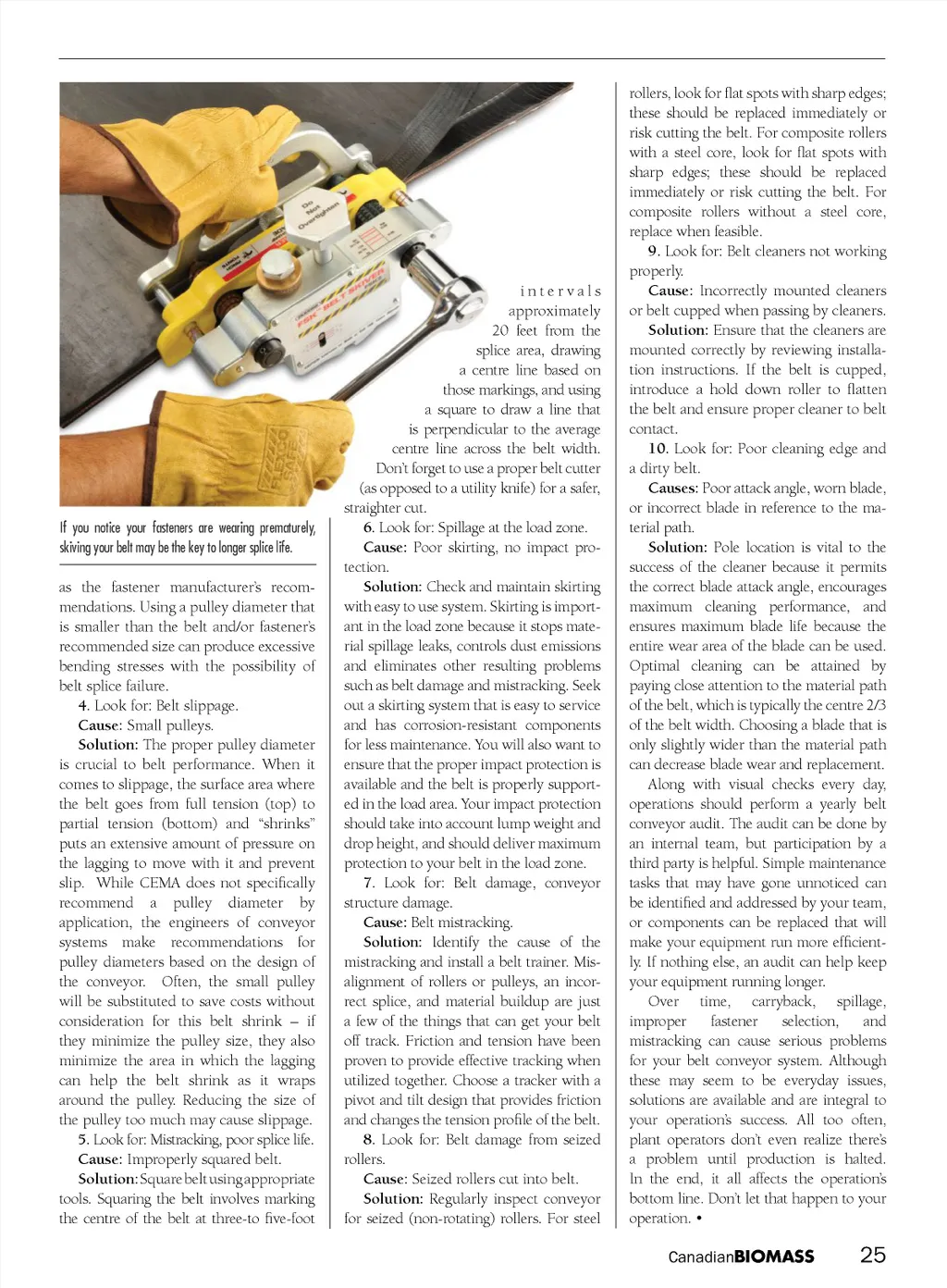
If you notice your fasteners are wearing prematurely, skiving your belt may be the key to longer splice life. as the fastener manufacturer’s recom-mendations. Using a pulley diameter that is smaller than the belt and/or fastener’s recommended size can produce excessive bending stresses with the possibility of belt splice failure. 4. Look for: Belt slippage. Cause: Small pulleys. Solution: The proper pulley diameter is crucial to belt performance. When it comes to slippage, the surface area where the belt goes from full tension (top) to partial tension (bottom) and “shrinks” puts an extensive amount of pressure on the lagging to move with it and prevent slip. While CEMA does not specifically recommend a pulley diameter by application, the engineers of conveyor systems make recommendations for pulley diameters based on the design of the conveyor. Often, the small pulley will be substituted to save costs without consideration for this belt shrink – if they minimize the pulley size, they also minimize the area in which the lagging can help the belt shrink as it wraps around the pulley. Reducing the size of the pulley too much may cause slippage. 5. Look for: Mistracking, poor splice life. Cause: Improperly squared belt. Solution: Square belt using appropriate tools. Squaring the belt involves marking the centre of the belt at three-to five-foot inter vals approximately 20 feet from the splice area, drawing a centre line based on those markings, and using a square to draw a line that is perpendicular to the average centre line across the belt width. Don’t forget to use a proper belt cutter (as opposed to a utility knife) for a safer, straighter cut. 6. Look for: Spillage at the load zone. Cause: Poor skirting, no impact pro-tection. Solution: Check and maintain skirting with easy to use system. Skirting is import-ant in the load zone because it stops mate-rial spillage leaks, controls dust emissions and eliminates other resulting problems such as belt damage and mistracking. Seek out a skirting system that is easy to service and has corrosion-resistant components for less maintenance. You will also want to ensure that the proper impact protection is available and the belt is properly support-ed in the load area. Your impact protection should take into account lump weight and drop height, and should deliver maximum protection to your belt in the load zone. 7. Look for: Belt damage, conveyor structure damage. Cause: Belt mistracking. Solution: Identify the cause of the mistracking and install a belt trainer. Mis-alignment of rollers or pulleys, an incor-rect splice, and material buildup are just a few of the things that can get your belt off track. Friction and tension have been proven to provide effective tracking when utilized together. Choose a tracker with a pivot and tilt design that provides friction and changes the tension profile of the belt. 8. Look for: Belt damage from seized rollers. Cause: Seized rollers cut into belt. Solution: Regularly inspect conveyor for seized (non-rotating) rollers. For steel rollers, look for flat spots with sharp edges; these should be replaced immediately or risk cutting the belt. For composite rollers with a steel core, look for flat spots with sharp edges; these should be replaced immediately or risk cutting the belt. For composite rollers without a steel core, replace when feasible. 9. Look for: Belt cleaners not working properly. Cause: Incorrectly mounted cleaners or belt cupped when passing by cleaners. Solution: Ensure that the cleaners are mounted correctly by reviewing installa-tion instructions. If the belt is cupped, introduce a hold down roller to flatten the belt and ensure proper cleaner to belt contact. 10. Look for: Poor cleaning edge and a dirty belt. Causes: Poor attack angle, worn blade, or incorrect blade in reference to the ma-terial path. Solution: Pole location is vital to the success of the cleaner because it permits the correct blade attack angle, encourages maximum cleaning performance, and ensures maximum blade life because the entire wear area of the blade can be used. Optimal cleaning can be attained by paying close attention to the material path of the belt, which is typically the centre 2/3 of the belt width. Choosing a blade that is only slightly wider than the material path can decrease blade wear and replacement. Along with visual checks every day, operations should perform a yearly belt conveyor audit. The audit can be done by an internal team, but participation by a third party is helpful. Simple maintenance tasks that may have gone unnoticed can be identified and addressed by your team, or components can be replaced that will make your equipment run more efficient-ly. If nothing else, an audit can help keep your equipment running longer. Over time, carryback, spillage, improper fastener selection, and mistracking can cause serious problems for your belt conveyor system. Although these may seem to be everyday issues, solutions are available and are integral to your operation’s success. All too often, plant operators don’t even realize there’s a problem until production is halted. In the end, it all affects the operation’s bottom line. Don’t let that happen to your operation. • Canadian BIOMASS 25
Canadian Biomass March-April 2015: Page 25